
Grow Room Environment

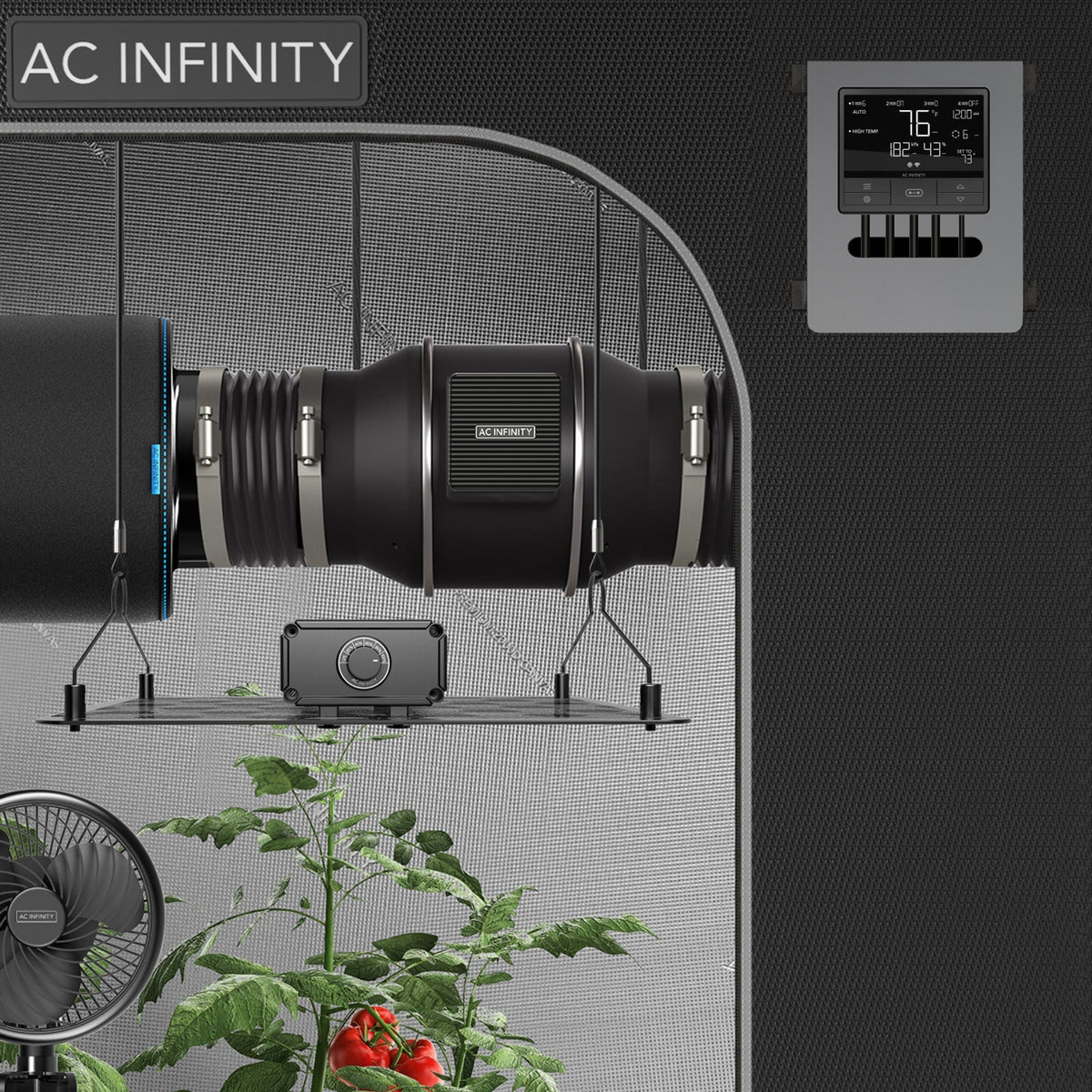
The CLOUDLINE T4 and Controller 69 Pro, the least expensive way into the AC Infinity UIS platform.
Both brands sell a controller, a light, a fan, and an app that ties them together. Both work. The part nobody tells you is that the two ecosystems solve the automation problem in completely different ways, and the right answer depends almost entirely on what you already own and what you plan to add next.
We sell AC Infinity, so read this with that in mind. We have also written down the places where Spider Farmer is flatly the better buy, because you are going to find those out anyway and we would rather you hear them here.
How each system actually connects
AC Infinity uses UIS. Launched in 2020, the UIS platform is a proprietary port on the back of every AC Infinity device. The controller does not just switch the device on and off. It sends a signal that sets output to one of 10 levels from 0 to 100 percent. Your exhaust fan does not go from off to full blast when the tent hits 80 degrees. It steps up one level at a time and settles.
Everything with a UIS port speaks the same language: CLOUDLINE inline fans, CLOUDRAY clip fans, CLOUDLIFT wall fans, AIRLIFT shutter fans, CLOUDFORGE humidifiers, and all four light families (IONBOARD, IONFRAME, IONBEAM, IONGRID). Anything that plugs into a wall outlet and is not AC Infinity joins through a UIS Control Plug, which gives you on and off only, no speed control.

One controller, one protocol. Every device on the UIS platform takes the same 10-level command.
Spider Farmer uses GGS. The Genius Grow System runs on RJ12 cables, the same connector style as an old telephone handset cord. The lineup is tiered by how much of your tent you want automated:
- GGS S-Station: a single smart plug for one device
- GGS Controller Kit: the physical controller with a screen and knob, listed at $55.99
- GGS AC5 Power Strip: 5 switchable outlets plus sensors, listed at $85.99
- GGS AC10 Power Strip: the same thing with 10 outlets, listed at $105.99
- GGS Pro Controller: 8 independent zones at up to 20 devices per zone, listed at $269.99
The power strip is the important design difference. Spider Farmer decided that the fastest way to get any brand's humidifier, heater, or pump under app control is to give you switchable outlets. AC Infinity decided the priority was deep control over its own hardware and sells a separate adapter plug for everything else.
Side by side, spec for spec
| AC Infinity (UIS) | Spider Farmer (GGS) | |
|---|---|---|
| Connector | Proprietary UIS port | RJ12 |
| Entry controller | Controller 69 Pro, 4 ports, $89.99 | GGS Controller Kit, $55.99 |
| Top single-tent unit | Controller AI+, 8 ports, $139 | GGS AC10 Power Strip, 10 outlets, $105.99 |
| Multi-room option | Splitter hubs, up to 32 devices on one AI+ | GGS Pro Controller, 8 zones, 20 devices per zone |
| Speed control on native fans | 10-level PWM across the whole fan lineup | Only on fans that ship with an RJ12 port |
| Other brands' equipment | UIS Control Plug, on and off only | AC5 or AC10 outlet, on and off only |
| Temp, humidity, VPD | Standard on 69 Pro and AI+ | Standard on all GGS kits |
| CO2 sensing | AI+ Climate Plus CO2 bundle | 5-in-1 SensorPro, $69.99 |
| PPFD sensing | Not offered in the controller line | 5-in-1 SensorPro, with target-PPFD auto dimming |
| Soil moisture and EC | Not offered in the controller line | 3-in-1 Soil Sensor Pro, up to 6 per system |
| Data export | CSV export from the app | In-app history and charts |
| Warranty | 2 years, no registration required | 5 years |
Prices above are what each manufacturer listed at the time of writing. Both brands run frequent sales, so check current pricing before you decide on cost alone.
Where Spider Farmer is genuinely better
The warranty is more than double
Spider Farmer lists a 5-year warranty. AC Infinity lists 2 years, with no registration required to activate it. On a controller that lives in a hot, humid box for years, that gap matters. It is the single clearest advantage either brand holds over the other.
The sensing goes further
Spider Farmer's 5-in-1 SensorPro reads temperature, humidity, VPD, CO2, and PPFD in one unit for $69.99. The PPFD piece is the interesting one: you set a target PPFD for the growth stage and the lights dim themselves to hit it. Spider Farmer publishes target bands of 100 to 300 PPFD for seedlings, 400 to 600 for veg, and 800 to 1000 for flower.
Their 3-in-1 Soil Sensor Pro adds substrate moisture, temperature, and EC, with support for up to six sensors on one system. AC Infinity does not sell an equivalent in its controller line. If you are a soil or coco grower who wants hard runoff-free EC data, that is a real capability gap.
The power strip handles mixed setups on day one
If your tent already has a Vornado circulating fan, an off-brand humidifier, and a space heater, a GGS AC5 puts all three under scheduled and threshold-based control for one purchase. Doing the same on UIS means buying a Control Plug for each device.
Where AC Infinity is genuinely better
Speed control works across the entire lineup
This is the one that surprises people. Per Spider Farmer's own documentation, real speed control through GGS requires the fan to have an RJ12 port, and outside of specific bundled kits, individually sold inline fans do not have one. Those fans can only be switched on and off through a power strip outlet.
Exhaust fan speed is the biggest lever you have over tent temperature. Losing granular control of it and falling back to on and off is a meaningful downgrade. Every UIS fan AC Infinity sells, from a $35 Raxial booster to a CLOUDLINE T10, takes 10-level commands from any UIS controller.
Check before you buy: if you go Spider Farmer, confirm the specific inline fan SKU has an RJ12 port. If it does not, budget for on and off control only, or plan to run the fan on its own separate speed controller.
More first-party hardware speaks the protocol natively
AC Infinity has spent five years building out devices that plug directly into UIS. Shutter fans for wall venting, floor and wall circulation fans, humidifiers with their own probes, four separate LED families, and a smart portable air conditioner. Every one of those is a native device, not an outlet being switched. Spider Farmer's native device list is shorter and leans heavily on the power strip to fill gaps.
Support and parts are easier to get in the US
AC Infinity is headquartered in Los Angeles and sells through a wide US dealer network, which means a replacement controller cord, splitter, or sensor probe is usually a few days out rather than a few weeks. If something fails mid-flower, that turnaround is the difference between a small annoyance and a lost cycle.
AC Infinity Controllers, Fans, Lights and Tents
The full UIS lineup we stock, including the Controller 69 Pro, Controller AI+, CLOUDLINE inline fans, CLOUDFORGE humidifiers, and the IONFRAME and IONBOARD light families. Everything on this page plugs into the same controller.
Browse AC InfinityThe light spec trap that trips up most comparisons
You will see AC Infinity's IONFRAME EVO series advertised at 3.14 micromoles per joule and Spider Farmer's SE and G series at 2.75 to 2.9. That looks like an easy win for AC Infinity. It is not a fair comparison, because those are two different measurements.
AC Infinity's spec sheets label 3.14 as Efficiency (Single Diode). That is the rating of the Samsung LM301H EVO chip itself, before driver losses, before the fixture. Spider Farmer publishes fixture-level PPE, which is what actually leaves the light and reaches your canopy. Independent PAR testing has measured the SE7000 at roughly 2.47 micromoles per joule of usable efficacy against a measured draw of 734 watts, which is a normal, honest result once you account for real-world losses.
The takeaway is not that one brand is lying. It is that you cannot line up two numbers from two spec sheets unless you know they are measuring the same thing. Compare PPFD maps at a stated hanging height, compare measured wall draw, and pay attention to corner values rather than the big number in the center.
AC Infinity IONFRAME EVO6, 500W for a 4x4
1680 Samsung LM301H EVO diodes, 1991 PPFD across a 4x4 footprint, removable driver, and a schedule controller that daisy-chains into the rest of your UIS gear. Part of our 4x4 PRO tent kit or available on its own.
See the 4x4 PRO kitWhat about mixing the two?
You can, but you give up the reason to buy either one. A Spider Farmer AC5 power strip will happily switch an AC Infinity fan on and off, and a UIS Control Plug will switch a Spider Farmer humidifier on and off. In both directions you lose the speed and brightness control that makes a smart system worth the money, because neither brand's protocol talks to the other.
If you already own lights from one brand and are shopping for climate gear, the cheaper long-term move is usually to match the lights. Fixtures outlast controllers.
Which one should you actually buy?
Buy AC Infinity if
- You plan to add equipment over the next two or three grows and want all of it on real speed control rather than on and off
- Your tent's biggest challenge is heat and humidity, where fan modulation does the heavy lifting
- You want a US dealer network and same-week parts if something fails
- You want VPD-driven automation with dual-zone sensing and an optional CO2 sensor, which is what the Controller AI+ adds over the 69 Pro
Buy Spider Farmer if
- Budget is the deciding factor and you want the cheapest path to app-controlled lighting
- You already own Spider Farmer SF, G, or SE series lights, which the GGS controller dims natively
- You specifically want PPFD-target auto dimming or substrate EC and moisture data, neither of which AC Infinity offers in its controller line
- Your tent is full of mixed-brand plug-in gear and you want it all under one app without buying an adapter per device
The honest middle ground
For a single tent under 4x4 with a modest parts list, either system will hold your temperature and humidity where you want them. The differences we have described here show up when you scale: second tent, CO2, a dehumidifier, supplemental bars, a heater for winter. That is when protocol depth and parts availability start deciding whether your automation is a system or a pile of timers.
CLOUDLINE Inline Fans with Controller 69 Pro
The T4 through T10 CLOUDLINE fans ship with the Controller 69 Pro included, which is the least expensive way into UIS. Add the light, humidifier, and clip fans later and they all run off the same controller.
Shop inline fansKey takeaway
Spider Farmer wins on warranty length, sensor variety, and price. AC Infinity wins on depth of speed control, breadth of native hardware, and US parts availability.
Do not compare the two on published light efficacy numbers. AC Infinity publishes single-diode efficiency and Spider Farmer publishes fixture PPE, and those are not the same measurement.
If you are buying a Spider Farmer inline fan, confirm it has an RJ12 port first. Without one you get on and off control instead of variable speed, and exhaust speed is the main lever you have over tent temperature.
Still not sure which way to go? Call us at 716-217-0353 and describe your tent, what you already own, and what you plan to add. We will tell you which system fits, including when the answer is the one we do not sell.
Related reads
Questions? We're easy to reach.
Happy Hydro has been serving growers since 2006. Call or email us before you order, after you order, or any time something comes up. When you're happy, we're happy.