
Grow Lights
IONPRIME vs IONFRAME vs IONBOARD: Which AC Infinity Grow Light Should You Actually Buy?
Three lines, three prices, and a lot of overlapping coverage claims. Here is what separates them on the spec sheet, and which one belongs in your tent.
AC Infinity now sells three separate grow light families that all claim to cover a 4x4. They sit within a couple hundred dollars of each other, they all run on the same UIS controller platform, and the marketing copy for all three uses the phrase "algorithmically spaced diodes." That makes the collection page hard to shop.
The good news is that the three lines are genuinely different products with different jobs, and once you know which spec to look at, the decision gets simple. Here is the short version.
The 30-second answer
Buy an IONBOARD if you want a dependable full-spectrum light at the lowest price and you are fine turning a dimmer knob by hand. One rigid panel, no scheduling built in.
Buy an IONFRAME EVO if you want the most photons per watt of electricity. It uses Samsung LM301H EVO diodes rated at 3.14 µmol/J, the highest single-diode figure in AC Infinity's catalog, and it ships with a schedule controller in the box.
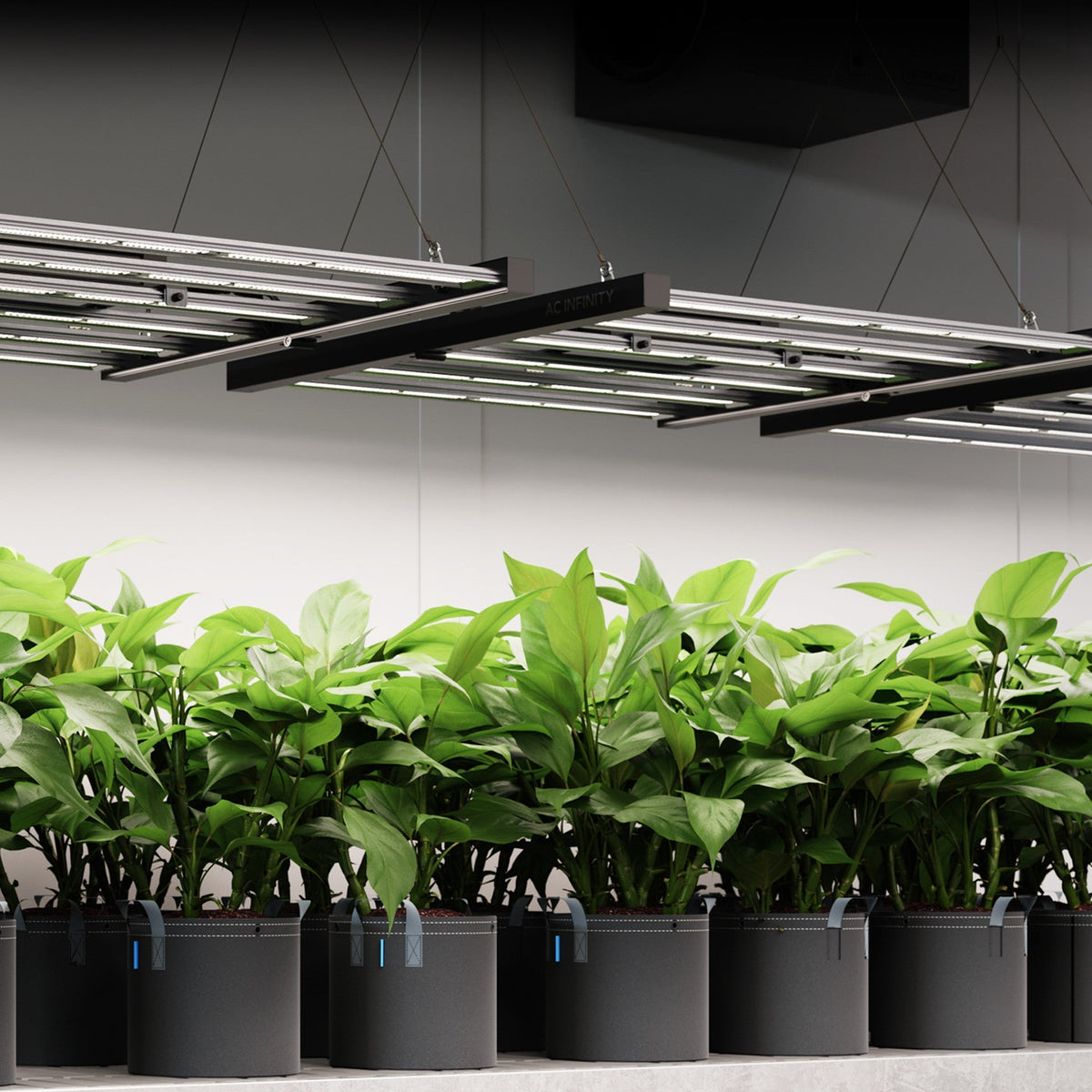
Buy an IONPRIME if your canopy is not a flat rectangle. Each bar pivots up to 180 degrees, so you can aim light into corners, down a row, or at a single large plant instead of spreading it evenly.
Those three links go to the 4x4 model in each line so you can compare like for like. Every other size is listed further down.
What actually separates the three lines
Coverage and wattage are the two numbers shoppers compare first, and they are the two numbers that will not help you here. An IONBOARD S44, an IONFRAME EVO6, and an IONPRIME 6 all cover a 4x4. Two of them draw exactly 500 watts. The real differences are form factor, diode quality, and whether the light can run itself.
| IONBOARD | IONFRAME EVO | IONPRIME | |
|---|---|---|---|
| Form factor | Single rigid aluminum panel | Fixed bar frame | Bar frame, each bar pivots 180 degrees |
| White diodes | Samsung LM301H | Samsung LM301H EVO | Unbranded full-spectrum |
| Efficiency, single diode | 2.65 to 2.75 µmol/J | 3.14 µmol/J | 2.81 µmol/J |
| Spectrum | 3000K, 5000K or 6500K, 660nm, 730nm | 3000K, 5000K, 395nm UV, 660nm, 730nm | 3000K, 5000K, 395nm UV, 660nm, 730nm |
| Onboard scheduling | No. Manual knob, 20 percent steps | Yes. Schedule controller included | Yes. Onboard controller with sunrise and sunset |
| Driver | Attached to the board | Removable, mounts outside the tent | Detachable |
| Sizes at Happy Hydro | 2x4, 3x3, 4x4 | 2x4, 3x3, 4x4, 5x5, 6x6 | 4x4, 5x5 |
| Price range today | $229 to $369 | $309.95 to $999 | $599 to $999 |
The one spec that decides your power bill
Photosynthetic photon efficacy, written as µmol/J, tells you how many usable photons a fixture produces for every joule of electricity it eats. It is the single most useful number on a grow light spec sheet and the one most often buried.
For context on where these lights sit in the wider market, the DesignLights Consortium maintains the horticultural Qualified Products List that many utility rebate programs use to decide what qualifies. Its V4.0 technical requirements set the minimum efficacy for listing at 2.5 µmol/J. Michigan State University's floriculture extension notes in its breakdown of LED efficacy that only about six percent of qualified products reach 3.0 µmol/J or better.
By that standard, all three AC Infinity lines are respectable and the IONFRAME EVO is genuinely near the top of the market.
AC Infinity publishes these numbers as "Efficiency (Single Diode)", not as whole-fixture efficacy. A single diode measured on a test bench does not account for driver losses, thermal derating, or the far-red and UV diodes that draw power outside the 400 to 700nm PAR range. Whole-fixture efficacy is always lower than the single-diode figure. Use these numbers to rank the three lines against each other, which is fair, and not to compare against a competitor that publishes a tested fixture-level PPE.
What this means in your tent
An IONFRAME EVO6 and an IONPRIME 6 both draw 500 watts and both cover a 4x4. Running 12 hours a day, either one costs you 180 kWh a month. At 18 cents per kWh that is about $32 a month, and it is the same $32 either way.
The efficacy gap does not lower that bill. It changes what you get for it. The EVO6's diodes convert roughly 12 percent more of each watt into usable light than the IONPRIME's do. If you dim the EVO to produce the same light as the IONPRIME, you draw less power. If you run both at full tilt, the EVO puts more photons on your canopy for the same money.
PPFD is a peak reading, not a coverage promise
Every one of these lights lists a headline PPFD figure: 1,745 for the EVO3, 2,123 for the IONPRIME 6, 2,034 for the IONBOARD S44. Those are peak center-canopy readings taken at a specific hang height, and the height is not always printed next to the number. Move the light six inches and the figure changes substantially.
What actually drives plant response is Daily Light Integral, the total number of photons a square meter receives over a full day. The math is simple:
DLI = PPFD × hours of light × 3,600 ÷ 1,000,000
Run a canopy at 800 PPFD for 12 hours and you land at 34.6 mol per square meter per day. Run that same canopy at 400 PPFD for 18 hours and you get 25.9. Two very different light schedules, one shared unit of measure. This is why a light that posts a big peak PPFD number can still underperform a dimmer fixture that spreads light evenly across the whole footprint.
A PAR meter turns all of this from theory into a number you can act on. Ours live in the PAR meters collection, and a single reading at four corners plus center will tell you more about your light than any spec sheet. AC Infinity also publishes a useful grow light placement guide with hang heights by growth stage.
IONBOARD: the value pick
The IONBOARD is one sealed aluminum board with the diodes laid out across its face. There are no bars, no articulation, and no schedule controller. You get a dimming knob on the driver that steps brightness from 0 to 100 percent in 20 percent increments, plus a UIS port for daisy chaining and for connecting an external controller later.
It is IP-65 rated, fanless, and rated for 50,000 hours. Current models use Samsung LM301H diodes with a spectrum of 3000K and 5000K or 6500K white, plus 660nm red and 730nm far-red. There is no UV diode in this line.
The trade-off worth understanding: a flat panel puts all its diodes in one plane above the canopy, so light falls off toward the edges faster than it does with a bar-style fixture. In a 2x2 or a 3x3 you will never notice. In a 4x4 with tall plants you might.
Buy an IONBOARD if
You want solid light per dollar and you are not automating yet
- You are running a 2x4 or 3x3 and want the most reliable light under $250
- You are vegging, cloning, or growing greens and herbs rather than pushing a heavy flowering canopy
- You are happy setting a wall timer and turning a knob by hand
- You want to add a controller later without replacing the light
IONBOARD S24, 2x4 $229 · IONBOARD S33, 3x3 $249 · IONBOARD S44, 4x4 $369
Shop AC Infinity grow lightsIONFRAME EVO: the efficiency pick
The EVO is the line most experienced growers land on, and the reason is the diode. Samsung's LM301H EVO chip is rated at 3.14 µmol/J, which beats the standard LM301H, the older LM301B, and the Bridgelux 3030 chips common in budget fixtures. The EVO also carries a fuller spectrum than the IONBOARD, adding Seoul 395nm UV diodes and OSRAM 730nm far-red alongside the 660nm deep red.
Two structural advantages come with the bar format. The driver detaches and mounts outside the tent, which pulls a meaningful heat source out of your grow space. And spreading diodes across multiple bars puts light into the canopy from several angles instead of one, which is what "penetration" actually means in practice.
Every EVO ships with a schedule controller that handles sunrise and sunset ramping and ten brightness levels without any additional purchase. Plug it in and the light runs its own photoperiod.
| Model | Watts | Flower coverage | Veg coverage | PPFD | Price |
|---|---|---|---|---|---|
| EVO3 | 280W | 2x4 | 3x5 | 1,745 | $309.95 |
| EVO4 | 300W | 3x3 | 4x4 | 1,819 | $359 |
| EVO6 | 500W | 4x4 | 5x5 | 1,991 | $579 |
| EVO8 | 730W | 5x5 | 6x6 | 2,013 | $799 |
| EVO10 | 1000W | 6x6 | 7x7 | 2,146 | $999 |
AC Infinity lists separate veg and flower footprints for the EVO line, and they differ by a full foot in each direction. The flower number assumes you are driving the light hard over a dense canopy. The veg number assumes lower intensity over a wider area. Buy to your flower footprint. An EVO6 in a 5x5 will veg beautifully and then leave your corners short in bloom.
Buy an IONFRAME EVO if
You want the most usable light per watt and a light that runs itself
- You are flowering a full canopy and want light reaching lower bud sites
- You want a schedule controller included rather than sold separately
- Heat is a constraint and moving the driver outside the tent helps
- You want named-brand diodes with a published efficiency you can verify
EVO3, 2x4 · EVO4, 3x3 · EVO6, 4x4 · EVO8, 5x5 · EVO10, 6x6
Shop all LED grow lightsIONPRIME: the pick for awkward canopies
The IONPRIME is AC Infinity's newest lighting line and the one people most often misread. It is not an upgraded EVO. It is a different tool.
Every bar on an IONPRIME pivots up to 180 degrees, independently. That means you can flatten the bars for even coverage across a full canopy, angle the outer bars inward to concentrate light on a single large plant, or tilt everything toward one side of a tent where a wall is stealing your footprint. The bars are also individually replaceable, so a failure does not scrap the fixture.
Here is the part the marketing does not lead with. The IONPRIME's diodes are rated at 2.81 µmol/J, below the EVO's 3.14. Its spec sheet lists the white diodes simply as "Full-Spectrum" with no manufacturer named, alongside Seoul 395nm UV, Everlight 660nm red, and Bridgelux 730nm far-red. The EVO's are Samsung LM301H EVO with OSRAM reds.
So why does the IONPRIME 6 post a higher headline PPFD than the EVO6 at identical wattage and coverage? Because it uses a much larger number of less efficient diodes. That produces a strong peak reading. It does not produce more light per watt.
The IONPRIME 6 costs $599 against the EVO6 at $579, and the IONPRIME 10 delivers 1000W across a 5x5 where the EVO10 spreads the same 1000W across a 6x6. If you are buying the IONPRIME expecting better efficiency, you have the wrong light. Buy it for the articulating bars, which are a real capability nothing else in the lineup offers, or save the money and take the EVO.
Buy an IONPRIME if
Your grow space or your canopy is not a clean rectangle
- You grow a few large plants rather than an even sea of green
- Your light hangs against a wall, in a closet, or over an irregular bench
- You want to reshape the footprint between veg and flower without rehanging anything
- You value replaceable bars over squeezing out the last few percent of efficiency
IONPRIME 6, 4x4 $599 · IONPRIME 8, 5x5 $799 · IONPRIME 10, 5x5 $999
See IONPRIME availabilityHead to head: EVO8 vs IONPRIME 8
These two land at the same price, the same wattage, and the same coverage, which makes them the cleanest comparison in the entire AC Infinity catalog and the decision we get asked about most.
| IONFRAME EVO8 | IONPRIME 8 | |
|---|---|---|
| Price | $799 | $799 |
| Wattage | 730W | 730W |
| Flower coverage | 5x5 | 5x5 |
| Veg coverage | 6x6 | Not published separately |
| Diode efficiency | 3.14 µmol/J | 2.81 µmol/J |
| White diodes | Samsung LM301H EVO | Unbranded full-spectrum |
| Red and far-red | OSRAM | Everlight and Bridgelux |
| Listed PPFD | 2,013 | 2,121 |
| Bar articulation | Fixed | 180 degrees per bar |
| Replaceable bars | No | Yes |
Our take: for a standard 5x5 tent with an even canopy, take the EVO8. Better diodes, more headroom in veg, and a track record across thousands of grows. Take the IONPRIME 8 when you need to aim the light somewhere a fixed frame cannot reach, or when replaceable bars matter more to you than the efficiency gap.
The controller question, which is really a budget question
This is where a $229 light quietly becomes a $400 purchase. All three lines connect to AC Infinity's UIS platform. What differs is what you get without buying anything else.
- IONBOARD: manual knob only. Scheduling, app control, and automation all require an external controller.
- IONFRAME EVO: schedule controller included. Sunrise and sunset ramping and ten brightness levels work out of the box. An external controller adds app control and environmental triggers.
- IONPRIME: onboard controller with 0 to 100 percent dimming, custom schedules, sunrise and sunset transitions, and power-outage memory. Wi-Fi app access requires connecting to a UIS controller.
If automation is where you are headed, the light is only half the decision. We have written up both of the controllers people usually pair with these fixtures: our Controller AI+ review covers the newer learning-based unit, and our Controller 69 Pro setup guide walks through programming the workhorse. Both live in the grow room controllers collection.
All three light lines daisy chain up to 80 fixtures on a single controller using UIS splitters, so a controller bought today scales with you.
One more you will see on the collection page: the IONFRAME A7
The A7 sits outside this comparison but it confuses people, so it is worth 60 seconds. It is a 700W bar light covering 4x5 with 1,808 diodes, a 2951 listed PPFD, an IP67 rating, and RJ-11 daisy chaining, at $499.
The catch is that it has no onboard controller at all. It is built to be run by an external UIS controller as part of a multi-light room. If you are lighting one tent, skip it. If you are running four or more fixtures off a single controller and care about cost per watt, the IONFRAME A7 is the cheapest way AC Infinity sells you 700 watts.
Pick by tent size
| Your space | Best value | Best performance | If your canopy is uneven |
|---|---|---|---|
| 2x2 | IONBOARD S24, dimmed | IONFRAME EVO3, dimmed | Not offered this small |
| 2x4 | IONBOARD S24, $229 | IONFRAME EVO3, $309.95 | Not offered this small |
| 3x3 | IONBOARD S33, $249 | IONFRAME EVO4, $359 | Not offered this small |
| 4x4 | IONBOARD S44, $369 | IONFRAME EVO6, $579 | IONPRIME 6, $599 |
| 5x5 | IONFRAME EVO6, run tight | IONFRAME EVO8, $799 | IONPRIME 8, $799 |
| 6x6 | IONFRAME A7, $499 | IONFRAME EVO10, $999 | Two IONPRIME 6 units |
Matching a light to a tent is easier when you buy both together. Our AC Infinity grow tents are sized to these exact footprints, and the 4x4 LED grow lights collection puts the AC Infinity options next to the other brands we carry if you want to shop wider.
Efficacy is the spec that matters, and the IONFRAME EVO wins it. At 3.14 µmol/J per diode it converts more of your electricity into light than either of the other two lines, and it includes a schedule controller most competitors charge extra for.
The IONBOARD is not a lesser light, it is a simpler one. Under $250 for a 2x4 or 3x3 with genuine Samsung diodes is a good deal, as long as you know a scheduling controller is a separate purchase.
The IONPRIME is a specialty tool priced like a flagship. Articulating bars solve a real problem. If you do not have that problem, the EVO gives you more light for less money.
Still not sure? Call us at 716-217-0353 and describe your space. We will tell you which one fits, including when the answer is the cheaper one.
- DesignLights Consortium, Horticultural Technical Requirements V4.0, for the 2.5 µmol/J efficacy threshold
- DLC Horticultural Qualified Products List, searchable database of tested fixture efficacy
- Michigan State University Extension, A Closer Look at LED Efficacy
- AC Infinity, Choosing the Right Grow Light and Grow Light Placement
- Product specifications pulled from AC Infinity's published technical spec tables for the IONBOARD, IONFRAME EVO, IONPRIME, and IONFRAME A7 series
Related reads
Questions? We're easy to reach.
Happy Hydro has been serving growers since 2006. Call or email us before you order, after you order, or any time something comes up. When you're happy, we're happy.