
Do Adjustable LED Grow Lights Actually Grow Plants Better?
No, not by themselves. A dimmer does not make a photon more useful and a pivoting light bar does not create new ones. What adjustability buys you is the ability to deliver the right number of photons to the right place at the right stage, using one fixture instead of three. That matters most if you run a full cycle from seedling to harvest in the same tent.
Adjustable is doing a lot of work as a marketing word right now. It can mean three completely different things: intensity you can dim, light bars you can physically angle, or a spectrum you can shift. Those have different amounts of research behind them, and only one of them is well established. Here is what each one actually does, and how to tell whether you need it.
Plants respond to a daily total, not to a peak number
The number that predicts growth is not the PPFD reading on your meter. It is daily light integral, or DLI: the total moles of photons landing on a square meter over a full day. Iowa State's extension service gives the working formula as PPFD multiplied by hours of light multiplied by 0.0036. Run 300 µmol/m²/s for 16 hours and you get 17.3 mol/m²/day.
Two very different setups can hit the same DLI. 720 µmol/m²/s for 15 hours and 600 µmol/m²/s for 18 hours both land at about 39 mol/m²/day. The lower intensity version puts less peak heat into your tent at any given moment, which is easier on temperature and humidity in a Buffalo basement in August. You need a light you can dim to run that version.
| Crop | DLI (mol/m²/day) | Roughly what that looks like |
|---|---|---|
| Seedlings and cuttings | 5 to 10 | 150 µmol/m²/s for 16 hours = 8.6 |
| Microgreens | 9 to 12 | 200 µmol/m²/s for 15 hours = 10.8 |
| Lettuce | 12 to 17 | 300 µmol/m²/s for 14 hours = 15.1 |
| Spinach | 14 to 20 | 350 µmol/m²/s for 14 hours = 17.6 |
| Basil | 15 to 25 | 400 µmol/m²/s for 16 hours = 23.0 |
A 1000W fixture built for a 5x5 canopy is not a seedling light at full output. It becomes one at roughly 10 percent. That is the entire practical case for dimming, and it is a real one if you are germinating in the same tent you flower in.
More light stops paying, and then starts costing you
Photosynthesis saturates. Past a crop's ceiling, extra photons do not become extra biomass, and they can actively work against you by pushing leaf temperature and transpiration demand higher than your climate control can handle. A 2023 vertical hydroponic study on iceberg lettuce found that raising DLI from 8.6 to 11.5 mol/m²/day increased shoot fresh weight by 42 percent, but pushing further to 14.4 cut shoot dry weight by 23 percent and dropped water use efficiency along with it.
That is the part most growers never test. If you bought a light rated for a canopy bigger than yours, or you are growing leafy crops under a fixture designed for fruiting ones, running at 100 percent is not a neutral default. It is an active choice that may be costing you both yield and electricity.
The non-obvious win: a dimmed LED is more efficient than a full-blast one
LEDs lose efficiency as you push current through them, an effect called current droop. Utah State's Crop Physiology Laboratory covers the mechanism in its review of LED fixture efficacy limits: decreasing drive current increases efficacy, up to the point where other loss mechanisms take over at very low current.
The practical version: a fixture dimmed to 60 percent power produces more than 60 percent of its full-output photons. You get a slightly better µmol/J than the spec sheet number, because that number was measured at full drive. This is why buying a larger fixture and running it dimmed can beat buying a smaller fixture and running it flat out, assuming both cover your footprint properly.
Two honest limits on that. Driver efficiency falls off at very low output, so the gain does not scale forever, and a bigger fixture costs more up front. If you only ever run one stage at one intensity, the smaller fixture is the better buy.
Adjustable light bars: what pivoting actually changes

- Concentrates output on a partial canopy early in a run, when four plants sit in the middle of a 5x5
- Pushes photons back toward tent corners where PPFD normally falls off hardest
- Adds side lighting into a tall canopy without buying separate bar lights
- Add photons. Total output is fixed by wattage and diode efficiency
- Beat a flat bar layout on a canopy that already fills the footprint evenly
- Tell you whether it worked. You need a meter, not your eyes
Angling is redistribution, and redistribution only helps when your current distribution is wrong for your canopy. If your plants form one even canopy across the whole footprint, flat bars are already doing the job. If you run four large plants in a 5x5, or you fill the tent gradually over a cycle, the ability to aim matters. Either way, verify it with a PAR meter rather than guessing. Human vision is a terrible photon counter.
Dim the light or raise it?

Both lower intensity at the canopy, but they do different things to the shape of the light. Raising the fixture widens the footprint and flattens the falloff between center and corners, and it also sends more photons into your tent walls instead of onto leaves. Dimming keeps the distribution pattern identical and scales the whole map down together.
The practical order of operations: hang at the height the manufacturer's PAR map says matches your footprint, then dim to hit your stage target. Reversing that, hanging high and running at 100 percent, wastes photons on mylar. Reflective tent walls return some of that light, but never all of it.
Worth flagging on manufacturer PPFD claims: those figures are center-point readings taken at a mounting height the manufacturer chose, and different brands choose different heights. Two lights advertising 2100 and 2400 PPFD may not be measured the same way. Compare µmol/J efficacy and total PPF when you can get them, and treat a single PPFD number as a starting point rather than a ranking.
The far-red wrinkle nobody mentions when they sell you a dimmer
Most current full-spectrum fixtures, including AC Infinity's IONPRIME and IONFRAME lines, include 730nm far-red diodes. That is well justified. Research from Utah State established that far-red photons between 700 and 750nm drive photosynthesis about as efficiently as traditional PAR photons when they are delivered alongside shorter wavelengths, at up to roughly 30 percent of total photon flux. That finding is why you now see fixtures rated in ePAR, covering 400 to 750nm rather than 400 to 700nm.
Here is the part that interacts with dimming. Far-red is also the signal plants use to detect shade, and the response to it depends on total intensity. In a 2023 study, increasing the far-red fraction increased lettuce leaf expansion at high photon flux but decreased it at low flux, with biomass partitioning shifting toward stems instead of leaves at the low end.
Your fixture holds its far-red ratio constant when you dim. So dimming to 15 percent for seedlings gives you exactly the combination that pushes stem elongation: low total flux, unchanged far-red fraction. If your seedlings stretch under a heavily dimmed full-spectrum light, that is the mechanism, and the fix is a shorter hang distance at low output or a dedicated seedling light rather than more dimming.
How to actually set a dimmable light
- Pick a DLI target for the crop and stage, not a percentage on the controller.
- Fix your photoperiod first. Photoperiod is often locked by the crop, so intensity is the variable you have left.
- Solve for PPFD: target DLI divided by hours, divided by 0.0036.
- Measure at canopy height, at center and at the four corners. Average them. Center-only readings overstate what most of your plants receive.
- Re-measure every two weeks. The canopy rises toward the light as the plants grow, so a setting that was right in week two is too hot in week six.
What matters more than adjustability
If you are choosing between two fixtures and one is adjustable, adjustability is not the first tiebreaker. Efficacy in µmol/J, total PPF, and whether the footprint matches your tent all outrank it. A fixed fixture with better efficacy that fits your space will out-perform an adjustable one that does not.
The two AC Infinity 1000W fixtures we carry make that trade-off visible, because they sit at the same price and cover the same class of space with different priorities.
| Feature | IONPRIME 10 | IONFRAME EVO10 |
|---|---|---|
| Diode efficacy | 2.81 µmol/J | 3.14 µmol/J (Samsung LM301H EVO) |
| Diode count | 4,624 | 3,710 |
| Dimming | 0 to 100% PWM, continuous | 10 brightness levels |
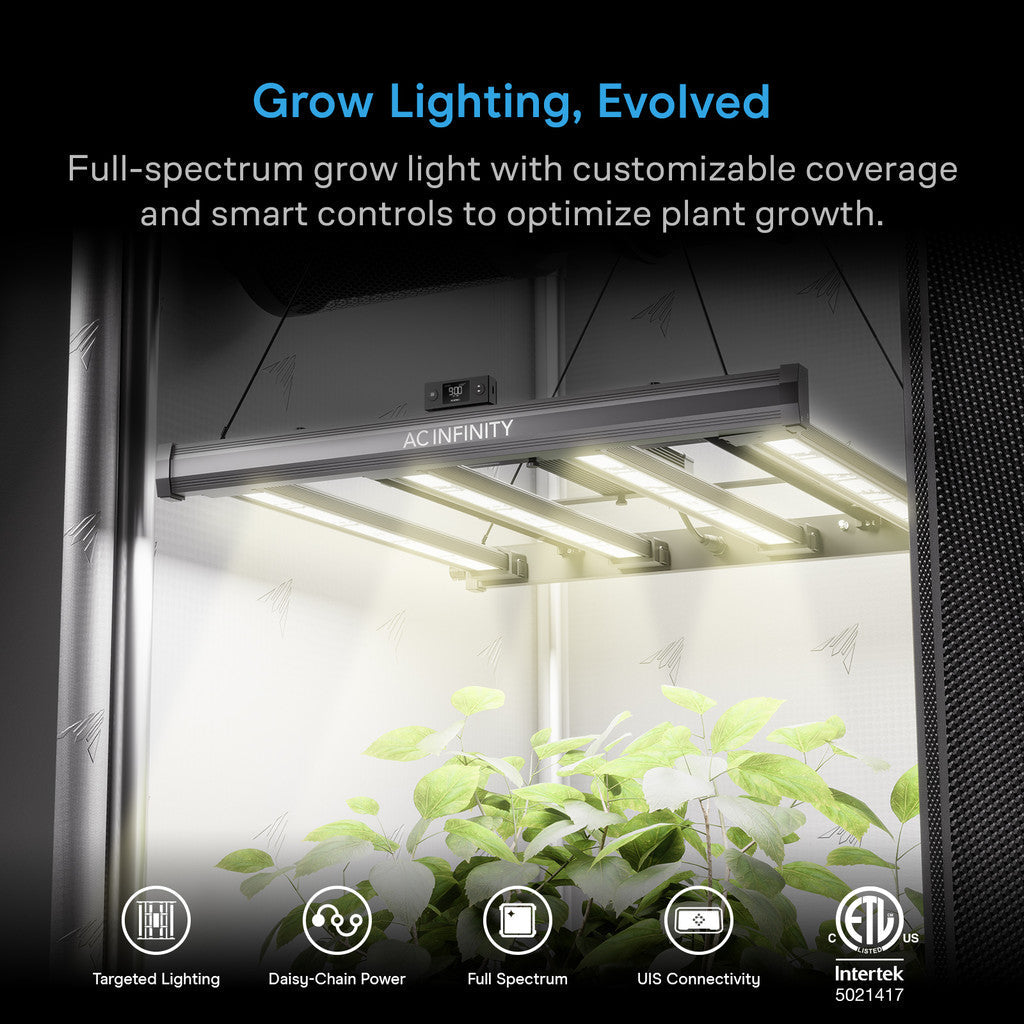
| Bar angle | Each bar pivots up to 180° | Fixed |
| Bar replacement | Individually replaceable | Not individually replaceable |
The EVO10 wins on chip efficiency. The IONPRIME 10 wins on control granularity and serviceability. If you run one crop at one intensity in a canopy that fills the tent, the EVO10 is the more efficient buy and we will tell you so on the phone. If you run seedlings through flower in the same space, or your canopy shape changes across a cycle, the control is worth the efficacy difference. For a spec-by-spec walk across all three AC Infinity lines, see our IONPRIME vs IONFRAME vs IONBOARD comparison.

AC Infinity IONPRIME 10, 1000W, 5x5 Coverage
1000W across a 5x5 ft canopy, 2410 PPFD, 4,624 diodes, and a spectrum spanning 395nm, 660nm, 730nm, 3000K, and 5000K. Every bar pivots up to 180° and is individually replaceable. Dimming is continuous 0 to 100% PWM with scheduling, sunrise and sunset transitions, and power outage memory. Daisy-chains up to 80 fixtures on one controller through the UIS platform, and the driver detaches for remote mounting. Currently on pre-order.
View the IONPRIME 10Not sure which class of fixture your space calls for? Start with the full LED grow light range, or narrow by wattage in the 800 to 1000W collection. If you want app control and automation across multiple fixtures, that lives in lighting controllers.
Adjustability does not grow better plants. Matching DLI to the crop and stage does, and adjustability is the cheapest way to do that with one fixture instead of several. Buy it if you run multiple stages in one space or your canopy changes shape across a cycle. Skip it and buy the higher-efficacy fixed fixture if you run one crop at one intensity.
Still deciding? Call us at 716-217-0353 or email help@happyhydro.com with your tent size, your crop, and how many plants you run at once. We will tell you what PPFD target to aim for and whether you need the dimmer at all.
- Iowa State University Extension and Outreach, "Important Considerations for Providing Supplemental Light to Indoor Plants."
- Virginia Cooperative Extension SPES-720, "Calculating and Using Daily Light Integral (DLI): An Introductory Guide."
- Kusuma, Pattison and Bugbee, "From physics to fixtures to food: current and potential LED efficacy," Horticulture Research, 2020.
- Zhen, van Iersel and Bugbee, "Why Far-Red Photons Should Be Included in the Definition of Photosynthetic Photons," Frontiers in Plant Science, 2021.
- Kusuma and Bugbee, "On the contrasting morphological response to far-red at high and low photon fluxes," Frontiers in Plant Science, 2023.
- Scientific Reports, "Determination of optimal daily light integral (DLI) for indoor cultivation of iceberg lettuce in an indigenous vertical hydroponic system," 2023.