
Watering Systems
AutoPot Tray2Grow: The Complete Setup Guide, and the Six-Inch Rule That Makes or Breaks It
Giving your reservoir a little boost off the ground can make the difference between watering your plants perfectly or not.
There is a specific kind of disappointment that comes from setting up an automatic watering system, walking away for a week, and coming back to find half your plants thriving and half of them bone dry. With the AutoPot Tray2Grow, that result is almost never the tray's fault. It is a measurement problem, and the measurement is six inches.
This guide covers the Tray2Grow properly: how the valve actually works, what fits in the tray, how to size and place your reservoir, and the handful of setup mistakes behind nearly every complaint that starts with "my system will not fill." If you are still deciding whether the concept suits you at all, Is AutoPot Technology Right For Your Indoor Garden? is the better starting point. This article assumes you have decided and want it running correctly.
The 30-second answer
Buy the Tray2Grow Slim at $99.99 if you already own a reservoir and a filter. Same tray, same valve, same capillary and root control sheets, without the accessories you already have.
Buy the standard Tray2Grow system from $144.80 if you are starting from nothing. It includes the filters, seed trays and capillary spikes the Slim leaves out, and the filter is not optional.
Whichever you buy, get the reservoir outlet at least 6 inches above the aquavalve. With the 12.4 gallon hard tank the AutoPot Stand at $23.99 solves this in one purchase. With a FlexiTank you need to work out the weight first.
What the Tray2Grow Actually Is
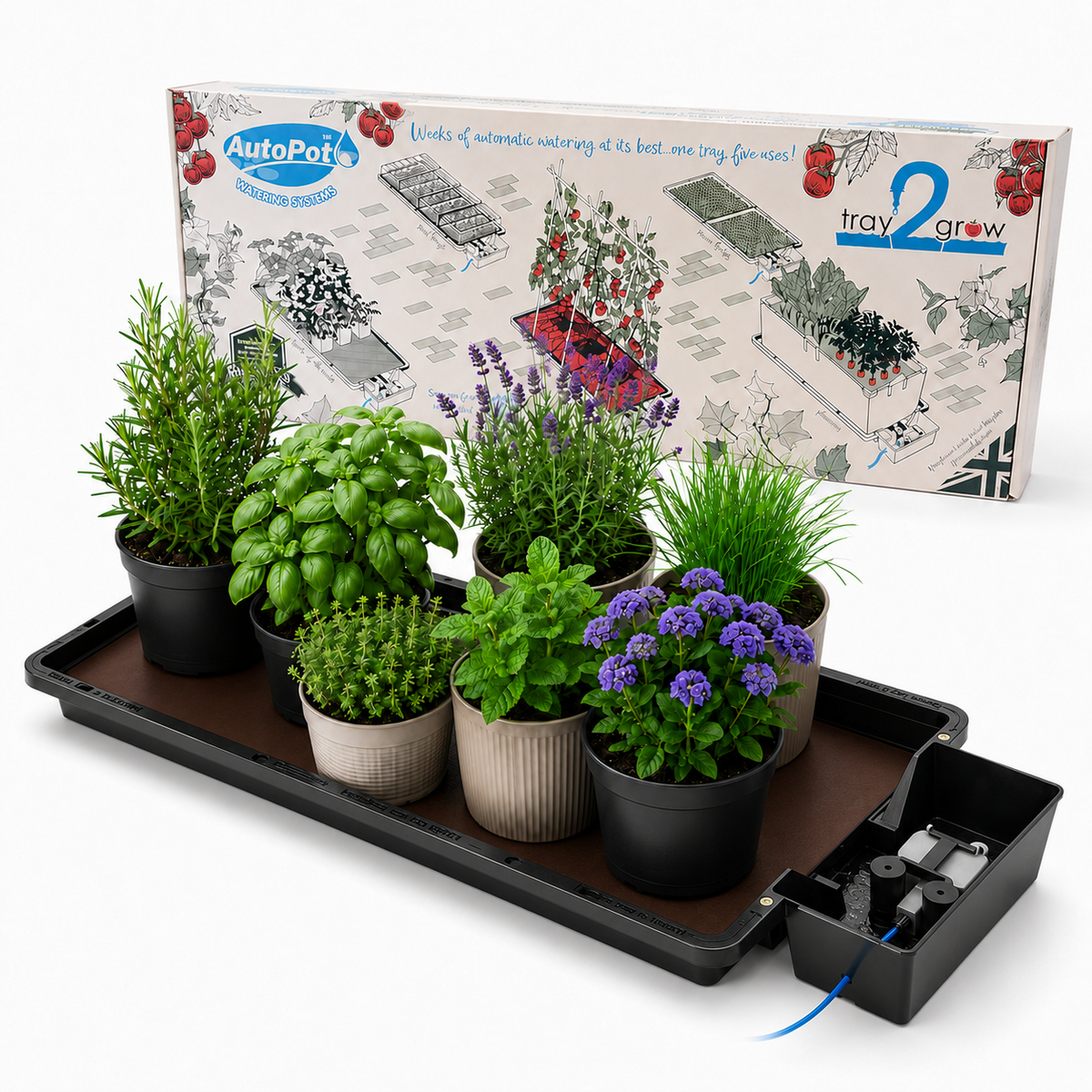
Most AutoPot systems are pot-based. You get a module, a 1Pot or an XL or a GeoPot, with a valve tray underneath each individual pot, and you daisy-chain them off a reservoir. The Tray2Grow throws that out. Instead of one small tray per pot, you get one long shallow tray with a single valve, and you put whatever you want on top of it.
That is a genuinely different tool. A 1Pot system asks you to commit to a pot size. The Tray2Grow asks you to commit to a footprint. Inside that footprint you can run four seed trays this month, a bed of microgreens next month, and a single large fabric planter after that, all on the same hardware with the same valve.
AutoPot's US spec table gives the tray as 44 inches long by 15 3/4 inches wide by 3 7/8 inches deep, with a usable interior of 37 1/2 by 13 5/8 inches. It is moulded from BPA-free food-safe plastic, with a channelled base that spreads water from the valve compartment to the far end, three spirit levels moulded into the frame, and three trellis support holes per side.
You will find conflicting tray dimensions online, including on AutoPot's own pages and on ours. The figures above are the ones on AutoPot USA's current product page. Multiply the interior out and the real growing area is 511 square inches, or 3.55 square feet, not the 532 square inches quoted in several places. It is a 4 percent difference that will not change anyone's buying decision, but if you are laying out pots against a tight shelf, plan for 511.
Everything runs on gravity. There is no pump, no timer, no controller and no power draw at all. That is not a marketing simplification. The system consumes zero watts, which is why it keeps working through a power cut and why it is one of the few pieces of automation you can leave running in an outbuilding with no electricity.
The Six-Inch Rule
Here is the number that matters more than any other, and the one buried deepest in the documentation.
Your reservoir must sit at least 6 inches above the highest AQUAvalve5 in the system. AutoPot states it in the system instructions for every product line, in capitals, and repeats it on the tank stand listing.
Read it again, because the important part is what you measure from. On every AutoPot reservoir, the rigid 12.4 gallon hard tanks and every size of FlexiTank, the tap is fitted at the base of the tank, not the top. The water level inside is irrelevant to whether the system works. What drives the valve is the height of the tap relative to the valve.
The Tray2Grow sits on the floor and the tank sits on the floor next to it. A 25 gallon FlexiTank is tall, so it looks like it towers over the tray. But its tap is a couple of inches off the ground and the AQUAvalve5 sits inside a tray whose floor is also on the ground. You have roughly zero head pressure, and depending on the geometry you may have negative head. The result is a system that dribbles, fills unevenly, or does nothing at all, on brand new hardware working exactly as designed. People replace valves over this. They send trays back. The tray was never the problem.
So get the tank up. If you are running the 12.4 gallon hard tank, this is a solved problem. The AutoPot Stand for the 12.4g Reservoir is a folding platform built for the job: 8.69 inches tall assembled, on a 12.69 by 9.5 inch frame with an 11.88 by 8.75 inch platform, rated to 300 lbs, rubber coated so the tank does not walk. AutoPot's instruction on that listing is unambiguous, and the 8.69 inches clears the 6 inch minimum comfortably. A full 12.4 gallon tank weighs about 103 lbs, so the 300 lb rating is ample. It folds flat when you strike the setup. Buy it with the tank.
FlexiTanks are a different problem, and this is where you do arithmetic before you improvise. Water weighs 8.34 lbs per gallon, so:
| Reservoir | Price | Weight of water when full | Getting it 6 inches up |
|---|---|---|---|
| FlexiTank 6.6G | $49.99 | About 55 lbs | Easy. A sturdy crate or low shelf will do. |
| FlexiTank 13G | $59.99 | About 108 lbs | Manageable on a proper shelf unit. |
| FlexiTank 25G | $69.99 | About 208 lbs | Needs genuinely structural support. |
| Hard Tank 12.4g | From $41.99 | About 103 lbs | Solved. Use the $23.99 AutoPot Stand. |
208 lbs is not a milk crate load and it is not a plastic storage tote load. Whatever you elevate a full 25 gallon FlexiTank on needs to be a proper shelving unit rated for the weight, a workbench, or a purpose-built platform, and it needs a flat continuous surface, because a FlexiTank's flexible base will find any gap in a slatted shelf and settle into it. The AutoPot Stand will not help here either: its platform is 11.88 by 8.75 inches, sized for the hard tank, and a 25 gallon FlexiTank will not sit on it.
If elevating 208 lbs safely is not realistic in your space, size down rather than improvise. For a single Tray2Grow, 13 gallons or even 6.6 is usually plenty of capacity, and both are far easier to get safely off the floor.
Position your inline filter further down the pipe run rather than hanging directly off the tap. A filter suspended from an elevated flexible tank pulls on the tank wall, and over time that strain is how seams start to weep.
How the AQUAvalve5 Works, and Why It Sometimes Looks Broken
Understanding the mechanism saves a lot of second-guessing, because the valve's normal behaviour includes a pause that reads exactly like a fault.
The AQUAvalve5 is a two-float device with silicone seals on both floats. Water enters through the nozzle and the tray fills. AutoPot specifies that it fills to a precise 1 inch depth and then shuts off automatically. The upper float lifts, which releases air trapped in the main body and lets the inner float rise fully to close off the incoming water. With air no longer able to enter, a vacuum holds the valve shut. Nothing more enters the tray regardless of what the reservoir is doing.
Then the plants drink. The water level falls as they take it up through the capillary matting, the top float descends and reseals the body, and once the level drops below the valve the vacuum has to break before the valve can open again.
That last step is the one that trips people up. The valve does not reopen the instant the tray runs low, because the vacuum has to release first. You watch the tray go dry, you wait a few minutes, nothing happens, and you conclude the valve has failed. It has not. AutoPot does not publish a figure for how long the reset takes, so treat a dry tray as normal for a good while before you touch anything, and change one thing at a time if you do intervene.
This is also why the Tray2Grow produces a real wet and dry cycle rather than a permanently saturated tray. The plants set the pace, because the valve only opens when they have actually drawn the water down. There is no timer to dial in and no schedule to get wrong, which is the system's real advantage over pump-and-timer irrigation for anyone who travels or forgets.
Standard Kit or Slim: What You Actually Get
We carry both, and the difference is larger than the price gap suggests. This is the head-to-head that matters, because it is the same tray and the same valve either way.
| Tray2Grow Standard | Tray2Grow Slim | |
|---|---|---|
| Starting price | $144.80 | $99.99 |
| Tray and lid | Yes | Yes, identical |
| AQUAvalve5 | Yes | Yes, identical |
| Capillary sheet | Yes | Yes |
| Root control sheet | Yes | Yes |
| Spirit levels | 3, moulded in | 3, moulded in |
| Tap, grommets, 3/8 inch pipe | Yes | Yes |
| Filters | Included | None. Buy separately. |
| Seed trays | Included | None |
| Capillary spikes for grow bags | Included | None |
| Copper slug tape | Included | None |
The Slim is the right buy if you already own a reservoir and a filter and you are running your own pots. It is the wrong buy if you are starting from nothing, because the filter is not optional and you will buy one separately anyway, which closes most of the gap.
Buy the Slim if
You have a reservoir already and you want the tray and the valve, nothing else
- You own a FlexiTank, a hard tank, or any gravity-fed reservoir you can elevate
- You already have an inline filter, or you are buying one deliberately
- You are running pots or fabric containers rather than grow bags on spikes
- You want the cheapest way into the AutoPot ecosystem
Tray2Grow Slim from $99.99
Shop the Tray2Grow SlimBuy the standard kit if
This is your first AutoPot system and you want it to work out of the box
- You have no reservoir, no filter and no spare fittings
- You want to propagate, so the four seed trays are worth real money to you
- You plan to run grow bags, which need the capillary spikes
- You would rather not work out which filter you need
Tray2Grow standard system from $144.80
See the standard kitWhat Fits on the Tray
The 37 1/2 by 13 5/8 inch interior is more flexible than it sounds. AutoPot's own framing is one tray, five different uses, and in practice these are the configurations worth knowing.
Pots on capillary matting. The default. Fabric pots, plastic pots and air pots all work, provided they have drainage holes in the base and sit flat. The capillary matting at $17.99 goes into the two outer channels running the length of the tray. Soak it thoroughly before you fit it. A dry mat will not start wicking on its own and you will spend a day wondering why nothing is moving.
Seed trays. Four standard seed trays fit the footprint, which makes the Tray2Grow a very good propagation bench. Bottom watering seedlings avoids the classic problem of blasting them out of the media from above.
Microgreens. Up to two large trays or eight minis. This is arguably the best use case for the tray. Microgreens are harvested inside a couple of weeks, they are sensitive to both over and under watering, and a demand-driven valve handles them better than any schedule you could set. Coco coir, hemp or unbleached paper mats, and commercial grow felt all work as media.
Grow bags on capillary spikes. The spikes in the standard kit push directly into the bags and deliver water via capillary lace, which is a different mechanism from matting. Choose based on your container, not on performance. Neither is better, they suit different things.
A single large planter. We carry the Grassroots Tray2Grow Living Soil Fabric Bed at $79.95 to $89.95, built to fit this tray. For anyone running living soil, it turns the Tray2Grow into a sub-irrigated raised bed, where the soil stays evenly moist from below instead of swinging between flood and dry with top watering.
The Root Control Sheet Is Not Optional Either
The Tray2Grow root control sheet at $9.79 sits on top of the capillary matting, copper side up. Its job is to stop roots growing down into the matting and eventually into the valve itself.
Skip it and you will get away with it for one cycle. By the second you will have roots in the valve compartment, and clearing them is genuinely difficult. AutoPot is blunt on the point: do not under any circumstances use a drill to clear the AQUAvalve5 nozzle, because it will potentially damage the valve beyond repair. Their recommended methods are a paper clip, a pipe cleaner, or blowing through the nozzle. A ten dollar sheet is cheaper than a valve and considerably cheaper than an afternoon.
Soak the sheet before fitting, same as the matting. The copper oxidises on the surface over time and looks spent, but the copper embedded in the fabric keeps working, and each sheet is good for multiple cycles.
Filtration: Weekly, Not Occasionally
AutoPot ships a filter with every system and expects you to use it. The valve's tolerances are tight and sediment is the single most common cause of a valve that will not seal properly. Check it weekly and clean it if necessary, especially if you are running organics or you are in a hard water area.
The filter range maps to system size:
| Filter | Price | Fitting | Use it for |
|---|---|---|---|
| Golf | $5.99 | 3/8 inch | A single Tray2Grow or any system of four pots or fewer |
| Inline | $10.39 | 1/2 to 3/8 inch | Same size bracket, inline rather than in-tank |
| Inline, larger | $14.49 | 1/2 inch | Six pots or more |
| Click-Fit | $24.99 | 1/2 inch | FlexiTank systems, comes apart easily for cleaning |
| ProFilter | $26.89 | 1/2 inch | Drum housing with swappable inserts |
| Click-Fit PRO | $34.29 | 1/2 inch | The ProFilter with click-fit connections for FlexiTanks |
For a single Tray2Grow the golf filter at $5.99 is genuinely enough. Clean filters in mild soapy lukewarm water or dilute hydrogen peroxide. Golf filter elements are replaceable separately.
Setting It Up Without Making the Usual Mistakes
Level the tray first. This is what the three moulded spirit levels are for and they are not decorative. The tray is nearly four feet long and fills to about an inch. A slope of a few millimetres end to end means one end floods while the other stays dry. Shim until all three read true, then check again once the tray is loaded, because weight will change things.
Do not put the tray on cold concrete. A slab pulls heat out of the water continuously, and a cold root zone slows uptake, which shows up as plants that look thirsty in a tray that is full. Put insulation between the slab and the tray: rigid foam, a pallet, even thick cardboard.
Plant established plants, not seedlings. The plant needs roots that can reach down to the wet zone. The Tray2Grow is more forgiving than the pot-based systems because you control the container, but the principle holds.
Then wait before you turn it on. Do not open the tap the moment you have potted up. AutoPot's instruction is to allow your plants to establish for 7 to 10 days before turning the system on, hand watering in the meantime. Turning it on immediately gives you a permanently saturated root ball with nothing drawing the water down, and that is how people conclude that AutoPot drowns plants.
Check both silicone seals. The valve has two, and both need to be present and sitting parallel to their seats. When you fit the valve into the tray, press only on the main body. Pressing on the floats will misalign the seals.
Feeding, Flushing and Water Management
The AQUAvalve5's inlet is 5 mm, which AutoPot describes as 66 percent larger than the AQUAvalve4 it replaced, and the system runs on 3/8 inch pipe rather than the old 1/4 inch. That is the reason the current generation handles a wider range of solutions, including organic feeds, coco, soil, perlite and living mixes. If you are fighting blockages on an older AutoPot setup running organics through quarter inch pipe, the pipe is why.
AutoPot's flushing instruction is to flush the pipework with plain water every time the reservoir empties, and that matters most with organics. With mineral nutrients in a hard water area, do it more often than that.
Two rules matter more than they sound:
- Never let the reservoir run completely dry. AutoPot puts this in capitals. Refill when about a third of the solution is left. Running to empty pulls the sediment that has accumulated at the tank base straight into the pipework and the valve.
- Turn the tap off before you refill. Pouring fresh solution into a tank stirs up whatever has settled. Give it time to drop back out of suspension before you open the tap again. This one habit prevents most valve blockages.
When you flush the plants themselves, do it with plain water from the reservoir, through the system. Do not pour water through the top of the pots. In a bottom-fed system salts accumulate at the media surface, and flushing from above drives that concentrated salt down through the root zone, which does real damage.
Troubleshooting: Five Failure Modes
1. The tray never fills, or fills very slowly. Head height, nine times out of ten. Measure from the reservoir tap to the valve and confirm you have at least 6 inches. If you do, check the filter and the inline tap next.
2. The tray drains and then nothing happens for a long time. Normal. The vacuum has to break before the valve reopens. Wait before intervening.
3. One end of the tray is wet and the other is dry. The tray is not level, or the capillary matting was not soaked before fitting, or it is not seated in both outer channels.
4. The valve will not seal and the tray overfills. Check both silicone seals are present and parallel. Then check for sediment or root intrusion in the valve compartment. If roots have got in, you skipped the root control sheet. Replace the sheet and clear the valve by hand, with a paper clip or a pipe cleaner, never a drill.
5. Plants wilting despite a full tray. Usually water temperature, so check the tray is not sitting on bare concrete. Failing that, the plants were potted too young and their roots have not reached the wet zone.
Who Should Buy One, and Who Should Not
The Tray2Grow is the right system if you want one footprint that changes jobs between cycles, if you propagate or run microgreens, if you want sub-irrigated living soil in a bed rather than pots, or if you need irrigation that keeps working without power. At $99.99 for the Slim it is also one of the cheapest ways into AutoPot's ecosystem.
It is the wrong system if you want to scale by adding pots. The tray models are not modular the way the 1Pot and XL systems are, so growth means buying more trays rather than more modules. It is also wrong if you cannot safely elevate a reservoir. That constraint is not negotiable, and it is better to know it before the box arrives than after.
Six inches of head is the whole ball game. Measure from the reservoir tap, not the top of the tank, to the highest valve. A Tray2Grow plumbed correctly and levelled properly is close to unbreakable. One sitting on the floor next to its tank will never work no matter what else you do.
Buy the filter and the root control sheet, and soak everything before you fit it. Between them the golf filter at $5.99 and the sheet at $9.79 prevent the two failures that actually kill these valves.
Wait 7 to 10 days after potting before you open the tap. Almost every "AutoPot drowned my plants" story starts with turning the system on the same day.
Not sure which kit or which reservoir fits your space? Call us at 716-217-0353 and describe it. We will tell you what you need, including when that is the cheaper option.
Related reads
Questions? We're easy to reach.
Happy Hydro has been serving growers since 2006. Call or email us before you order, after you order, or any time something comes up. When you're happy, we're happy.