
Harvest and Extraction
Bubble Hash Micron Sizes: What Each Bag Catches and Which Ones Matter
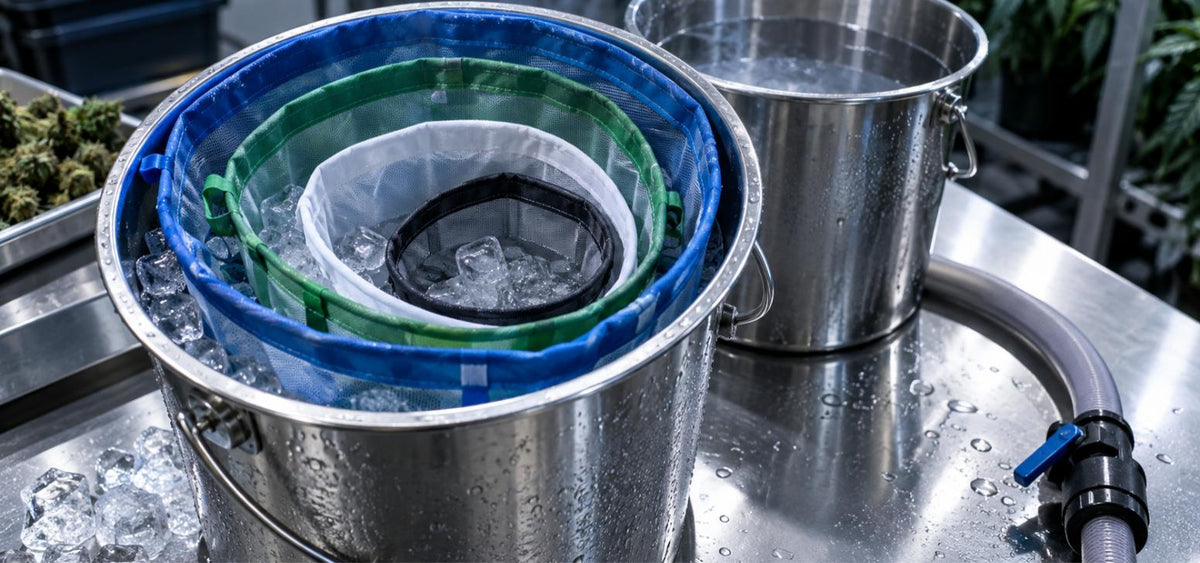
An eight-bag set gives you eight screens and three of them do most of the work. Here is what lands in each one, and why 73 micron is the number people talk about.
The first time you open an eight-bag set, the instructions tell you to stack them and the numbers tell you nothing. 220, 190, 160, 120, 90, 73, 45, 25. Eight bags, eight buckets of wet material at the end, and no obvious answer to which pile is the good one.
The short version is that the bags are a sieve stack sorting by particle size, and resin glands fall in a narrow band. Everything coarser than that band is plant matter you are trying to lose. Everything finer is broken fragments. Knowing where the band sits turns eight confusing piles into two or three you actually care about.
The short answer
- Mature resin heads measure roughly 70 to 120 microns across. That is the entire reason the 73, 90 and 120 bags exist, and why they hold the material worth drying carefully.
- 220 is a work bag, not a collection bag. It holds your plant material during the wash so the debris never reaches the stack below.
- Three bags will cover most home runs: a 220 work bag, a 160 to catch contamination, and a 73 to collect. Browse the full range in Bubble Bags or the wider Bubble Magic collection.
What the micron number actually means
A micron is one thousandth of a millimetre, and the number on a bag is the size of the holes in its mesh. A 73 micron bag lets anything smaller than 73 microns pass through and holds back anything larger. Stack the bags coarsest at the top and finest at the bottom, pour the wash water in, and each screen keeps a different slice of what came off the plant.
The useful fact underneath all of it: resin heads are not all one size, but they cluster. Published guidance puts mature heads at roughly 70 to 120 microns in diameter. That is a narrow window, and it lands almost exactly across the 73, 90 and 120 screens. Those three bags are not arbitrary marketing gradations. They bracket the thing you are trying to collect.
Bag by bag
| Micron | What lands in it | What it is for |
|---|---|---|
| 220 | Leaf, stem, bulk plant debris | The work bag. Material goes inside this one. Nothing here is worth keeping. |
| 190 | Finer plant matter | A cleanup screen. Catches debris that slipped past 220, collects nothing of value. |
| 160 | Coarse resin plus contamination | Lowest usable grade. Edible or press material rather than anything you would smoke. |
| 120 | Heads with stalks attached, some contamination | The first bag holding something genuinely worth keeping. |
| 90 | Full mature heads, stalks mostly absent | Consistently one of the two best returns in the stack. |
| 73 | Full, unbroken mature heads | The closest match to head diameter, and the reason this number gets quoted. |
| 45 | Partial heads, stalks, fragments | Fine material. Good for edibles or mixing back into flower. |
| 25 | Fines and broken pieces | Lowest grade in the stack. Many growers skip it entirely. |
Grades shift by cultivar. Head size varies between plants, so the bag that gives you the best return on one run may not on the next. If you are working with an unfamiliar plant, run the full stack once and weigh each bag separately. After that you will know which two screens to bother with.
How many bags you actually need
Set makers sell four-bag and eight-bag configurations, and the difference is resolution rather than quality. A four-bag set typically runs 25, 73, 160 and 220: one work bag, one contamination screen, one collection screen and one catch-all for fines. That covers a home run completely.
An eight-bag set adds 45, 90, 120 and 190, which lets you separate the premium band into three grades instead of lumping it into one. That matters if you are selling, pressing different grades separately, or learning what a particular plant does. It matters much less if everything you make ends up in the same jar.
The Bubble Magic All Mesh Extraction Bags ship as a five-bag 5 gallon set at 25, 73, 120, 160 and 220 microns, which is a sensible middle ground: you get the 120 and 73 collection screens without paying for resolution you may never use. The mesh sidewalls drain faster than solid-walled bags, and draining speed matters more than it sounds when you are working against melting ice.
Ice, water and agitation
The screens only sort what the wash releases, so the wash is where yield is won or lost. Four things govern it.
- Cold, and stay cold. Resin heads are brittle at low temperature and rubbery when warm. Warm water smears them rather than snapping them off, and smeared resin does not pass a screen cleanly. Keep ice in the vessel for the entire wash, not just at the start.
- Agitate in short bursts. The Bubble Magic machines run a 15 minute timer in 3 minute increments, and that granularity is the point. A first wash of three to five minutes pulls the heads that are ready to come off. Longer cycles pull progressively more plant matter along with them.
- Wash more than once. One long cycle is not the same as three short ones. Later washes yield less and grade lower, which is why keeping them separate is worth the extra buckets.
- Drain fast, then dry faster. Water is the enemy from the moment the material is off the screen. Get it spread thin and cold as quickly as you can.
Drying is where most home runs are actually lost, not washing. Material that took hours to collect can mould in a day if it goes into a jar damp, and over-agitating to chase a bigger number produces more weight of a worse grade. If you are choosing between a longer wash and a better dry, take the better dry every time.
Machine size: 5 gallon or 20 gallon
Both Bubble Magic machines do the same job with the same 15 minute timer and 3 minute increments, both have a built-in drain, and both ship with a 220 micron zipper washing bag. The difference is batch size and nothing else.
| 5 Gallon | 20 Gallon | |
|---|---|---|
| Price | $199.00 | $316.24 |
| Best for | Home runs, trying a new plant, small batches | Full harvests, repeat runs, anything commercial |
| Included bag | 220 micron zipper washing bag | 220 micron zipper washing bag |
| Timer | 15 minutes, 3 minute increments, both models | |
The honest guidance is to size to your harvest rather than your ambition. A 5 gallon machine run three times costs you an afternoon. A 20 gallon machine run at quarter capacity wastes ice and water on every cycle, and ice is the consumable that actually adds up. If you are unsure, the 5 gallon starter kit pairs the machine with bags so you are not assembling a stack piece by piece.
When dry sifting makes more sense
Ice water is not the only route. Dry sifting skips water entirely, tumbling cold material across a screen so the heads break off and fall through. It is faster, there is nothing to dry afterwards, and the equipment is simpler. It also grades lower, because a tumbler cannot separate by size the way a bag stack can.
The rule of thumb: wash when quality is the goal and you have the time, sift when volume is the goal and you do not. A Pollen Tumbler handles trim continuously in a way a bag stack never will, and the rest of the Dry Sifters range covers the smaller end. Plenty of people run both, washing the best material and sifting the trim.
Gear for this job


The verdict, three ways
- Starting out? Buy a four or five bag set, not eight. A 220 work bag, a 160, a 73 and a fines screen will grade a home harvest properly. Add resolution later if you find you want it.
- Chasing quality? 73 and 90 are your bags. They bracket mature head diameter, which is why they consistently hold the best material in the stack.
- Running volume? Look at sifting instead. A tumbler processes trim continuously and skips the drying stage entirely, at the cost of a grade.
Not sure which stack fits your harvest size? Call 716-217-0353, 10am to 4pm EST Monday to Friday, and we will size it with you. More harvest gear in Harvest & Essentials.
Sources
- The Press Club, on the purpose of multiple wash bags, for the role of each micron screen from 220 down to 25.
- Miraculix Lab, for resin head diameter of roughly 70 to 120 microns and the micron capture bands.
- Bubble Magic product documentation, for the 15 minute timer with 3 minute increments, the built-in drain, the included 220 micron zipper washing bag, and the micron sets supplied with each bag configuration.
Questions? We're easy to reach.
Happy Hydro has been serving growers since 2006. Call or email us before you order, after you order, or any time something comes up. When you're happy, we're happy.
Free shipping on orders over $49 to the lower 48. Most orders ship in 3 to 5 business days from Buffalo, NY in a discreet plain box. 30-day returns on new, resalable items.