
Propagation
Clonex Rooting Gel Review, and the Color Change That Is Not Spoilage
The active ingredient is 0.31% IBA and everything else is delivery. Here is what that buys you, why the purple gel goes brown, and where the Clone Solution fits.
Clonex has been the default rooting gel since 1988, which means most growers buy it without ever reading what is in it. That is usually fine. It becomes a problem in two specific situations: when the gel in the bottle has changed colour and you are trying to decide whether to bin it, and when you are staring at the gel and the Clone Solution on the same shelf assuming they are alternatives.
They are not alternatives, and the colour change is documented by the manufacturer. Both of those are worth knowing before you take fifty cuttings.
The short answer
- The active ingredient is Indole-3-butyric acid at 0.31%. The rest is water and minor ingredients. You are paying for a gel that seals the cut and holds the hormone in place, not for a higher hormone load.
- Purple turning mauve or brown is expected. The manufacturer's own safety data sheet describes it as a "viscous purple liquid that can turn to light mauve or brown after storage." Discolouration alone is not a reason to throw it out.
- The gel and the Clone Solution do different jobs. Gel is a hormone applied once at the cut. Solution is a nutrient for cuttings that have already rooted. Buying one expecting the other is the most common mistake with this line.
What is actually in the bottle
Clonex Rooting Gel is registered with the EPA under number 79664-1 and manufactured by Growth Technology Ltd in Taunton, UK. The safety data sheet lists a single active ingredient: Indole-3-butyric acid, or IBA, at 0.31%. Everything else is declared as water and other minor ingredients.
IBA is an auxin, the class of plant hormones that drives cell division at a wound site. Applying one to a fresh cut pushes the plant toward making roots there rather than callusing over and sitting still. Worth correcting a common assumption: IBA is not purely a lab invention. The USDA's technical report notes it is "manufactured in industry, biosynthesized by natural plants, and produced by soil bacteria." It occurs naturally, just at concentrations far too low to harvest, so commercial product is synthesised.
None of this is unique to Clonex. Most rooting products on the shelf, gel or powder, are IBA in some carrier at some concentration, and the USDA puts the commercial range at anywhere "from 0.5 mg L-1 to less than 1%". At 0.31% Clonex sits toward the strong end of that band without being an outlier.
Here is the caveat that should temper every rooting-hormone claim you read, including this one. The same USDA report states plainly that "the mechanisms of IBA's role in plant growth and development are not well understood yet and are still under debate." The industry sells this category with a lot of confidence. The federal technical literature is more careful, and it is worth knowing that the certainty in the marketing runs ahead of the science.
So what are you actually buying? The carrier. Clonex is a thick, water-based gel that stays where you put it, seals the cut surface, and keeps the hormone in contact with the tissue instead of washing off when the cutting goes into a wet medium. The formulation is alcohol-free, which matters because alcohol-based products can burn tender stem tissue. Compared with dipping a stem in loose powder, more of what you paid for ends up where it needs to be.
The label pH is 7 to 8. That is worth knowing if you are fussy about your propagation environment, because the gel is close to neutral and will not meaningfully shift the pH of the medium you dip into.
The colour change, and why people waste good gel
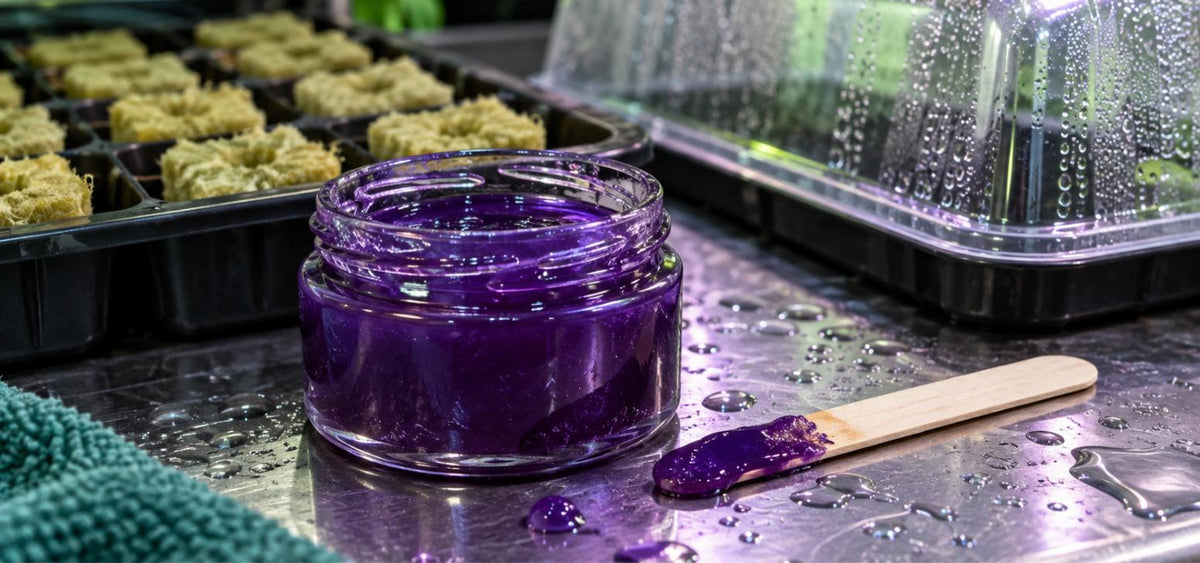
Fresh Clonex is a distinctive purple. Over time in storage it fades toward light mauve, and eventually toward brown. Growers see this, assume the product has spoiled or the hormone has degraded, and throw away a bottle that still has most of its life in it.
The manufacturer describes the product's physical appearance as a "viscous purple liquid that can turn to light mauve or brown after storage." That is in the safety data sheet as a description of the product, not as a failure mode. Colour drift is a normal property of the formulation sitting on a shelf.
What that does not mean is that the gel is immortal. Storage conditions are specified: keep it cool and dry, and keep it in the original container. Heat is what degrades the product, and a bottle that has been sitting in a hot garage through August has had a harder life than one in a cupboard. Judge it on how it has been stored and whether the texture still looks right, not on colour alone.
Never dip a cutting directly into the main bottle. Decant what you need into a shot glass or a small cup and dip from that, then discard what is left over. A stem carries whatever was on the plant, and one infected cutting dipped into the bottle contaminates every batch you take for the rest of the year. This is the single cheapest habit in propagation and the one most often skipped.
Gel or Clone Solution, and why it is not a choice
This is where the money gets wasted. The two products sit next to each other, both say Clonex, and they solve completely different problems.
| Clonex Rooting Gel | Clonex Clone Solution | |
|---|---|---|
| What it is | Hormone, 0.31% IBA | Nutrient: nitrogen, phosphorus, potassium, calcium and trace elements |
| When it is used | Once, at the moment you take the cutting | After the cutting is in the medium, and once roots appear |
| How it is applied | Dipped onto the cut surface | Diluted into the water or reservoir |
| What it does not do | Feed the cutting | Initiate roots |
The manufacturer is direct about this: the Clone Solution is "specifically formulated for rooted clones and seedlings" and is designed to work alongside a rooting agent, not to replace one. If you buy the Solution expecting it to root cuttings for you, it will not, and you will conclude Clonex does not work when you simply bought the second half of a two-part process.
The practical version: gel at the cut, solution once roots show, and nothing in between. A cutting with no roots cannot take up much of anything, so heavy feeding before rooting is at best wasted and at worst a source of rot.
Using it without wasting it
- Decant first. A small amount into a separate container, always. See the warning above.
- Cut at a node, on an angle. More surface area means more contact with the gel and more sites where roots can form.
- Dip and go straight in. Do not let the cut surface dry out between the gel and the medium. Have your cubes or plugs soaked and waiting before you take the first cutting.
- Do not over-apply. A coating on the bottom half inch of stem is the whole job. Burying the stem in gel does not double the rooting rate, it just costs you gel.
- Leave it alone. The hormone has done its work within the first days. Resist pulling cuttings up to check for roots, which tears the fragile new tissue you are waiting for.
Which size to buy
Both sizes are the same product. The only question is how many cuttings you take in a year against how long an opened bottle stays good in your storage conditions.
| Size | Price | Who it suits |
|---|---|---|
| 100 mL | $21.21 | Home propagation, a few dozen cuttings a season, anyone taking cuttings occasionally |
| 250 mL | $52.95 | Regular runs off a mother plant, or a small nursery operation working through it steadily |
At these prices the 250 mL is not a volume discount, so there is no reason to size up unless you will genuinely use it. A bottle you finish is better value than a bigger bottle you half use and then leave in a warm shed for two years.
Our recommendation
Clonex Rooting Gel, 100 mL
- Anyone taking cuttings from a mother plant and wanting a consistent strike rate
- Growers moving up from loose rooting powder who keep losing product into the medium
- Woody and herbaceous cuttings alike, including fruit trees, vegetables and ornamentals
- Anyone who wants the hormone to stay on the stem rather than rinse off
Clonex sits inside the wider Hydrodynamics International line, and if you are still deciding on a method rather than a product, the Cloning Gel & Rooting Solutions range covers the alternatives. For anyone taking cuttings at volume, Cloning Machines change the economics entirely, and Seed & Clone Kits bundle the medium and dome with the gel.
Gear for this job


The verdict, three ways
- Taking cuttings at all? The gel earns its place. 0.31% IBA in a carrier that actually stays on the stem beats loose powder that ends up in the medium, and the strike rate difference shows up across a whole tray.
- Bottle gone brown? Judge it on storage, not colour. The manufacturer lists mauve and brown as normal after storage. Heat is what kills it, so the question is where it has been living, not what shade it is.
- Buying the Clone Solution to root cuttings? Wrong product. It is a nutrient for clones that have already rooted. You want the gel first, and the solution later.
Setting up propagation from scratch? Call 716-217-0353, 10am to 4pm EST Monday to Friday, and we will put the list together with you.
Sources
- Clonex Rooting Gel Safety Data Sheet, revised 21 November 2023, published by Hydrodynamics International, for the 0.31% Indole-3-butyric acid active ingredient, EPA Registration Number 79664-1, pH of 7 to 8, the viscous purple liquid description and its colour change after storage, and the storage and handling guidance.
- USDA Agricultural Marketing Service, Indole-3-Butyric Acid Technical Report, for IBA's status as an auxin implicated in adventitious root formation, its natural occurrence alongside industrial manufacture, the commercial concentration range, and the note that its mechanisms remain under debate.
- Growth Technology Ltd, Taunton, UK, named on the safety data sheet as the manufacturer.
- Clonex Clone Solution product documentation, for its formulation as a nutrient for rooted clones and seedlings containing nitrogen, phosphorus, potassium and calcium, and its intended use alongside a rooting agent.
Questions? We're easy to reach.
Happy Hydro has been serving growers since 2006. Call or email us before you order, after you order, or any time something comes up. When you're happy, we're happy.
Free shipping on orders over $49 to the lower 48. Most orders ship in 3 to 5 business days from Buffalo, NY in a discreet plain box. 30-day returns on new, resalable items.