
Nutrients and Additives
Silica for Plants: Mono-Silicic Acid Earns Its Price on Drippers, Hard Water and Bloom Feeds
Both chemistries end up as silicic acid in your reservoir. What the expensive bottle actually removes is a pH swing, a precipitation risk, and a potassium load you did not ask for.
A silica supplement is one of the few additives where the sales pitch and the chemistry point in slightly different directions, and the gap is worth money. The standard pitch runs like this: plants can only absorb silicon as mono-silicic acid, potassium silicate is not mono-silicic acid, therefore the cheap potassium silicate bottle on the shelf is feeding your plants a form they cannot use. The first half of that is correct and well documented. The second half does not survive contact with what actually happens when you dilute a silicate in water.
That matters because the price gap is not small. A 100 mL bottle of Grow Genius Mono-Silicic Acid 40% runs $78.29, while a quart of potassium silicate is a $20 item at most shops. If the difference were purely about plant availability, the choice would be obvious and this article would be short. It is not about availability. It is about what the product does to your tank on the way in, and for a good number of growers that turns out to justify the spend anyway, just for different reasons than the label gives.
The short answer
- Silicon is a beneficial element, not an essential one. Plants complete their life cycle without it. The documented gains are in structural strength, pest and pathogen pressure, and tolerance of drought, salinity and heat, which is a real list but not a nutrient deficiency you are correcting.
- Both product types arrive at the same molecule. Dilute silicate solutions are dominated by silicic acid. The conversion happens in the reservoir in the ordinary course of mixing, not over weeks in the root zone.
- Buy Grow Genius Mono-Silicic Acid 40% if you run drippers, an automated reservoir, hard water, or a potassium-heavy bloom feed. It is pH neutral, it adds no potassium, and it will not drop calcium silicate sludge into a line.
- Stay with potassium silicate if you hand mix one tank at a time and pH it anyway. Add it to plain water first, stir, then nutrients. Done in that order it works, and it costs less per unit of silicon.
- Buy the biggest bottle you will use inside a season. At the label rate the 1 Liter size works out to roughly 4.7 cents per gallon of finished feed against 8.9 cents for the 100 mL.
What silicon actually does, and which plants bother to take it up
Start with the part that is settled. Plants take up silicon as mono-silicic acid, Si(OH)4, an uncharged molecule that moves into root cells through an aquaporin-family transporter called Lsi1 and is pushed onward by an active efflux transporter, Lsi2. That is the only doorway. Nothing else gets in. Once inside and carried to the shoots, transpiration concentrates it and it polymerizes into an amorphous silica gel that deposits in cell walls, cell lumens, intercellular spaces, and in dedicated silica cells.
The deposits are the mechanism. A silicon-reinforced epidermis is physically harder to chew through and harder for a fungal germ tube to penetrate. Silicon deposition in rice leaves is associated with better resistance to blast infection. In sugarcane it hardens the rind and reduces boring damage from larvae. Under drought, a silicon layer beneath the cuticle cuts transpiration. Under salt stress, deposits in the root endodermis and exodermis hamper apoplastic flow and reduce sodium uptake. Silicon also lifts the activity of the antioxidant enzymes catalase, superoxide dismutase and glutathione reductase in wheat under drought.
Now the part that gets left off the label. Silicon is not classified as an essential element for higher plants, because plants finish their life cycle without it. The formal designation is beneficial. And uptake capacity varies enormously by family. Grasses and sedges are the heavy accumulators, reaching as much as 10 percent of dry weight. Cucurbits, nettles and spiderworts sit in the middle. Brassicas and the nightshade family, which covers tomato, pepper and eggplant, are poor accumulators.
If your tent is mostly tomatoes and peppers, temper your expectations before you spend. Solanaceae are listed among the poor accumulators in the uptake literature, which means a large fraction of what you dose will simply not end up in the plant. The supplement is not doing nothing, but it is doing less than it would in a grass.
The form argument, and why it decides less than the label implies
Here is the claim to test: silicates are not plant available and need extended conversion in the root zone before the plant can use them. The chemistry says otherwise, and it says so from two independent directions.
Potassium silicate in the bottle is a concentrated, strongly alkaline solution, around pH 11.3. In that state it is a polymerized silicate network loosely associated with potassium ions. Dilute it and it depolymerizes. The USDA technical review of potassium silicate is direct about where that lands: the concentrations used in foliar sprays and nutrient solutions are dominated by silicic acid, which is readily absorbed by plants. The conversion is a hydrolysis reaction on dilution, and it happens in the tank, on the timescale of mixing, not over weeks of root chemistry.
The uptake literature agrees from the other side. Mono-silicic acid is the soluble form present below pH 9 and below roughly 2 mM silicon, which is about 56 ppm. Soil solution normally sits at 0.2 to 0.6 mM. Your reservoir at pH 5.8 with a sane silicon dose is comfortably inside the window where silicic acid is the stable species no matter which bottle you poured it from.
So the honest framing is that both products convert, and they convert from opposite directions. A silicate depolymerizes downward into silicic acid when you dilute it. The mono-silicic acid product, as the next section covers, hydrolyzes upward into silicic acid when you dilute it. Neither one is handing the plant a molecule the other cannot supply.
What is actually inside the mono-silicic acid bottle
Grow Genius publishes the headline figures plainly: 40 percent w/w mono-silicic acid and 21 percent elemental silicon, described in their own wording as delivery guaranteed. That phrasing is doing real work, and the safety data sheet explains why.
The declared composition is not an aqueous solution of silicic acid. It lists tetraethyl silicate at 10 to 20 percent, ethylpolysilicate at 1 to 10 percent, and a polyether modified polysiloxane at 1 to 10 percent, in a carrier making up the balance. Tetraethyl silicate, better known as tetraethyl orthosilicate, is a silicate ester. In contact with water it hydrolyzes and releases silicic acid. The 40 percent number is a statement about how much mono-silicic acid the bottle will yield once diluted, not an assay of what is sitting in the bottle on the shelf.
Three practical things fall out of that, and all three are visible elsewhere in the manufacturer's own documentation once you know to look for them. The product is classified as a flammable liquid, category 3, which is not a property of water and silicic acid. The reservoir life is quoted at up to seven days, described as a biodegradable stabilization that progressively releases mono-silicic acid, which is a hydrolysis curve rather than a shelf-stable solution. And the readily biodegradable rating, 95 percent over 28 days by OECD Test Guideline 301F, is a measurement of the organic carrier, not of silicon.
Handle it as the flammable it is. The manufacturer classifies the concentrate as Flam. Liq. 3 and as causing serious eye damage, with respiratory and skin irritation on exposure. Wear eye protection when you decant, keep it away from ignition sources, and do not store it next to a ballast or a heater. This is a concentrate you use in fractions of a milliliter, so a single splash is a disproportionate amount of the bottle in your eye.
None of this makes the product worse. It explains the product. Progressive release is precisely why the tank stays clear for a week instead of gelling, and why the label warns against foliar spraying above 86 degrees Fahrenheit or under full-intensity lights, since you are applying an organic carrier and a surfactant to a leaf surface. What it does mean is that the phrase plant available the instant it hits the root zone oversells the mechanism. It hydrolyzes. It just hydrolyzes reliably, at a pH that does not move, without dropping anything out of solution.
Specifications side by side
The comparison below uses Grow Genius Mono-Silicic Acid 40% against General Hydroponics Armor Si, chosen because its label is public and it is the most widely stocked potassium silicate on the market. Figures are from the manufacturers' published specifications and labels.
| Specification | Grow Genius Mono-Silicic Acid 40% | Armor Si (potassium silicate) |
|---|---|---|
| Silicon declaration | 21% elemental Si, 40% w/w mono-silicic acid delivery | 10% silicon dioxide, roughly 4.7% elemental Si |
| Source chemistry | Tetraethyl silicate and ethylpolysilicate, hydrolyzing on dilution | Potassium silicate, depolymerizing on dilution |
| Guaranteed analysis | Not a registered fertilizer analysis | 0-0-4, 4% soluble potash |
| pH behavior | pH neutral, no adjustment required | Strongly alkaline concentrate near pH 11.3, raises tank pH |
| Root dose | 0.03 to 0.05 mL per liter, weekly to daily | 0.25 mL/L mild, 0.5 mL/L full, 1.0 mL/L maximum |
| Foliar dose | 0.5 mL/L, up to 0.75 mL/L on woody stems | 0.25 to 0.5 tsp per gallon |
| Mixing order | Before or after base nutrients, last minimizes foaming | Into fresh water first, stir, then fertilizer |
| Reservoir life | Up to 7 days after mixing | Mix and use, pH will drift upward |
| Potassium added | None | Yes, proportional to dose |
| Hazard class | Flammable liquid 3, serious eye damage | Corrosive alkaline concentrate |
Read the first two rows together and the price stops looking absurd. Grow Genius carries about four and a half times the elemental silicon per unit volume, and it doses at roughly a tenth to a twentieth of the rate. But run the label percentages against the label doses and something more interesting appears. Armor Si at its full-strength 0.5 mL/L works out to about 0.023 mL of elemental silicon per liter. Grow Genius at the top of its range, 0.05 mL/L, works out to about 0.011. Armor Si at its mild 0.25 mL/L rate lands at about 0.012, near enough identical.
That arithmetic ignores the density difference between the two liquids, and a potassium silicate solution is the denser of the two, which would widen the gap further in its favor. Substitute your own densities if you have them. The direction of the answer does not change: at label rates you are not buying more silicon when you buy the expensive bottle. You are buying the same amount, or less, delivered differently.
Head to head: the three things that actually decide it
If silicon quantity is a wash, the decision rests on what each product does to the rest of your solution. There are exactly three differences that cost or save real money.
1. The pH swing
A potassium silicate concentrate sits near pH 11.3. Add it to a tank you have already balanced and the reading climbs, sometimes substantially. The label handles this by telling you to add it to fresh water first and then check and adjust into the 5.5 to 6.5 range afterward. That is a perfectly workable instruction if you are standing at the reservoir with a pen meter and mixing a batch you will use today. It is a nuisance if your reservoir is topped up automatically, and it is a genuine problem if you are dosing into a running system. Grow Genius moves pH essentially not at all, which is the single clearest reason it exists.
2. Calcium silicate precipitate
This is the expensive failure. Silicate in concentrated form, brought into direct contact with concentrated calcium or magnesium, precipitates. The visible result is a white sludge in the bottom of the tank. The invisible result is that both the silicon and the calcium have left solution, so the plants get neither, and the deficiency symptoms that follow read as a calcium problem you then try to fix by adding more calcium. In a hand-mixed bucket this is avoidable with mixing order. In a system with drippers and emitters, the same precipitate is also a clog, and that is a maintenance cost rather than a nutrient one.

3. The potassium you did not order
Armor Si is a 0-0-4. Every milliliter you add also adds potassium. Through veg that is usually harmless and occasionally welcome. Through mid and late bloom, when your base feed is already potassium heavy by design, it is an unplanned addition to a nutrient that is already at the top of its range, and it can push the potassium to calcium and magnesium ratio somewhere you did not intend. Grow Genius contributes none. For growers who stop silica at the start of flower purely to stop the extra potassium, a zero-potassium silicon source removes the reason to stop.
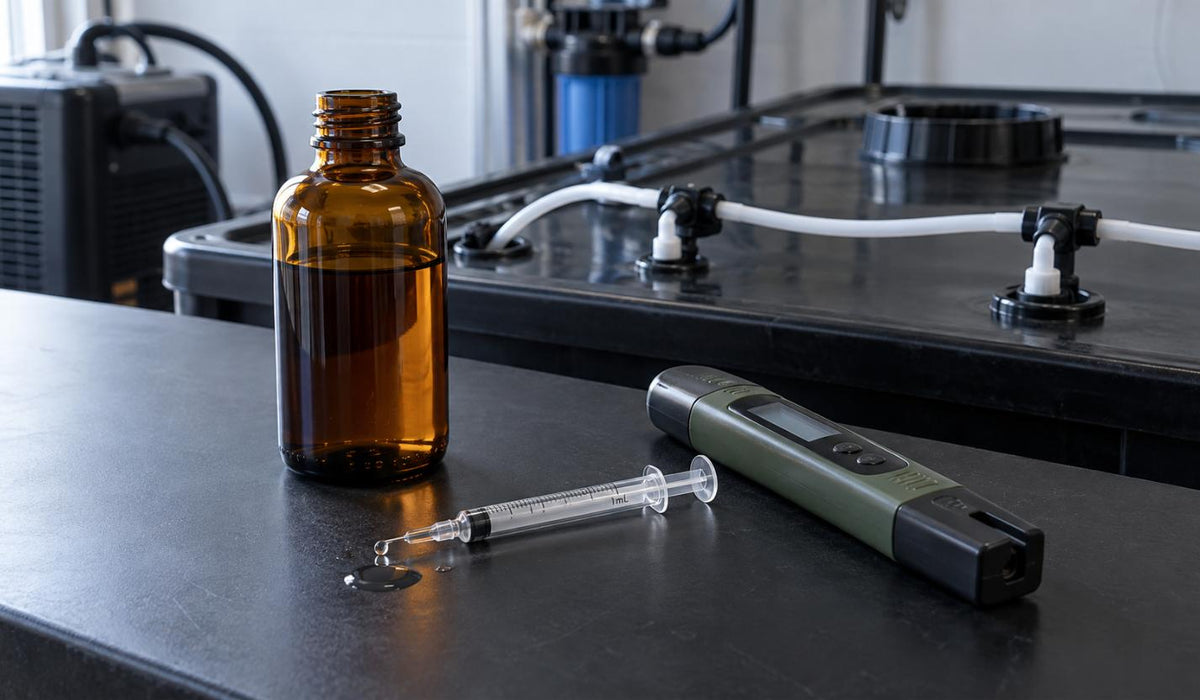
There is a fourth difference that is not a chemistry problem but a workflow one. At 0.03 mL per liter you cannot dose a 5 gallon bucket with a measuring cup. You need a syringe or a pipette, and for a single gallon you are measuring around a tenth of a milliliter. Growers who mix in small batches should plan on a 1 mL syringe living next to the bottle.
What a bottle actually costs per gallon of feed
Sticker price is the wrong unit for a product dosed in hundredths of a milliliter. The useful figure is cost per gallon of finished nutrient solution. The math is simple enough to check: bottle volume divided by dose rate gives you liters of solution, divided by 3.785 gives gallons, and the price divided by that gives cost per gallon.
| Size | Price | Gallons at 0.03 mL/L | Cost per gallon | Gallons at 0.05 mL/L | Cost per gallon |
|---|---|---|---|---|---|
| 100 mL | $78.29 | 881 | $0.089 | 528 | $0.148 |
| 250 mL | $148.49 | 2,201 | $0.067 | 1,321 | $0.112 |
| 500 mL | $269.99 | 4,403 | $0.061 | 2,642 | $0.102 |
| 1 Liter | $413.99 | 8,806 | $0.047 | 5,283 | $0.078 |
Two things to take from that table. First, the per-gallon cost is trivial at every size. Even the worst case in the grid, the 100 mL bottle run at the top of the dose range, is under 15 cents a gallon. Second, the dose range matters as much as the bottle size. The manufacturer publishes 0.03 to 0.05 mL per liter, and the difference between the bottom and the top of that range is a 40 percent swing in how long a bottle lasts. Coverage figures quoted anywhere at the 0.03 rate are best-case numbers. Budget on the top of the range and you will not be surprised.
For a grower running a 4x4 tent with a 20 gallon reservoir refilled weekly, that is roughly 1,000 gallons a year. The 250 mL bottle covers two years at the low rate and a little over one at the high rate. Most single-tent growers are buying the 100 mL or 250 mL, and the 1 Liter is a commercial purchase rather than a value play for a home room, notwithstanding its better per-gallon number.
Our pick for automated systems
Grow Genius Mono-Silicic Acid 40%
- You run drip emitters, an AutoPot reservoir, or any system where a precipitate becomes a clog
- Your source water is hard, so you are already fighting calcium in solution
- Your bloom feed is potassium heavy and you do not want more
- You dose into a standing reservoir rather than mixing a fresh batch each time
- You want to keep silicon running through flower without changing your potassium ratios
When to run it, and when to stop
Silicon is immobile once deposited. It polymerizes into silica gel in the cell wall and it does not move again. There is no redistribution from old tissue to new, which is the whole basis of the timing rule: silicon only helps tissue that is still being built. Dosing a plant that has finished expanding adds silicon to the solution and not to the plant.
In practice that means running it from early veg through the stretch and into early flower, which is where cell expansion is happening fastest and where a stronger stem is worth the most. The manufacturer's guidance is from germination through to a few weeks before harvest, weekly at the root, with the option to go as often as daily at the low end of the range.
The traditional advice to stop silica at the start of flower exists mostly because of the potassium that comes with a silicate product, not because of the silicon. If you are running a zero-potassium source, that reason evaporates and the only remaining question is whether the tissue you are feeding is still growing. Late flower, it mostly is not.
Foliar, and the temperature limit
Foliar is a different application with a different rate, 0.5 mL per liter every one to two weeks, and up to 0.75 mL per liter on woody-stemmed plants. It is genuinely useful for putting silicon on leaf surfaces where pest and pathogen pressure lands, and it bypasses the root uptake bottleneck in species that are poor accumulators. The constraint is heat: do not apply above 86 degrees Fahrenheit or under full-intensity lights. Spray at lights-off or in the first hour of the photoperiod.
Mixing order is not optional with any silicon product. Silicon and concentrated calcium in direct contact will precipitate, and a reservoir that clouds an hour after mixing was mixed in the wrong order rather than dosed too heavily. Silicon into plain water first, agitate until dispersed, then base nutrients, then calcium-bearing supplements, then pH last. Reverse any two of those steps and you get white sludge, a false calcium deficiency, and in a drip system, blocked emitters.
Who should buy which
The uncomfortable version, since it saves people money: if you hand mix one reservoir at a time, pH it with a meter before you feed, and run a soil or coco pot under a hose, the mono-silicic acid product is buying you convenience rather than agronomy. A silicate added to plain water first, stirred, and then pH adjusted gets the same silicic acid to the same roots for less. Buy it if you value the simplicity, but do not buy it believing your old bottle was not working.
The case flips completely the moment automation or water chemistry enters. Drippers and emitters turn a precipitate from an annoyance into a service call. Hard water means calcium is already abundant and looking for something to bind. An automated top-up reservoir means nobody is standing there to re-pH after the silicate goes in. A potassium-loaded bloom feed means the free potassium in a silicate is not free. In any of those four situations the pH-neutral, potassium-free, precipitation-resistant option is solving a problem you actually have, and at under a dime a gallon it is solving it cheaply.
Gear for this job
The takeaway
- Availability is not the reason to upgrade. Dilute silicate solutions are dominated by silicic acid, and the mono-silicic acid concentrate hydrolyzes to the same molecule. Both convert in the tank. Anyone selling you on plant availability alone is selling the wrong feature.
- pH neutrality, zero potassium and no precipitate are the reasons to upgrade. Those three are real, measurable, and they matter most in drip systems, hard water, standing reservoirs and potassium-heavy bloom feeds. If none of those describe your room, keep your current bottle.
- Dose by the top of the range and buy by cost per gallon. The published rate is 0.03 to 0.05 mL per liter, and planning at 0.05 keeps you honest. Even then every bottle size lands under 15 cents per gallon of finished feed.
Not sure which side of that line your setup falls on? Call us at 716-217-0353, 10am to 4pm EST Monday to Friday. Tell us your water hardness and how you feed and we will tell you straight whether the upgrade is worth it.
Sources and further reading
- Grow Genius Ltd, Mono-Silicic product specification and safety data sheet, 2022
- AutoPot USA, Grow Genius Mono-Silicic Acid 40% distributor specifications
- General Hydroponics, Armor Si 0-0-4 registered product label, guaranteed analysis and directions for use
- USDA Agricultural Marketing Service, Potassium Silicate Technical Advisory Panel Report, National Organic Program
- Journal of Experimental Botany, Significance of silicon uptake, transport, and deposition in plants, volume 71 issue 21
- OECD Test Guideline 301F, Ready Biodegradability, Manometric Respirometry Test
Related reads
Questions? We're easy to reach.
Happy Hydro has been serving growers since 2006. Call or email us before you order, after you order, or any time something comes up. When you're happy, we're happy.