
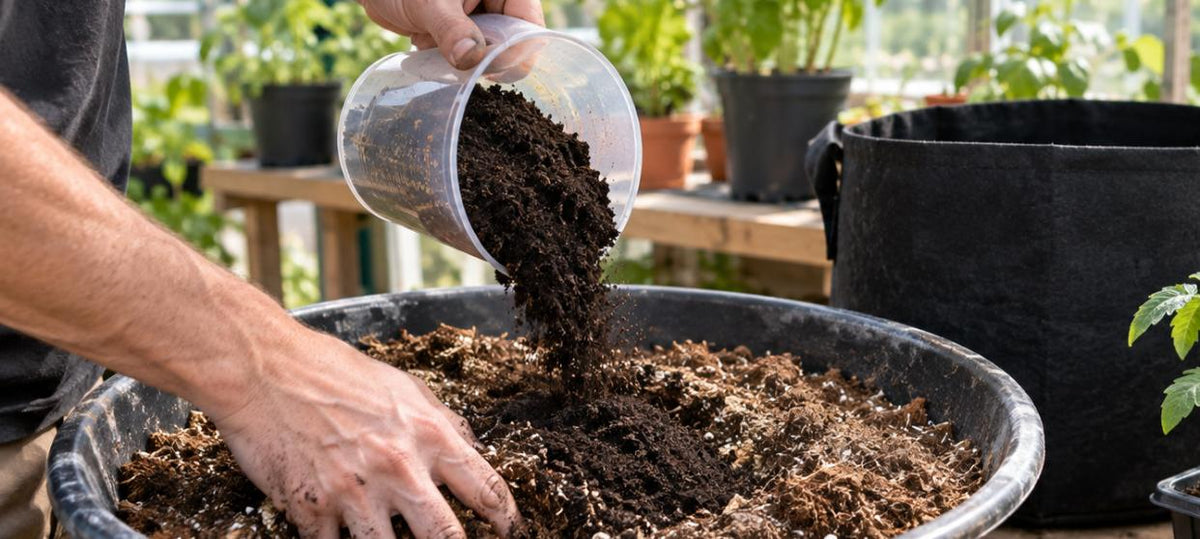
Soil and Amendments
Worm Castings Stop Paying Off Above 10 Percent of Your Mix
The guaranteed analysis on the bag is 2-0-0, which tells you almost nothing useful. The dose curve tells you everything.
Worm castings are the digested output of earthworms fed organic matter. They come out looking like fine, dark, crumbly coffee grounds, and they have been sold to growers for decades as the amendment you add when you want your soil to come alive. Most people buy a bag, dump some in, and never find out whether they used the right amount, because nothing obviously goes wrong either way.
That is the problem worth solving here. Castings are not expensive per bag, but they are expensive per liter, and the amount you put in your mix changes the result more than which brand you buy. The published research on this is unusually clear, and it points somewhere most bag copy does not: the growth response rises, peaks early, and then falls off. Adding more is not a safe default. It is a way to spend money moving backwards.
The short answer
- Containers: 5 to 10 percent of total mix volume. That is the rate Gaia Green Worm Castings prints on the label, and it is the rate the trial work supports.
- Beds and garden soil: 2 liters per square meter per month. Roughly half a gallon per 10 square feet.
- Established pots: 3 tablespoons per gallon of soil, top dressed monthly. Scratch it into the surface and water it in.
- Buy the 30 liter bag if you have more than one or two pots. It works out at $2.33 per liter against $8.98 for the 2 liter pouch.
- Castings do not feed a plant. If your soil needs nitrogen, phosphorus or potassium, you need an actual amendment alongside them.
What 2-0-0 on the bag is really telling you
Gaia Green's published guaranteed minimum analysis for its worm castings is 2.0 percent total nitrogen and 0.14 percent sulfur. Phosphorus and potassium are not declared at all, which is how a label says the values fall below the threshold that would require printing them.
Read that as a fertilizer label and castings look like a poor buy. Two percent nitrogen in a product that costs several dollars a liter is not a competitive way to deliver nitrogen, and a product with no declared P or K is not going to carry a plant through bloom. Growers who judge castings on the analysis panel usually conclude they are overpriced compost, and on that one measure they are right.
The analysis panel is the wrong instrument. It reports what a chemist can extract, and the extractable nutrient content is not what the research attributes the growth response to.
Worth knowingGaia Green states its castings are produced with African nightcrawlers and are approved for use in organic agriculture by Ecocert Canada, under the Canadian organic production standards CAN/CGSB 32.310-2015 and 32.311-2015. That is the certification the manufacturer publishes for this product.
The growth response is not a nutrition response
The most useful experiments on castings are the ones that removed nutrition from the equation on purpose. In the humic acid work out of Ohio State, seedlings were watered daily with a solution containing every nutrient they needed, so that any difference in growth could not be explained by feeding. Then humic acids extracted from vermicompost were added to the container medium at measured concentrations.
The plants still responded. Tomato seedlings showed shoot dry weight increases of 47.0 percent, 37.4 percent and 43.4 percent at 200, 250 and 500 milligrams per kilogram of humic acid, and root dry weight increases of 77.5 percent, 79.3 percent and 72.1 percent at the same three concentrations. Every one of those plants was already fully fed.
The related substitution trials found the same pattern at the level a grower actually works at. As little as 5 percent vermicompost substituted into a commercial nursery mix produced large growth responses across test crops, and 10 and 20 percent substitutions increased tomato seedling weights. The authors were direct about what this meant: the growth increases in their experiments were far too large to be explained by the nutrient content of the vermicompost, and they attributed the surplus to humic acids and plant growth regulators produced during the vermicomposting process itself.
That is the reason a 2-0-0 product does anything at all. You are not buying nitrogen. You are buying a biologically active material that behaves more like a signal than a meal.
Which is exactly why more stops working
Signals have a range. Meals mostly do not, and that difference is the practical heart of this.
In the same humic acid work, growth improved across a band of 50 to 500 milligrams per kilogram, and then reversed. Once humic acid concentration in the container medium passed roughly 500 to 1000 milligrams per kilogram, the growth response decreased significantly. The curve is a hump, not a ramp. The material that helped at one dose suppressed at three times that dose, with nothing else changed.
That behavior, an effect that rises and then inverts with concentration, is what you expect from something acting hormonally. It is not what you expect from a nutrient. And it means the intuition growers carry over from fertilizer, where the failure mode of too much is a visible burn you can flush, does not transfer. Overdosing castings does not burn anything. It quietly costs you the response you paid for.
This is the mistake that costs moneyDoubling the castings because the first bag seemed to help is the single most common way growers spend more and get less. There is no burn to warn you, no deficiency symptom, no signal at all. The plant simply performs closer to the unamended control while you keep buying bags.
Where the published rates disagree, and why
If you go looking, you will find a second set of numbers that seem to contradict everything above. A 2019 meta-analysis in Agronomy for Sustainable Development, pooling 212 root biomass observations and 245 shoot biomass observations, put the productive range at 20 to 60 percent vermicompost by volume, with the largest effects between 30 and 50 percent. A 2023 review reported that vermicompost suppressed bacterial vascular wilt in tomato by 60 and 66.67 percent, at 30 and 40 percent by volume respectively.
Those are much higher numbers than the 5 to 10 percent on a bag label, and the gap is not a contradiction. It is a difference in what the baseline was.
The high-rate studies are mostly substituting vermicompost into a soilless nursery substrate, something like a peat and perlite mix that starts with very little biology or nutrition in it. In that context vermicompost is not an amendment, it is a large fraction of the growing medium, and 40 percent of the pot is doing structural and nutritional work as well as biological work. The bag rate assumes something different: that you are adding castings to a complete potting soil that already has organic matter, amendments and structure. You are topping up one input, not building the medium.
The meta-analysis pools both kinds of study, which is why its optimum sits high. Both sets of numbers are honest. They answer different questions.
How to read this for your own setupIf you are mixing your own medium from coco or peat and building it up from nothing, the higher substitution rates are the relevant ones. If you are amending a bagged living soil that is already complete, stay at the label rate. The question is not how much vermicompost is good, it is how much of your pot is already doing that job.
The rates Gaia Green publishes
These are the manufacturer's own application rates, in both metric and the equivalents a grower in the States will actually use.
| Use | Published rate | In practice |
|---|---|---|
| Transplanting and container mixes | 5 to 10% castings by volume, mixed with soil or growing medium | The main rate. Blend through the whole pot, not just the root zone |
| Garden and landscape | 2 L per square meter once per month | About half a gallon per 10 square feet |
| Houseplants and established pots | 50 mL per 4 L of soil, monthly as required | 3 tablespoons per gallon, scratched into the surface |
| Lawn | Up to 2.8 kg per 10 square meters annually | Roughly 6 pounds per 100 square feet per year |
Two details in that table are easy to skim past. The container rate is by volume, not by weight, which matters because castings are heavy and damp and a volume rate measured with a scale will come out badly wrong. And the garden rate is monthly, not once per season, so the total annual quantity for a bed is much larger than a single application suggests.
How far a bag actually goes
This is where most of the purchasing regret lives. A 2 liter pouch sounds like a reasonable amount of anything. Run it against the label rate and it is smaller than it feels.
A standard 5 gallon pot holds 18.9 liters of medium. At the label's 5 to 10 percent, that pot wants 0.95 to 1.9 liters of castings. One 2 liter pouch treats one 5 gallon pot at the top of the recommended rate, and that is the whole pouch.
| What you are filling | Castings needed at 10% | 2 L pouch covers | 30 L bag covers |
|---|---|---|---|
| One 3 gallon pot (11.4 L) | 1.14 L | 1 pot | 26 pots |
| One 5 gallon pot (18.9 L) | 1.89 L | 1 pot | 15 pots |
| One 10 gallon pot (37.9 L) | 3.79 L | Not enough | 7 pots |
| 4 x 4 bed, one monthly garden dose | 2.97 L | Not enough | 10 months |
| 4 x 8 bed, one monthly garden dose | 5.95 L | Not enough | 5 months |
| Houseplant top dress, 3 tbsp per gallon | 50 mL per dose | 40 doses | 600 doses |
The pouch is a houseplant product and a single-container product. It is not a garden product, and buying three of them to do a bed is the most expensive route to the same result.
2 liter pouch against 30 liter bag
Same castings, same analysis, very different cost per liter
At $17.95 for 2 liters, the pouch costs $8.98 per liter. The 2 pack at $31.95 brings that to $7.99 per liter. The 30 liter bag at $69.95 costs $2.33 per liter, which is 3.8 times cheaper than the single pouch for an identical product.
Put that against a single 5 gallon pot at the 10 percent rate. The 1.89 liters that pot wants costs $16.97 out of a pouch and $4.40 out of the bag. The bag pays for itself somewhere around the fourth or fifth 5 gallon pot, and after that the gap only widens.
The pouch still earns its place in two situations: you have a handful of houseplants and 40 monthly top dressings is more than a year of supply, or you want to try castings on part of a grow before committing 30 liters of storage space to them. Castings are damp and biologically active, and a 30 liter bag you use a liter of per year is not going to be the same material by the end.
Storage changes what you boughtThe value here is living biology, so a bag stored hot, dry or sealed airtight for a season is not delivering what the label describes. Keep it closed but not sealed, out of direct sun, and somewhere it will not freeze or bake. Buy the quantity you will work through, not the quantity with the best headline price.
When compost is the better purchase
Castings and compost get treated as interchangeable, and for one of the two jobs people ask them to do, they are not close.
If your goal is bulk organic matter, better structure, improved water holding and a soil that drains and rewets properly, compost is the correct buy. You need volume to move those properties, compost is a fraction of the price per liter, and there is nothing castings do in that role that justifies four times the cost. Amending a bed with 30 liters of castings instead of 30 liters of compost is a straightforward waste.

If your goal is the biological and hormonal effect described above, compost is not a substitute. The vermicomposting process is what generates the humic acid fraction and the growth regulators, and ordinary thermophilic compost does not go through it. That effect is available at 5 to 10 percent of a container, which is the one place a costly material makes economic sense.
The clean way to hold both facts: compost is how you build the soil, castings are how you inoculate it. Growers who use both use a lot of the first and a little of the second, and that ratio is not a compromise, it is the correct answer.
Where castings will not help you
Three situations come up repeatedly and castings are the wrong tool in all of them.
A hungry plant in late flower. Undeclared P and K means castings cannot correct a bloom-stage deficiency, and the material is too slow acting to fix anything urgent regardless. A plant showing deficiency needs a real amendment or a feed, and it needs it this week.
A drainage problem. Castings are fine textured and hold water well, which is a benefit at 5 percent of a mix and a liability if you reach for them to fix a pot that is already staying wet. Adding a moisture-holding material to a waterlogged container makes the problem worse. That is an aeration and pot-choice question.
A sterile medium you expect to stay sterile. Castings are alive by design. In a system where that is the point, they are the wrong input, and no rate solves it.
Where this lands
Gaia Green Worm Castings
- Growers amending a complete potting soil who want the biological effect without rebuilding the medium
- Anyone transplanting into containers, where 5 to 10 percent by volume is the documented rate
- Bed and raised-bed growers running the monthly 2 liter per square meter schedule
- Houseplant keepers who want a monthly top dress that will not burn anything
2 L pouch $17.95 • 2 L two pack $31.95 • 30 L bag $69.95 • Guaranteed analysis 2-0-0, 2.0% N and 0.14% S
See sizes and stockGear for this job
From $17.95
bio365 bioAll Organic SoilFrom $12.95
bio365 bioStart Organic SoilFrom $14.95
KIS Organics Biochar Water Only Soil Mix$66.44
Gaia Green Power Bloom 2-8-4From $12.95
Gaia Green Glacial Rock Dust$15.95
Real Growers Recharge Soil MicrobesFrom $9.95
Grassroots Living Soil Fabric BedsFrom $87.60
A working schedule
If you want this reduced to something you can follow without rethinking it each time:
At mix-up or transplant, blend castings through the full volume of medium at 5 to 10 percent. For a 5 gallon pot that is somewhere between 1 and 2 liters. Mix the whole pot, because a concentrated layer in the root zone puts part of the medium above the useful dose and leaves the rest below it.
Every month after that, top dress at 3 tablespoons per gallon of pot volume and water it in. A 5 gallon pot gets about 15 tablespoons, a little under a cup. Scratching it into the top inch gets it into contact with the soil rather than leaving it to dry out on the surface.
For beds, 2 liters per square meter monthly through the growing season. Measure the bed once and write the number down, because the monthly cadence is what people forget and it is most of the annual total.
Do not compensate for a slow crop by adding more. If the plants are not performing, the answer is in your feed, your light, your water or your root zone. It is not another liter of castings, and the dose curve means the extra liter can cost you.
The takeaway
- 5 to 10 percent by volume in containers is the whole recommendation. The label rate and the trial data agree, and the response curve turns over above it.
- Judge castings on biology, not on 2-0-0. Fully fed plants still responded to the humic acid fraction, which is what you are actually paying for.
- Buy the 30 liter bag past three or four pots. $2.33 per liter against $8.98 is the same material at a quarter of the cost.
Not sure how this fits your mix? Call us at 716-217-0353, 10am to 4pm EST Monday to Friday.
Sources
- Gaia Green Organics, published guaranteed minimum analysis and application rates for Earthworm Castings
- Ecocert Canada organic input approval, CAN/CGSB 32.310-2015 and CAN/CGSB 32.311-2015
- Blouin et al., Vermicompost significantly affects plant growth, a meta-analysis, Agronomy for Sustainable Development, 2019
- Arancon, Edwards et al., Effects of humic acids from vermicomposts on plant growth, Ohio State University Soil Ecology Laboratory
- Vermicompost, Enhancing Plant Growth and Combating Abiotic and Biotic Stress, Agronomy, 2023
Related reads
Questions? We're easy to reach.
Happy Hydro has been serving growers since 2006. Call or email us before you order, after you order, or any time something comes up. When you're happy, we're happy.