
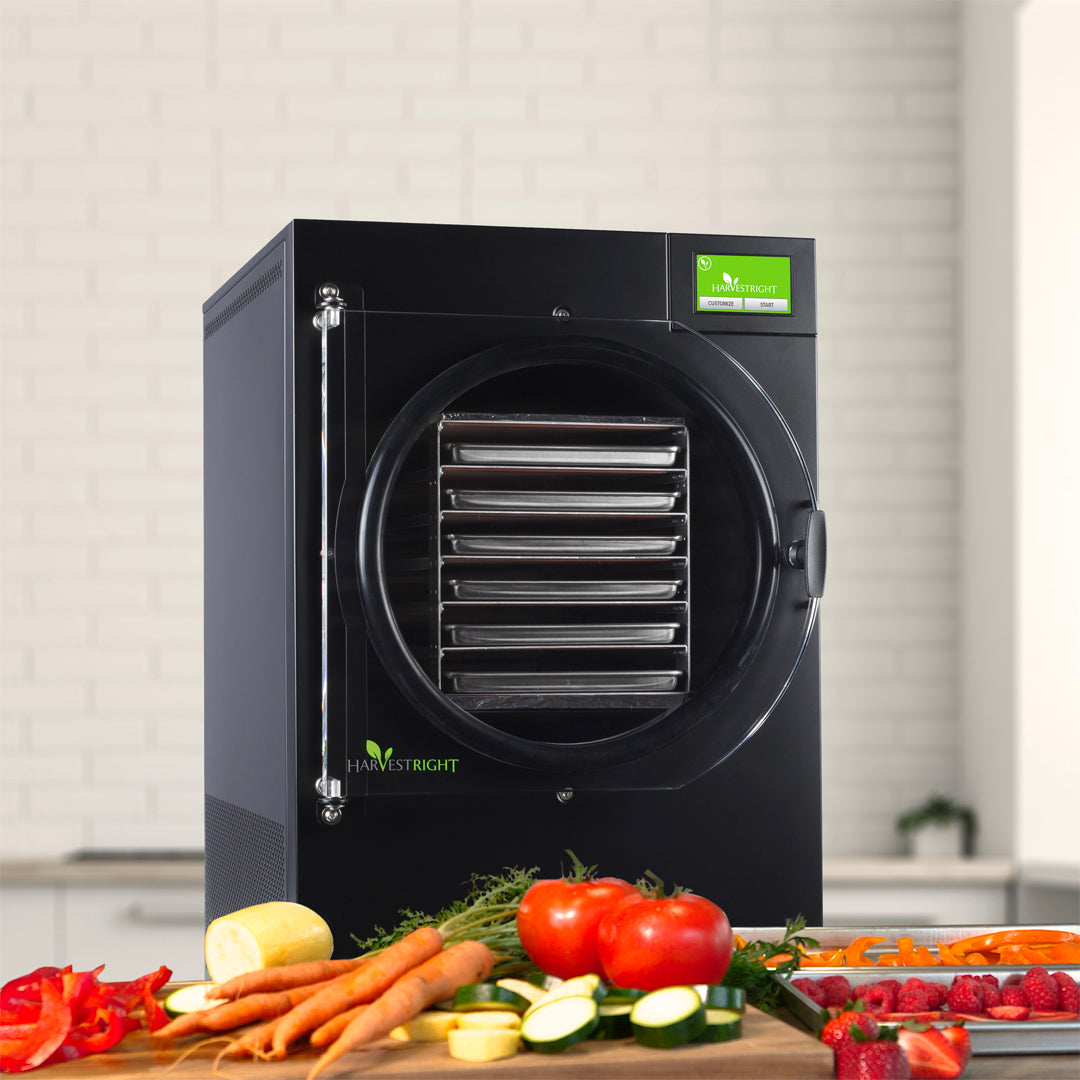
Buyer's Guide
Pick a Harvest Right Freeze Dryer by Batch Weight and Circuit Size, Not by Price
Four sizes, four tray counts, and one electrical spec that decides whether you also need an electrician.
Most people arrive at a home freeze dryer with a volume problem. There is a chest freezer running out of room, a garden that produces more than anyone can eat in August, a bulk meat order, or a harvest that needs to keep for years instead of months. The machine solves that problem well. What trips buyers up is that the four sizes are not four versions of the same appliance at four prices. They differ in tray space, in how long they tie up your kitchen, in how much floor they need, and in what they ask of the wiring behind them.
The size question also gets answered backwards more often than not. People pick a number that sounds reasonable, buy it, then discover they are running four batches a week to keep up, or that a 7-tray machine sits half empty most of the year. Batch weight and annual throughput are published figures, so the sizing part is arithmetic rather than guesswork. The part that is not obvious from a spec sheet is the electrical requirement, and that is where a $4,995 machine can quietly become a $5,600 machine.
The short answer
- One or two people, a garden, occasional bulk buys: the 4-tray Small Pro at $1,695. Six to 10 pounds of fresh food per batch, 434 square inches of tray, up to 1,800 pounds a year.
- A family of four preserving most of a season: the 5-tray Medium Pro at $2,495. Ten to 15 pounds per batch, 675 square inches, up to 3,000 pounds a year.
- The best tray space per dollar that still runs on a 15 amp circuit: the 6-tray Large Pro at $3,095. Eighteen to 27 pounds per batch, 1,107 square inches, up to 5,000 pounds a year.
- Small business volume, and you have a 20 amp circuit or will add one: the 7-tray XL Pro at $4,995. Forty to 50 pounds per batch, over 2,250 square inches, up to 10,000 pounds a year.
What a size actually buys you
Harvest Right publishes tray dimensions for every size, which means you can check the tray space yourself instead of taking the marketing number. Multiply width by length by the number of trays. The Small is 7.75 by 14 inches across four trays, which is 434 square inches. The Medium is 7.5 by 18 across five, or 675. The Large is 9 by 20.5 across six, or 1,107. The XL is 10.9 by 29.5 across seven, or 2,251. Those are the figures the batch weights are built on, and they are the honest way to compare sizes, because a tray count on its own tells you nothing about tray area.
| Model | Trays | Tray space | Fresh food per batch | Per year | Footprint (W x D x H) | Weight |
|---|---|---|---|---|---|---|
| Small Pro | 4 | 434 sq in | 6 to 10 lbs | up to 1,800 lbs | 17.4" x 21.5" x 26.8" | 91 lbs |
| Medium Pro | 5 | 675 sq in | 10 to 15 lbs | up to 3,000 lbs | 19" x 25" x 29" | 119 lbs |
| Large Pro | 6 | 1,107 sq in | 18 to 27 lbs | up to 5,000 lbs | 21.3" x 27.5" x 31.3" | 143 lbs |
| XL Pro | 7 | 2,251 sq in | 40 to 50 lbs | up to 10,000 lbs | 24.3" x 37.4" x 35.6" | 258 lbs |
Two things stand out in that table. The first is that the jump from Medium to Large is the biggest single step in value. The Large costs $600 more than the Medium and returns 64 percent more tray space and 67 percent more annual throughput. Work it out per square inch of tray at current pricing and the Small lands near $3.91, the Medium near $3.70, the Large near $2.80, and the XL near $2.22. Bigger is cheaper per unit of capacity all the way up, which is the usual shape for this kind of equipment.
The second is the footprint. The XL is 37.4 inches deep and 258 pounds. That is not a countertop machine and it is not a machine you move by yourself. Measure the doorway and the path before you order, not after.
The amp rating and the power bill are two different numbers
This is where most of the confusion around running cost comes from, and it is worth slowing down on because both numbers come from Harvest Right and they appear to contradict each other.
Harvest Right lists average draw for the Small and Medium at 9 to 11 amps, which they convert to 990 to 1,210 watts. They also publish an estimated electricity cost of $1.25 to $2.80 per batch for those same machines. Run the arithmetic on the first number and you do not get the second. At 1,210 watts for a 24 hour cycle you are looking at 1,210 x 24 divided by 1,000, or 29 kilowatt hours. At 13 cents a kilowatt hour that is $3.77, and at 20 cents it is $5.81. Both are above the published per batch estimate, the higher one by roughly double.
The reconciliation is on Harvest Right's own Pharmaceutical Small page, which is the one place they break out draw by phase for the same chassis as the home Small: 330 watts while freezing and 725 watts while drying. Put 725 watts through the same arithmetic and you get 17.4 kilowatt hours for a 24 hour cycle, which is $2.26 at 13 cents. That lands inside the published range, and the freezing phase pulls less still.
How to use each number
The amp figure is what the compressor, the heaters and the pump can pull together at their peak. Size your circuit off it. The wattage figure is what the machine actually averages once it settles into a phase. Budget off that. Substitute your own rate and your own cycle length: watts x hours divided by 1,000 gives kilowatt hours, and kilowatt hours times your rate gives dollars.
The caveat worth stating plainly is that Harvest Right publishes an average draw and a cost estimate, not a metered duty cycle across a full run. The machine moves between phases, and the phase mix depends on what is on the trays. Treat the per batch dollar figures as a range rather than a meter reading, and expect dense or sugary loads to sit at the top of it.
Scale that across sizes and something useful falls out. Harvest Right puts the Large near 13 amps and $2 to $3 a batch, and the XL near 15 amps and about $4 a batch. The XL runs 40 to 50 pounds for that $4, which is roughly 9 cents a pound. The Small runs 6 to 10 pounds for about $2, which is closer to 25 cents a pound. Per pound of food, the XL is around three times cheaper to operate than the Small.
The circuit is the part that costs extra
Every size in the Home Pro line runs on 110 volts, which sounds like it settles the question. It does not. Harvest Right requires a dedicated circuit for all four sizes, meaning nothing else on that breaker. For the Small, Medium and Large that is a dedicated 15 amp circuit on a standard NEMA 5-15 outlet, the ordinary three prong receptacle already in your wall. For the XL it is a dedicated 20 amp circuit on a NEMA 5-20 outlet, which is the one with the sideways T-shaped neutral slot.
That distinction is the real price step in the lineup. Moving from the Large to the XL is not only $1,900 of machine. If your space does not already have a 20 amp circuit with the right receptacle, it is also an electrician, a breaker, a run of 12 gauge wire and a new outlet. Depending on how far the panel is from where the machine will live, that is commonly a few hundred dollars and occasionally much more.
Check the breaker before you check out
A dedicated circuit means the freeze dryer is the only thing drawing on that breaker. A garage outlet that also feeds a chest freezer and a door opener is not a dedicated circuit, even if it is rated 15 amps. Running a machine that averages 9 to 13 amps on a shared circuit is how people end up tripping a breaker 18 hours into a cycle.
Extension cords are the other common mistake. A long or light gauge cord drops voltage and heats up under a sustained draw of this size. Plug the machine straight into the wall.
Premier oil pump or oil-free, and what the upgrade actually buys
Every Home Pro machine ships with a Premier industrial oil pump included. The oil-free pump is an upgrade, and at current pricing it adds $1,395 on the Small and $1,495 on the Medium and Large. Bought on its own it is $1,795, against $895 for a Premier pump.
What you are buying is the elimination of a maintenance chore. Harvest Right calls for an oil change on the Premier pump every 20 to 30 batches. Their older standard oil pump needed one every 4 to 5 batches, which is the source of the reputation oil pumps still carry, and it is worth knowing that the Premier is a different animal. At 20 to 30 batches, a household running one batch a week changes oil somewhere between twice and three times a year. Filtered oil is reusable, and a 6-pack of pump oil runs $89 with an oil filter at $59.
So the honest way to frame the upgrade is not maintenance cost, because the consumables are cheap. It is whether you want the chore at all, and whether you want the noise. Utah State University Extension measured vacuum pump noise on home freeze dryers at 62 to 67 decibels, against about 70 for a vacuum cleaner, and that is the part people underestimate when they put the machine in a hallway or a spare bedroom. The oil-free pump is the quieter option.
Where the upgrade earns it
Go oil-free if the machine lives somewhere you spend time
- The machine sits in a kitchen, a laundry room off a bedroom, or anywhere within earshot overnight
- You expect to run more than two batches a week, where oil changes stop being occasional
- You would rather not handle and store used pump oil
- Stick with the included Premier pump if the machine lives in a garage, basement or shed and you run a batch a week
Cycle time is set by the ice, not by how full the trays are
Harvest Right puts most foods between 13 and 35 hours, with candy closer to two hours because there is very little water to remove. Utah State Extension, working from owner reports rather than manufacturer figures, puts the practical range at 20 to 40 hours and notes fresh pineapple running 48 to 52 hours because of its sugar and water content.
The operational consequence matters more than the exact number. A cycle ends when the load is dry, and the machine keeps running the refrigeration and the vacuum until it gets there. A half loaded set of trays does not take half as long, and it does not cost much less to run, because the compressor and pump duty cycle barely change. If you are going to run the machine, fill it.
That is also the argument against oversizing. The per pound running cost advantage the XL has over the Small only shows up if the XL goes in full. An XL run at half capacity costs about what a full XL costs and preserves what a Large would have handled. Size to what you will realistically load in one go, not to the biggest number you can justify.
Where the machine can actually live
Harvest Right asks for a stable, level surface at least three feet off the ground, which surprises people who pictured the machine on the floor. The height is about the drain line and about access to the pump. They also ask that the unit is not boxed into a corner or an enclosed cabinet, because it needs airflow, and that the room stays between 50 and 75 degrees Fahrenheit and never above 105. Utah State Extension gives a slightly wider practical window of 45 to 80 degrees and points out the pump throws heat into the room.
Put those together and a lot of otherwise obvious locations fall away. A closet is out. A tight corner of a pantry is out. An uninsulated garage in a place with real summers is out for part of the year, and an unheated one is out for the other part. A basement, a mudroom, a utility room or a well ventilated corner of a kitchen all work, as long as you can give the machine a sturdy bench and a dedicated outlet.
Weight is a bench question
The Large is 143 pounds before you load it, and the XL is 258. Three feet off the ground means a bench or a heavy duty shelf rated for that load plus the food. A folding table will not do it.
What a freeze dryer does not do
Freeze drying pulls water out by sublimation. The load is frozen hard, the chamber is put under vacuum, and the ice turns straight to vapor without passing through liquid. University of Minnesota Extension describes primary drying as removing up to 90 percent of a food's water, with a secondary phase taking another 1 to 2 percent. The low residual moisture is why properly packaged freeze dried food keeps so much longer than dehydrated food, and why texture and shape survive the process.

What the process does not include is a kill step. University of Minnesota Extension is direct about it: the mild heat used during drying is not enough to inactivate illness-causing microorganisms, so freeze drying does not kill bacteria or viruses. Anything that was unsafe going in is unsafe coming out, and it becomes active again on rehydration. Handle raw meat, eggs and dairy the way you would for any other preservation method, keep everything clean, and package into moisture proof containers with oxygen absorbers.
Some foods also simply do not work. Minnesota Extension flags high fat foods, high sugar foods and baked goods as poor candidates. Fat does not sublimate and goes rancid in storage, and high sugar loads hold water stubbornly, which is why that pineapple takes two days.
The 25 year figure has a footnote
The commonly quoted 25 year shelf life comes from commercially freeze dried and commercially packaged food. Minnesota Extension notes there is limited data on home prepared freeze dried products, since the equipment has only been widely available to households for about a decade. Treat 25 years as the ceiling under ideal packaging, not a default.
Head to head: Medium or Large
These two are the real decision for most buyers, and they are close enough on price to be worth a direct comparison. The Medium is $2,495 with the Premier pump and the Large is $3,095, a $600 gap. They share the same electrical requirement, a dedicated 15 amp circuit on an ordinary outlet, so neither one triggers electrical work the other avoids. They share the same 3 year limited warranty, full for the first year and covering the sealed refrigeration system in years two and three.
What $600 buys is 432 more square inches of tray, roughly 8 to 12 more pounds of fresh food per batch, and 2,000 more pounds a year of headroom. It also costs you 24 pounds of machine weight and between 2.3 and 2.5 inches in every direction of footprint, plus a slightly higher draw, near 13 amps against 9 to 11.
If you are sizing off a garden and a couple of bulk meat orders a year, the Medium is enough and the money is better spent on the oil-free pump. If you are preserving for a household of five or more, running a small food business, or you already know you will be doing back to back batches through harvest season, take the Large. It is the cheapest tray space in the lineup that does not ask anything unusual of your wiring, and that combination is why it is the one to beat.
The Pharmaceutical line, and when a grower wants it
Alongside the Home Pro machines, Harvest Right builds a Pharmaceutical line in stainless steel aimed at lab, research and small commercial work. The Pharmaceutical Small uses five trays at 7.75 by 14 inches in the same 17.4 by 21.5 by 26.8 inch chassis as the home Small, weighs 98 pounds, and is the model that publishes the 330 watt freezing and 725 watt drying figures used earlier.
For growers the draw is the tighter process control, not the steel on its own. The Home Pro machines come in stainless too, from $2,295 on the Small, so if all you want is a surface that wipes down properly between food and plant material, that is the cheaper way to get it. What the Pharmaceutical line adds is control over the drying profile, which is the reason people freeze dry fresh frozen flower rather than hang drying it. The Pharmaceutical Medium is $2,995 with the Premier pump. If you are only preserving food, the powder coated Home Pro machines do the same job for less.
Gear for this job
The takeaway
- Size off batch weight, then check the breaker. Small and Medium for a household, Large for a big household or a side business, XL only if a dedicated 20 amp NEMA 5-20 circuit already exists or you have budgeted an electrician.
- The Large is the value pick. At about $2.80 per square inch of tray it is the cheapest capacity in the line that still runs on an ordinary dedicated 15 amp circuit.
- Buy the oil-free pump for quiet, not for savings. Pump oil and filters are cheap. The $1,395 to $1,495 upgrade is worth it when the machine lives where you can hear it.
Not sure which size fits your space or your panel? Call us at 716-217-0353, 10am to 4pm EST Monday to Friday, and we will work it out with you before you order.
Sources
- Harvest Right, Home Pro Freeze Dryer specifications and frequently asked questions, for tray dimensions, batch and annual capacity, unit dimensions, weight, amp draw, per batch cost estimates, outlet and circuit requirements, placement and ambient temperature limits, and pump oil change intervals.
- Harvest Right, Pharmaceutical Freeze Dryer product documentation, for phase level power draw of 330 watts freezing and 725 watts drying.
- Utah State University Extension, Buying a Home Freeze-Dryer: What to Know Before You Go, for measured pump noise, practical cycle times, ambient temperature range and running cost reports.
- University of Minnesota Extension, Preserving food at home: Freeze-drying, for the three phase process, moisture removal percentages, shelf life caveats, unsuitable foods and the absence of a kill step.
Related reads
Questions? We're easy to reach.
Happy Hydro has been serving growers since 2006. Call or email us before you order, after you order, or any time something comes up. When you're happy, we're happy.