
Dry Amendments
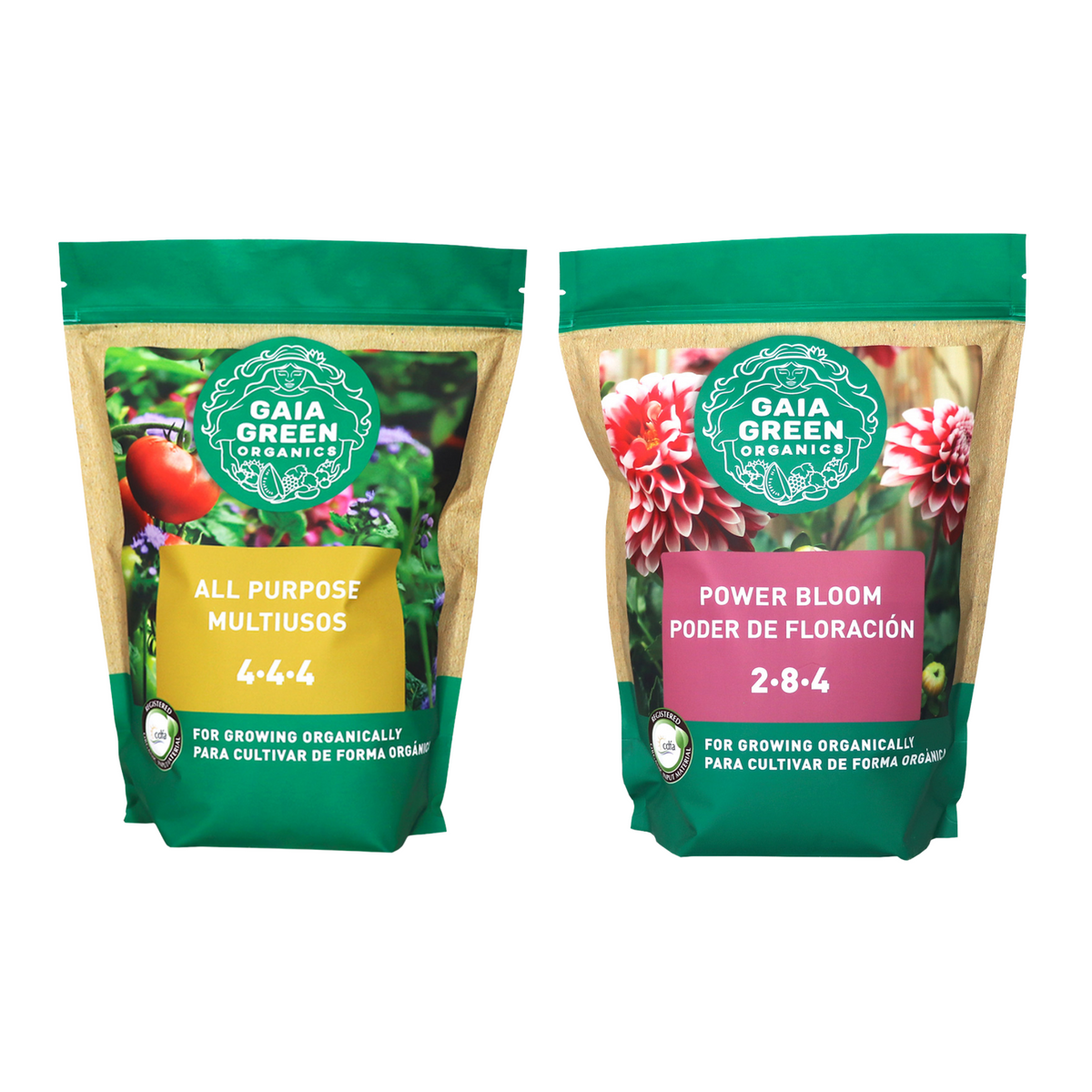
Power Bloom 2-8-4 Doubles Your Phosphate, Halves Your Nitrogen, and Does Nothing for Potassium
The bloom bag changes two of the three numbers on the label. The one it leaves alone is the one flowering plants actually want more of.
Your plants set their first flowers and the internet tells you to switch to a bloom fertilizer. So you buy the bag with the big middle number, you stop using the one you were using, and you top dress the same way you always did. That switch feels like an upgrade because the phosphate figure jumped from 4 to 8. Most of what actually happened is invisible on the front of the bag.
Gaia Green publishes a guaranteed analysis and an application rate for every product it sells, and both of those numbers matter equally. Put the All Purpose 4-4-4 label next to the Power Bloom 2-8-4 label and read the rates as carefully as the ratios, and the picture changes. In a container, swapping one for the other doubles the phosphate you apply, cuts the nitrogen in half, and moves potassium not at all. In a garden bed the same swap actually delivers about a fifth less potash than the all purpose blend did, because the two labels permit different application weights. That is the opposite of what most growers think a bloom feed does.
The short answer
- Do not swap, stack. Top dressing 1 tbsp per gallon of All Purpose 4-4-4 alongside 1 tbsp per gallon of Power Bloom 2-8-4 lands you at an effective 3-6-4 and doubles the total potash reaching the pot. Running Power Bloom alone leaves potash exactly where All Purpose had it.
- Skip the 500 g bag. Power Bloom at $12.95 for 1.1 lb works out to $11.77 per pound. The same product in the 10 kg bag at $54.95 is $2.50 per pound. The small bag is a sample, not a season.
- The All Purpose and Power Bloom bundle is the honest starting kit for a container grower, because the two products are designed to be read against each other and neither one is a complete flowering feed on its own.
- Ignore the ratio when comparing across brands. Two dry amendments labeled 2-8-4 and 2-8-6 can differ by a factor of two to three in how much product their own labels tell you to apply. The rate is the number that decides how much nutrient your plant sees.
What the two labels actually say
Everything below comes from Gaia Green's published guaranteed analysis and application instructions for the powdered versions of both products, which are the ones sold in 500 g, 2 kg, 10 kg and 20 kg bags.

| Specification | All Purpose 4-4-4 | Power Bloom 2-8-4 |
|---|---|---|
| Total nitrogen (N) | 4.0% | 2.0% |
| Water soluble N | 3.0% | 0.5% |
| Water insoluble N | 1.0% | 1.5% |
| Available phosphate (P2O5) | 4.0% | 8.0% |
| Soluble potash (K2O) | 4.0% | 4.0% |
| Pre-mix rate | 45 ml per 4 L 3 tbsp per gallon |
45 ml per 4 L 3 tbsp per gallon |
| Top dress rate | 15 ml per 4 L 1 tbsp per gallon, monthly |
15 ml per 4 L 1 tbsp per gallon, monthly |
| Garden rate, single application | 1.8 kg per 10 m² 18.4 lb per 500 ft² |
1.4 kg per 10 m² 28.5 lb per 1000 ft² |
| Garden annual maximum | 7.2 kg per 10 m² | 5.6 kg per 10 m² |
| Ingredients | Fishbone meal, feather meal, alfalfa meal, phosphate rock, sulfate of potash, insect frass, soy protein hydrolysate, gypsum, seaweed meal, oyster shell, greensand | Phosphate rock, fishbone meal, sulfate of potash, insect frass, soy protein hydrolysate, seaweed meal, gypsum, greensand |
| Organic approval | Ecocert Canada, CAN/CGSB 32.310-2015 and 32.311-2015 | Ecocert Canada, CAN/CGSB 32.310-2015 and 32.311-2015 |
Three rows on that table are worth more than the rest. The potash rows are identical. The container rates are identical. And the nitrogen in Power Bloom is mostly water insoluble, 1.5 of its 2.0 percent, while the nitrogen in All Purpose is mostly water soluble, 3.0 of its 4.0 percent. So the bloom product does not just carry less nitrogen, it carries nitrogen in a slower form. Between the two effects, the drop in plant available nitrogen when you swap is steeper than the label ratio of 4 to 2 suggests.
In a container, the switch does not touch potassium
Take a 5 gallon fabric pot on a monthly top dress. At Gaia Green's rate of 1 tablespoon per gallon of soil, that is 5 tablespoons of product per pot per month, whichever bag you reach for, because both labels give the same rate.
| Monthly top dress, 5 gallon pot | Volume applied | Relative N | Relative P2O5 | Relative K2O |
|---|---|---|---|---|
| All Purpose 4-4-4 alone | 5 tbsp | 1.0x | 1.0x | 1.0x |
| Power Bloom 2-8-4 alone | 5 tbsp | 0.5x | 2.0x | 1.0x |
| Both together, 1 tbsp per gallon each | 10 tbsp | 1.5x | 3.0x | 2.0x |
Read the third column of the middle row. Switching to the bloom product cuts your applied nitrogen in half. Read the last column of that same row. Potassium does not move, at all, because both products are 4 percent potash and both are applied at the same volume. If your reason for switching was that flowering plants want more potassium, the switch did not do it.
The bottom row is the version that does. Running both at 1 tablespoon per gallon each puts 10 tablespoons of product in the pot at a blended 3-6-4, which is 1.5 times the nitrogen of All Purpose alone, three times the phosphate, and twice the potash. It costs you a second bag and about thirty seconds of scratching amendment into the surface. It is also the only configuration in this product line that raises potassium at all.
The label numbers are oxides, not elements. The middle and last figures on any North American fertilizer label are reported as phosphate (P2O5) and potash (K2O), not as phosphorus and potassium. Multiply the phosphate figure by 0.436 for actual phosphorus and the potash figure by 0.830 for actual potassium.
So Power Bloom's 8 percent phosphate is 3.5 percent elemental phosphorus, and its 4 percent potash is 3.3 percent elemental potassium. Those two are far closer together than 8 and 4 make them look, which is worth knowing before you decide the bag is phosphorus heavy.
In a garden bed, the switch cuts potash by about a fifth
Beds behave differently from containers because the two labels do not permit the same application weight. Gaia Green allows up to 18.4 lb of All Purpose per 500 ft² in a single application, which is 36.8 lb per 1000 ft². Power Bloom is capped lower, at 28.5 lb per 1000 ft². Work the analysis against those weights and the swap looks like this.
| Single application per 1000 ft² | Product applied | N delivered | P2O5 delivered | K2O delivered |
|---|---|---|---|---|
| All Purpose 4-4-4 | 36.8 lb | 1.47 lb | 1.47 lb | 1.47 lb |
| Power Bloom 2-8-4 | 28.5 lb | 0.57 lb | 2.28 lb | 1.14 lb |
| Change on switching | 22% less | 61% less | 55% more | 22% less |
A 55 percent bump in phosphate is a real increase, and it is smaller than the doubled label number implies. The nitrogen cut of 61 percent is larger than the halved label number implies. And potassium goes backwards. For an outdoor grower switching a whole bed to the bloom product at the start of flowering, that is three surprises in one application, none of which are visible from the front of the bag.
The annual caps carry the same asymmetry. All Purpose is cleared for up to 7.2 kg per 10 m² across a season, Power Bloom for 5.6 kg. If you are planning a season of feeding rather than a single dressing, the all purpose blend gives you more total room to work with.
The dose rate matters more than the ratio, and nothing on the bag tells you that
Here is the comparison that breaks the habit of shopping by NPK. Gaia Green Power Bloom is 2-8-4. KiS Organics Bloom Booster is 2-8-6. Those labels look like near twins, two percent nitrogen and eight percent phosphate in both cases, with a small potassium edge to KiS. Now read what each manufacturer tells you to apply.
| Dry bloom amendment | Gaia Green Power Bloom 2-8-4 | KiS Organics Bloom Booster 2-8-6 |
|---|---|---|
| Total nitrogen | 2.0% | 2% |
| Available phosphate | 8.0% | 8% |
| Soluble potash | 4.0% | 6% |
| Calcium in guaranteed analysis | Not listed | 9% |
| Rate, 5 gallon pot | 5 tbsp | 1/2 cup, or 8 tbsp |
| Frequency | Monthly | Every 2 to 3 weeks |
| Applied per 5 gallon pot per month | 5 tbsp | 11 to 16 tbsp |
| Ingredients | Phosphate rock, fishbone meal, sulfate of potash, insect frass, soy protein hydrolysate, seaweed meal, gypsum, greensand | Alfalfa meal, fish bone meal, potassium sulfate, insect frass, gypsum, wollastonite |
Two products whose analyses sit within two points of each other call for volumes of material that differ by a factor of two to three. Per month, in the same 5 gallon pot, following each label as written, the KiS product puts roughly two to three times as much phosphate into the soil as the Gaia Green product does. The ratio on the front of the bag did not predict that, and no amount of staring at 2-8-4 against 2-8-6 would have revealed it.
That is the practical lesson for anyone comparing bloom fertilizers. The analysis tells you the composition of the powder. The rate tells you how much powder. Only the two together tell you what the plant gets, and manufacturers set their rates independently, against different assumptions about soil, container size and how often a grower will actually get around to top dressing.
Neither rate is wrong. Gaia Green's line is built around frequent light top dressing on a soil that is already amended, with a heavier 3 tablespoon per gallon charge worked in at mix time. The KiS approach front loads a larger charge and repeats it less often. If you follow one label using the other's mental model, you either starve the pot or overload it.
Never carry a rate across brands. The most expensive mistake with dry amendments is applying a new product at the volume and frequency you learned on an old one. Half a cup in a 5 gallon pot every two weeks is a normal dose by the KiS label. Run that same half cup schedule with a product whose own label says 1 tablespoon per gallon monthly, and you are putting down roughly three times the amendment it was designed for. Dry amendments cannot be flushed out of a pot the way an overdosed liquid feed can.
Where the high phosphorus premise gets weak
Bloom fertilizers exist because of a widely held belief that flowering plants need a large surplus of phosphorus and that supplying it produces more and bigger flowers. The horticultural literature is much less enthusiastic about that idea than the fertilizer aisle is.
Linda Chalker-Scott, extension horticulturist at Washington State University, reviewed the phosphate research and found that where nitrogen addition reliably restores shoot growth in a depleted soil, "phosphate addition, on the other hand, often has no apparent effect." The same review documents two costs to piling phosphorus on soil that already has enough. High phosphorus levels "will compete with iron and manganese uptake by roots," which shows up as interveinal yellowing on new growth and gets misdiagnosed as a nitrogen problem. And "high levels of phosphorus are detrimental to mycorrhizal health and lower the rate of mycorrhizal infection of root systems," which matters a great deal if you are running a living soil whose whole premise is that fungal networks do your nutrient transport for you.
None of that makes a bloom amendment useless. Container soil genuinely does run down over a long flowering period, phosphate is one of the things that runs down, and a top dress that replaces it is sensible. What the research argues against is the reflex of treating more phosphorus as automatically better, and of judging a bloom product by how large its middle number is.
It also sharpens the potassium point. Potassium is the nutrient whose demand climbs most clearly through flowering, it moves readily in soil solution, and it is the one figure that stays flat across the entire Gaia Green swap. If you are going to add something for flowering, adding something that raises potassium is better supported than adding more phosphate on top of a soil that is already phosphate rich.
What these guaranteed analyses do not cover
A guaranteed analysis is a legal minimum, not a full composition. Gaia Green guarantees three figures on both of these products: total nitrogen with its soluble and insoluble split, available phosphate, and soluble potash. Calcium, sulfur, magnesium and micronutrients are not guaranteed on either label, even though the ingredient lists include gypsum, which is calcium sulfate, and seaweed meal, which carries a broad micronutrient load. Those inputs are in the bag. Their quantities are simply not measured and published.
That is why the calcium row in the head to head table above reads "not listed" for Gaia Green and 9 percent for KiS. It does not mean the Gaia Green product has no calcium. It means only one of the two manufacturers measures and guarantees it, so calcium is not a dimension the two can honestly be compared on. Anywhere a spec is unguaranteed, the right move is to treat it as unknown rather than as zero or as equivalent.
The same caution applies to Gaia Green's Living Soil, which is a useful base for this feeding approach. Its guaranteed analysis lists total nitrogen at 1.0 percent, magnesium at 0.5 percent and iron at 0.3 percent. It does not guarantee phosphate or potash at all, despite being pre-charged with rock phosphate, fishbone meal, mineralized phosphate and potassium sulfate. You cannot read that bag and conclude your flowering nutrition is already handled, because the label was never designed to tell you that.
Both products carry Ecocert Canada approval for use in organic agriculture under Canada's Organic Production Systems standards, CAN/CGSB 32.310-2015 and CAN/CGSB 32.311-2015. If you are growing under a United States organic certification, confirm accepted input status with your own certifier before a season's inputs are locked in, since certifiers differ on which foreign approvals they recognize.
How to actually feed a flowering container
Working entirely from the published rates, here is what a season looks like in a 5 gallon pot of amended soil.
At mix time
Work 3 tablespoons per gallon of All Purpose 4-4-4 into the medium, which is 15 tablespoons, a little under a cup, for a 5 gallon pot. This is the charge that carries the plant through early growth, and it is four times the strength of a monthly top dress for a reason: it is mixed through the full soil volume rather than sitting on the surface.
Through vegetative growth
Top dress 1 tablespoon per gallon of All Purpose monthly, scratched lightly into the top inch and watered in. Nothing about the bloom product belongs here. Its nitrogen is too low and too slow to support leaf and stem expansion.
From the first flowers onward
Add Power Bloom at 1 tablespoon per gallon and keep the All Purpose at 1 tablespoon per gallon. Together that is 10 tablespoons per 5 gallon pot per month at an effective 3-6-4. You have raised phosphate substantially, raised potassium for the first time, and kept enough nitrogen in the system that leaves stay working instead of yellowing out early.
If you drop the All Purpose anyway
Some growers want the nitrogen down hard late in flowering, and running Power Bloom alone is a legitimate way to do that. Do it knowing what it costs. You are at half the nitrogen, unchanged potassium, and you should expect lower leaves to fade sooner. That fade is the switch working as designed, not a deficiency to chase with a corrective feed.
Recommended setup
Run both bags, and size them to your garden
- A handful of 5 to 10 gallon containers: the smaller bags are enough, and the bundle pairs the two products in matched sizes
- A tent of ten or more pots, or raised beds: the 10 kg bags cut the cost per pound by about 60 percent against the 2 kg size
- Anyone who wants the potassium higher than 4 percent without adding a second brand: increase total applied volume by running both bags rather than searching for a higher potash ratio inside this line
Gear for this job
Gaia Green
Power Bloom Fertilizer 2-8-4
From $12.95
Gaia Green
Organic All Purpose Fertilizer 4-4-4
From $54.95
Gaia Green
Worm Castings
From $17.95
KiS Organics
Large Bloom Booster 2-8-6
$124.95
KiS Organics
Original Water Only Soil Mix
$62.44
Grassroots
Living Soil Fabric Pots
From $5.55
The takeaway
- Swapping All Purpose for Power Bloom gains you phosphate and costs you nitrogen, and leaves potassium untouched in a container and 22 percent lower in a bed. If potassium was the reason you switched, the switch did not deliver it.
- Running both at 1 tablespoon per gallon is the only configuration in this line that raises potassium. It lands at an effective 3-6-4 and doubles total potash over either bag alone.
- Compare dry amendments on rate times analysis, never on the ratio alone. Two bloom products two points apart on the label can differ two to three fold in how much material their own instructions call for.
Not sure how your soil is already amended? Call us at 716-217-0353, 10am to 4pm EST Monday to Friday, and we will work it out with you before you order.
Sources
- GAIA GREEN Organics, published guaranteed analysis, ingredient statements and application instructions for All Purpose 4-4-4, Power Bloom 2-8-4 and Living Soil.
- KiS Organics, published guaranteed analysis, ingredient list and application rate for Bloom Booster 2-8-6.
- Linda Chalker-Scott, PhD, Extension Horticulturist and Associate Professor, Washington State University Puyallup Research and Extension Center, The Myth of Phosphate Fertilizer.
- Canadian General Standards Board, Organic Production Systems standards CAN/CGSB 32.310-2015 and CAN/CGSB 32.311-2015, cited by Ecocert Canada in both product approvals.
Related reads
Questions? We're easy to reach.
Happy Hydro has been serving growers since 2006. Call or email us before you order, after you order, or any time something comes up. When you're happy, we're happy.