
Soil Biology
Leave the Molasses Out of Your Compost Tea and You Can Use It on Food Crops Without Waiting
The sugar that nearly every recipe tells you to add is the one ingredient that puts the finished tea under a pre-harvest restriction, and the published evidence that it helps is thinner than most growers expect.
You have a five gallon bucket, a bag of finished compost or worm castings, and a recipe you found somewhere that says one cup of compost, a tablespoon of molasses, twenty four hours on an air pump. Underneath that recipe is a much simpler question: what goes in the bucket, how long do I run it, and can I pour the result on the tomatoes I plan to eat next week.
The answers change depending on which version of compost tea you make, and the split is not between good compost and bad compost. It is between tea you feed and tea you do not. That one decision changes the brew time, changes the risk, and changes whether the finished tea can legally go on a food crop the same day you make it under organic certification rules. Most recipes online tell you to feed it and never mention the second half.
The short version
- Brewing for vegetables, herbs or fruit: compost or castings and water only. No molasses, no kelp, no fish. One part compost to ten or twenty parts water, eighteen to twenty four hours on air, applied the same day.
- Brewing for ornamentals, lawn or anything you will not eat: feed it if you want to. The pre-harvest restriction does not apply to non-food crops.
- You want soil biology without a bucket: a dry inoculant such as Real Growers Recharge mixes at half a teaspoon per gallon and pours straight away, with nothing to brew and nothing to time.
- You want the simplest possible version: top dress with worm castings and water them in. No extraction step at all.
Compost tea is an extraction, not a fermentation
The National Organic Standards Board defines compost tea as "a water extract of compost produced to transfer microbial biomass, fine particulate organic matter, and soluble chemical components into an aqueous phase, intending to maintain or increase the living, beneficial microorganisms extracted from the compost." That wording matters more than it looks. You are not making anything new in the bucket. You are pulling what already lives in the compost into water so it can be poured or sprayed.
That framing kills a lot of bad advice immediately. If the compost you start with is thin, old, or was never finished properly, no amount of bubbling improves it. Tea is a delivery method for the biology in the pile, and the pile is the product. It is the same reason a grower running a well built living soil in fabric pots gets less out of tea than someone trying to rescue a sterile substrate: there is already biology in the container.
Two versions exist and they are genuinely different processes. Non-aerated compost tea is compost sitting in water, stirred occasionally, extracting slowly over days. Aerated compost tea runs an air pump and an air stone in the bucket for a much shorter window, usually overnight. Growers use the terms loosely, which is why two people can follow "a compost tea recipe" and end up with brews that took three days and eighteen hours respectively.
The two recipes, side by side
Here are the working numbers from the literature rather than from forum lore. Ratios are compost to water by volume.
| Non-aerated | Aerated | |
|---|---|---|
| Compost to water | 1:3 to 1:10 | 1:10 to 1:20 optimal, commercial brewers run 1:10 to 1:50 |
| Extraction time | 3 to 7 days typical, 8 to 16 days in the reviewed optimum | 12 to 24 hours, with 18 to 24 hours cited as the optimum |
| Temperature | 15 to 20 C, about 59 to 68 F | Ambient room temperature |
| Equipment | Bucket, stirring stick, cheesecloth to strain | Bucket, air pump, air stone, mesh bag, cheesecloth to strain |
| Attention required | A stir a day for a week | One overnight run, then immediate use |
One number from the research handbook is worth keeping in your head when you are tempted to make the brew stronger. Benefits fall off in a roughly linear fashion as the solution gets more dilute, but some measurable effect still shows at dilutions as low as 1:100. In practical terms, going from 1:20 to 1:10 does not double anything, and a bucket packed with compost mostly makes the strainer harder to clean.
The molasses is the restriction
This is the part that almost never makes it into a recipe post, and it is the single most useful thing on this page if you grow food.
The National Organic Standards Board recommendation that governs compost tea in organic production draws a hard line around what it calls compost tea additives: molasses, yeast extract, fish based products, kelp, and green plant tissue. Tea brewed with none of those may be applied to food crops without restriction. Tea brewed with any of them may be applied without restriction only if the brewing system has been pre-tested, with at least two batches tested and an annual re-test after that, and only if the tea meets EPA recreational water quality guidelines: Escherichia coli at 126 CFU per 100 ml or enterococci at 33 CFU per 100 ml.
If you add molasses and you have not tested, the recommendation restricts use on food crops to the 90/120 day pre-harvest interval, the same waiting period applied to raw manure. That is 90 days before harvest where the edible portion does not contact the soil, and 120 days where it does. Crops not intended for human consumption, ornamentals and grain crops are exempt from both the testing and the interval.
Almost nobody brewing in a garage is running plate counts on two batches a year. So for a home grower, the real choice is not "should I add molasses to make it stronger." It is "do I want to add molasses and then wait three months to harvest, or leave it out and use the tea tonight."
The sugar does not create pathogens. It feeds whatever was already in the compost. Reviews of the compost tea literature found that where residual pathogens were present in the starting compost, added nutrient supplements supported the growth of E. coli and Salmonella, and that pathogen concentrations ran consistently higher in aerated tea with nutrients than in non-aerated preparations without them.
If you are brewing for a vegetable bed, the fix costs nothing: leave the sugar out. Molasses still has a place as a soil feed poured on its own, where it is not being incubated on a warm bubbler for a day first.
The aerated version has the thinnest evidence behind it
Aerated tea is the version people build equipment for, and it is the version with the least published support. The Washington State University extension review of the topic counted more than a dozen peer reviewed articles examining non-aerated compost extracts, with mixed results and some documented success against specific pathogens in German work from the 1980s that has apparently not been repeated elsewhere. For aerated compost tea, the review found only two controlled, published studies. One reported that aerating non-aerated teas decreased their efficacy in controlling pathogens. The second found aerated tea was not effective at preventing apple scab and in some cases appeared to enhance it. The review's own 2001 trial on cherry blossom brown rot found compost tea not significantly different from a plain water application.
Read that carefully, because it is narrower than "compost tea does not work." Those studies measured disease suppression, foliar pathogen control specifically. They are not a verdict on soil biology, root colonization, or nutrient cycling, and the same body of work credits composted mulch with documented disease suppression through several mechanisms. What the research does not support is buying an air pump because you expect a fungicide out of it.
The honest summary: brew tea because you want to move biology and soluble organic matter from a pile into a watering can. Do not brew it expecting it to replace a spray program.
The four hour window nobody plans for
Finished tea does not keep. The convention across the handbooks is to use it within four hours of the brew finishing. Research at Ohio State found that refrigeration can extend efficacy for up to fourteen days, which is useful to know and impractical for most people, since it means dedicating fridge space to five gallons of brown water. The reviews are consistent that the effects of compost tea are short lived and that repeat applications are required.
Plan the application before you start the brew, not after. An eighteen hour aerated brew started at 8pm is ready at 2pm the next day, which needs to be a day you are home, the beds are already watered in, and you have time to strain five gallons. Tea that sat on the counter until the following evening is not the tea you made.
Water quality matters at the front of the process too. Chlorinated tap water run straight into the bucket works against the thing you are trying to extract, which is why most brewing instructions call for letting tap water sit out or filtering it first. If you have not looked at what comes out of your tap, water quality affects a lot more than tea.
What a dry inoculant does differently
A shelf stable microbial powder solves a different version of the same problem. Instead of extracting living organisms from a pile and racing a four hour clock, you are rehydrating a known set of organisms at a known count and pouring immediately.

The label on Real Growers Recharge lists Bacillus subtilis and Bacillus megaterium at 100,000,000 CFU per gram each, plus four endomycorrhizal Glomus species, aggregatum, mosseae, intraradices and etunicatum, at 6.4 propagules per gram each. The non-microbial portion is kelp at 12 percent, molasses at 6 percent and leonardite derived humic acid at 5 percent. The rate is half a teaspoon per gallon of water, applied weekly through the growing cycle from first roots through flowering.
Two things worth saying plainly about that. First, yes, there is molasses in it, as microbe food, the same job it does in a brew. The difference is dose and dwell: six percent of a half teaspoon in a gallon of water that gets poured within minutes is not a tablespoon of straight molasses incubating on an air stone overnight. Second, the mycorrhizal counts are per gram of product, and endomycorrhizae need physical contact with a root to colonize. A surface drench on an established plant does less for colonization than the same product worked into the root zone at transplant. If mycorrhizae are the reason you are buying, apply at planting.
Where this lands
Real Growers Recharge
- Growers who want soil biology on a weekly schedule without brewing or timing anything
- Anyone running coco or another inert substrate with no resident biology to extract
- Food growers who would rather not test two batches a year to satisfy an additive rule
- Transplant day, where mycorrhizal contact with new roots actually happens
16 oz, $57.97 · 5 lb, $229.98 · 25 lb, $1,030.98 · half a teaspoon per gallon, weekly
Brewed tea against mix and pour, head to head
These two genuinely compete for the same job on the same watering day, which is the only reason a table like this is worth reading.
| Aerated compost tea | Dry microbial inoculant | |
|---|---|---|
| Lead time | 18 to 24 hours before you can apply | Under a minute |
| Usable window | About 4 hours, up to 14 days refrigerated | Mix what you need, store the rest dry |
| Known organism counts | Unknown, depends entirely on the source compost | Printed on the label |
| Food crop restriction | None without additives; 90/120 day interval with untested additives | Follow the product label |
| Up front cost | Air pump, air stone, bucket, mesh bag | None beyond the product |
| Ongoing cost | Compost or castings, plus pump power | Cost per application from the container size |
| Main failure mode | Poor source compost, sugar fed brew, missed application window | Surface drench when the plant needed root contact |
The running cost is not the interesting number
People assume the air pump is the expensive part of brewing. It is not, and the arithmetic is quick enough to do with your own rate. A 6 watt, four outlet air pump running a 24 hour brew uses 6 x 24 / 1000, which is 0.144 kWh. At 17 cents per kWh that is about two and a half cents of electricity per brew. Substitute your own rate and the answer stays trivial.
The real cost of brewing is the lead time and the window. Twenty four hours of notice, a strainer to clean, and a four hour slot where you have to be home. For growers with a fixed watering day that is genuinely fine. For growers who water when they get to it, that constraint is the reason half finished brewing setups end up in the corner of the garage. Pick the method that survives contact with your actual schedule, not the one that reads best.
Gear for this job
Real Growers
Recharge Soil Microbe Pack, 16 oz
$57.97
Gaia Green
Worm Castings, 2 L
$17.95
Elite
Worm Castings, 4 lb
$18.00
Earthshine
Biochar, 2 lb
$20.52
Active Aqua
Air Pump, 4 Outlets, 6 W
$43.95
Active Aqua
4 Inch Round Air Stone
$8.18
KIS Organics
Biochar Water Only Soil Mix
$66.44
Pride Lands
Worm Castings, 4 lb
$15.99
How to actually brew it, start to finish
If you have read this far and still want to brew, here is the version that holds up.
Non-aerated, the low effort route
Fill a watering can or bucket roughly half with finished compost or castings and half with water, which lands you inside the 1:3 to 1:10 band. Stir once. Leave it somewhere between 59 and 68 F, out of direct sun. Give it three to seven days, stirring when you walk past. Strain through cheesecloth before it goes anywhere near a sprayer or a dripper. Apply as a soil drench.
Aerated, the overnight route
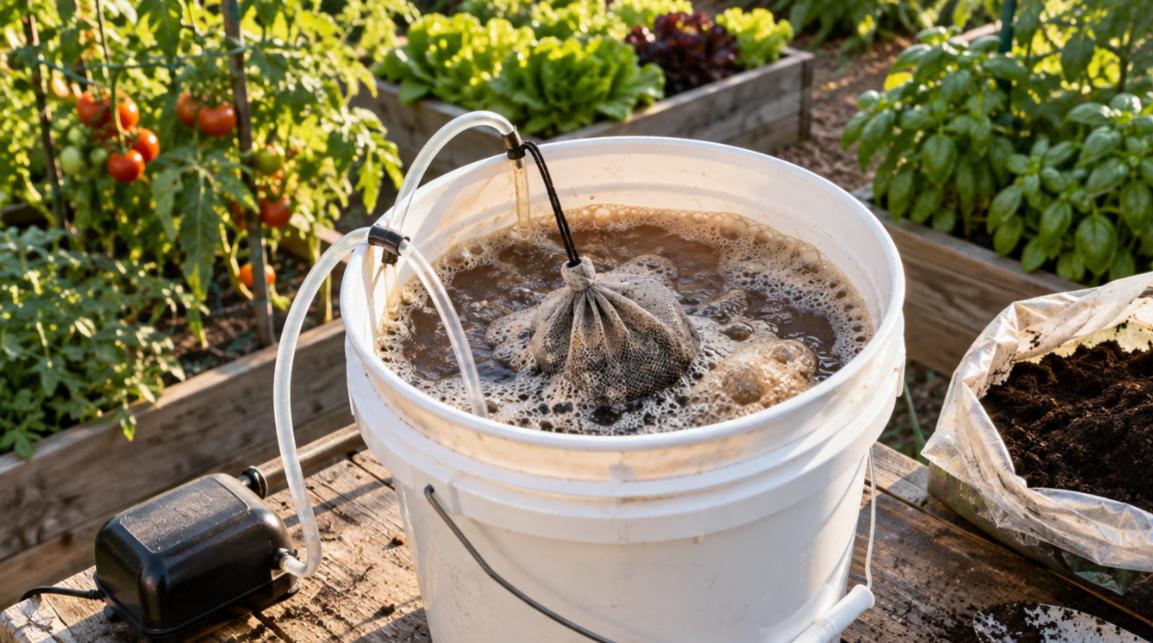
Put your compost in a mesh bag so you are not straining sludge later, at roughly one part compost to ten or twenty parts water. Drop the air stone in the bottom of the bucket, under the bag, not beside it. Run the pump eighteen to twenty four hours at room temperature. Leave the additives out if this is going on food. Strain and apply the same day, ideally within four hours of pulling the pump.
Either way
Water the beds or containers before you apply, so the tea moves into moist media instead of running off dry soil. Apply as a drench rather than a foliar spray if food crops are involved, which keeps the question of surface residue off the table entirely. Clean the bucket, the stone and the bag when you are done: dried organic film on an air stone chokes the airflow on the next run, and a sour smelling bucket is the fastest way to ruin a brew before it starts.
The takeaway
- Brewing for food, leave the sugar out. Compost and water only keeps the tea free of the 90/120 day pre-harvest interval, and the sugar was never the part doing the work.
- Aerated tea is an extraction method, not a spray program. Only two controlled published studies exist on it, and neither supports buying a pump to control disease.
- If the goal is soil biology rather than the ritual, a labeled inoculant gets there in a minute with counts printed on the bag and no four hour window to hit.
Not sure which way to go for your setup? Call us at 716-217-0353, 10am to 4pm EST Monday to Friday.
Sources
- National Organic Standards Board, formal recommendation on the use of compost, vermicompost and compost tea, USDA Agricultural Marketing Service, for the additive definition, the EPA recreational water quality thresholds and the 90/120 day interval.
- Sustainable Agriculture Research and Education, compost tea handbook, for brewing ratios, brew times, the dilution response and the four hour convention.
- Washington State University Extension, Linda Chalker-Scott, extension review of compost tea research, for the count of controlled studies and the disease suppression findings.
- San Francisco Department of the Environment, compost tea literature review, for the aerated and non-aerated ratio and brew time ranges and the pathogen growth findings with nutrient supplements.
- Maine Organic Farmers and Gardeners Association, compost tea resource, for the non-aerated ratio, temperature range and straining method.
- Real Growers, published Recharge label panel, for species, CFU counts, percentages and application rate.
Related reads
Questions? We're easy to reach.
Happy Hydro has been serving growers since 2006. Call or email us before you order, after you order, or any time something comes up. When you're happy, we're happy.