
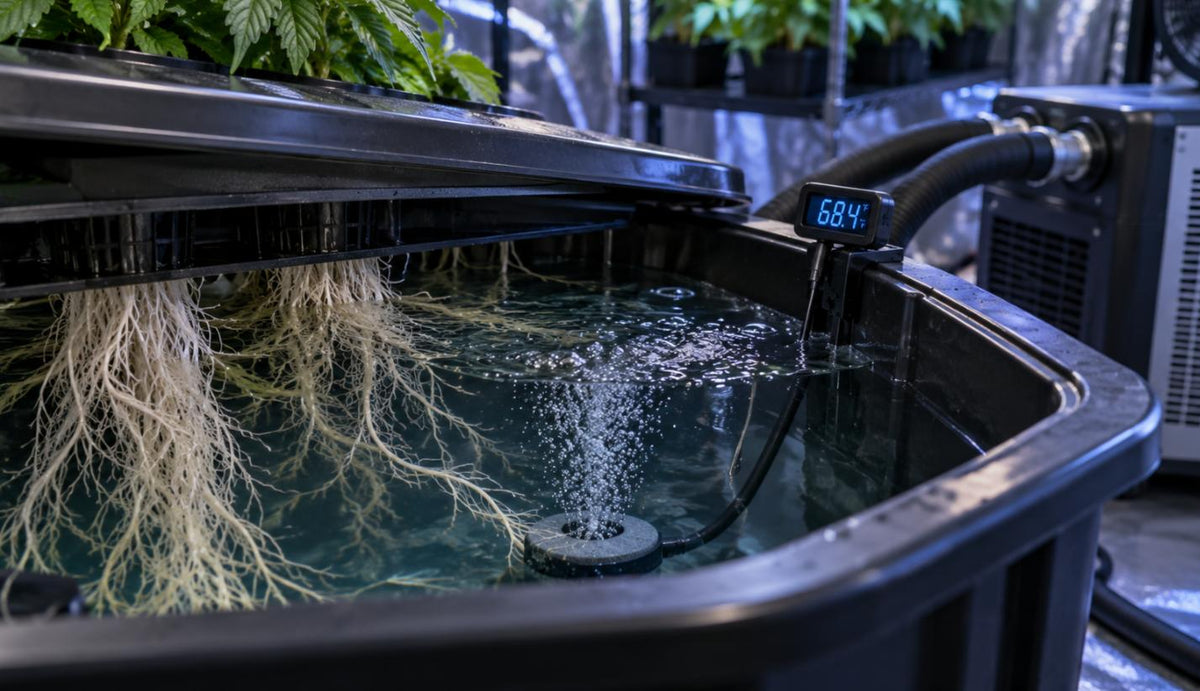
Why Reservoir Water Temperature Matters More Than You Think
Most growers dial in pH and EC and stop there. Water temperature controls how much oxygen your roots actually get, and it does it quietly, with no color change and no smell, until the plant is already stressed. A reservoir sitting in the mid 70s Fahrenheit holds meaningfully less dissolved oxygen than one sitting at 65, and that gap shows up as slower growth, weaker roots, and a much higher chance of root rot. It is one of the easiest numbers to ignore and one of the most expensive to get wrong.
Warm water holds less oxygen. That's the whole problem.
Water's ability to hold dissolved oxygen drops as it warms up. That is basic chemistry, not something specific to growing, and it means every degree your reservoir climbs works against your roots. In deep water culture, RDWC, and any system where roots sit directly in the nutrient solution, that dissolved oxygen is what keeps them from suffocating. Warm, low oxygen water also favors Pythium and other root rot pathogens, so a hot reservoir is doing two things wrong at the same time: starving the roots of oxygen and creating the exact conditions those pathogens need to take hold. Colorado State University's extension service lists low dissolved oxygen and warm root zone temperature as two of the main conditions that favor root disease in hydroponic systems.
The range that actually works: 65°F to 72°F
Most hydroponic crops do best with reservoir temperatures in the 65°F to 72°F range. Below 60°F, root metabolism slows down enough that plants stop taking up nutrients at a normal rate, even when EC and pH are dialed in correctly. Above the mid 70s, dissolved oxygen drops fast and root rot risk climbs right along with it. Consistency matters almost as much as hitting an exact number. A reservoir that swings from 68°F overnight to 82°F under a full day of lights is harder on roots than one that just holds steady at 70°F.
This is not a minor detail. A 2025 study on deep water culture spinach found that cooling the root zone during hot conditions produced measurably better shoot growth than leaving reservoir temperature to track the room, with the effect getting stronger the hotter the air temperature ran. (Full study.)
How to tell your reservoir is already out of range
- Roots turning brown or slimy
- Wilting under full light despite adequate water and nutrients
- Sour or rotten smell from the reservoir
- pH swinging with no obvious cause
- Pale leaves and stalled growth despite correct EC and pH
- EC readings that stay high because roots aren't pulling nutrients out of solution
- Slow, stringy root development in young plants
Both sets of symptoms overlap with nutrient and pH problems, which is exactly why reservoir temperature gets missed. If your EC and pH are correct and you're still seeing these signs, check the water temperature before you change anything else. Purdue's extension fact sheet on Pythium root rot describes the same brown, dead root tips and midday wilting as early warning signs in soft-rooted crops.
Getting your reservoir back into range
If your reservoir runs a few degrees warm, moving it out of direct light, insulating the tote or tank, and keeping the lid sealed all cut down on heat gain. Frozen water bottles work as a short term fix for one hot week, but they add water volume and dilute your nutrient concentration, so they're not a real long term plan. For a room that consistently runs warm, whether from lights, pumps, or just a hot house in July, a dedicated water chiller is the only way to hold a steady number without babysitting it every day.
Active Aqua Water Chiller with Power Boost
We stock this chiller in four sizes: 1/10 HP, 1/4 HP, 1/2 HP, and 1 HP, so there's a match for a single tent reservoir up through a larger recirculating system. Each size uses a titanium evaporator, which resists corrosion from nutrient salts far better than standard materials, and the Power Boost setting temporarily raises cooling output when you need to bring a warm reservoir down fast. A built in digital thermostat lets you set and hold a target number instead of guessing.
Shop Active Aqua Water ChillersSize it exactly, not by feel
The formula matters less than getting the real number for your setup. Answer a few questions below and this tool estimates your cooling load in BTU per hour, plus the chiller class that typically covers it.
How big a chiller does your reservoir actually need?
Answer five questions about your setup and get an estimated cooling load in BTU per hour, plus the chiller class that typically covers it.
Includes 20% headroom
A chiller isn't sized off gallons alone. It has to remove heat as fast as heat gets added. Four things add heat to a reservoir, and they stack.
Most crops tolerate up to 72 to 74°F without issue. If your reservoir consistently runs hotter than that, or you're seeing slow growth and root problems you can't otherwise explain, a chiller is worth adding.
Not really. An oversized chiller short-cycles, turning on and off more than it should, which wears the compressor faster and doesn't hold temperature any tighter. Matching the load is the goal, not maxing it out.
Yes. Growers in cold rooms or with wide day and night swings often run both on a dual-stage controller so the reservoir holds a tight range in either direction.
Yes, noticeably. In the estimate above, insulation cuts the ambient heat gain roughly in half, which is often enough to drop you a full chiller size and save real money up front.
Call us with your gallons, temps, and equipment list. We'll compare it against what's actually in stock and tell you straight which one fits, instead of guessing on a borderline case.
Check it. Don't assume it.
A chiller that's running doesn't guarantee your number is where you think it is. Check reservoir temperature with a real thermometer, not by feel, and check it during both lights on and lights off, since the two periods behave differently. If you're already testing pH and EC on a schedule, add temperature to that same check. It takes five seconds and it's the difference between catching a problem early and finding out about it once your roots already show it.
Keep your reservoir between 65°F and 72°F. Warm water starves roots of oxygen and invites root rot. Cold water slows nutrient uptake. If your grow room runs warm, a properly sized Active Aqua Water Chiller holds the number steady so you're not managing it by hand every day.