
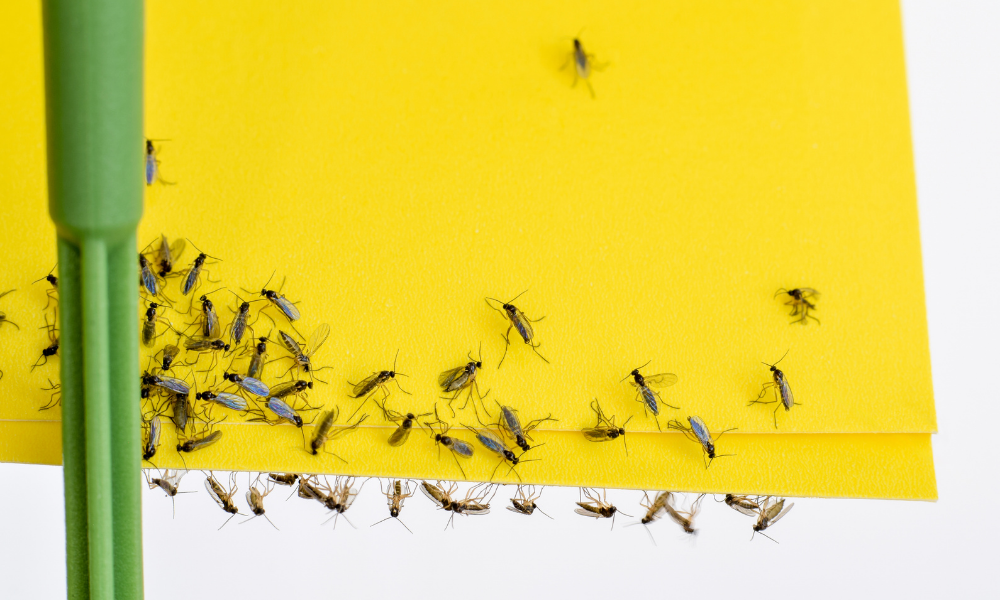
You notice tiny dark flies hovering just above your soil. Maybe one or two at first, barely worth mentioning. A week later there are dozens, and your plants are starting to look off. They seem generally unhappy and that doesn't match your feeding schedule.
That's fungus gnats doing cannabis damage. And while the adults are mostly just annoying, the larvae are chewing through your root system underground, sucking away their botanical lifeforce.
This guide covers how to identify fungus gnats on weed plants and what the damage actually looks like. With an accurate ID, it also covers how to get rid of fungus gnats cannabis using beneficial insects, and how to set up a preventive program that stops them before they start (no hydrogen peroxide required).
What Are Fungus Gnats?
Fungus gnats (Bradysia spp.) are small, dark flies that look a bit like tiny mosquitoes. They're one of the most common soil pests in indoor grows, greenhouse environments, and outdoor container gardens. They thrive in moist, organically rich growing media which describes just about every cannabis soil setup.
The adult flies are mostly a nuisance. They don't bite, they don't directly feed on plants, and their main job is to mate and lay eggs in the top layer of your soil. The problem is what hatches from those eggs.
Fungus gnat larvae are small, translucent worms with a shiny black head. They live in the top few inches of your growing medium and feed on organic matter, fungi, and plant roots. Root feeding is where the real damage happens, and it can be severe in young plants or heavy infestations.

Are Fungus Gnats Harmful to Cannabis Plants?
Yes, and more than most growers expect. Again, the adults are harmless, which leads some growers to dismiss a gnat problem as cosmetic. But the larvae fungus gnats cause cannabis damage:
- Direct root damage: larvae chew through fine root hairs and young root tips, reducing the plant's ability to take up water and nutrients. In seedlings and young plants, a moderate larval population can stunt growth significantly or kill plants outright.
- Secondary infections: root wounds created by larval feeding become entry points for pathogens, particularly Pythium (root rot) and Fusarium. A fungus gnat infestation and root rot often show up together, and untreated gnats make root disease much harder to clear.
- Nutrient deficiencies: when roots are damaged, plants can't absorb what they need. Yellowing, slow growth, and deficiency symptoms that don't respond to feeding adjustments are often traced back to root damage from larvae, not a pH or nutrient problem at all.
- Hydroponics and soilless media: we hate to break it to you… but you could even have a problem with fungus gnats in cannabis hydroponics set ups. These guys can establish in rockwool, coco, peat-based mixes, and other soilless media. If you're running a hydroponic setup and seeing adult gnats, the larvae are likely in any exposed organic material or root zone near the medium.
How to Identify Fungus Gnats on Cannabis
- Adult flies: tiny (2 to 3mm), dark-bodied flies with long legs and clear wings, hovering just above the soil surface or flying up when you water. They move in a distinctive, weak, erratic pattern. If you see flies near your plants, look down at the soil, not up at the canopy.
- Larvae in the soil: dig into the top inch of your medium and look for small (up to 5mm), translucent worms with a glossy black head. They're easier to find in moist soil immediately after watering. A slice of raw potato placed cut-side-down on the soil surface for 24 hours is a classic way to draw larvae to the surface for counting.
- Yellow sticky traps: one part pest identification strategy and one part trap, place yellow sticky cards horizontally just above the soil surface. Adults are strongly attracted to yellow. Count the catches over several days to gauge how large your population is and whether your treatment program is working.
- Plant symptoms: wilting that doesn't resolve with watering, yellowing starting on lower leaves, slow growth, and a general decline that doesn't match your care routine. In seedlings, sudden collapse can be the first visible sign of a larval infestation.
- Root inspection: if you suspect gnats are causing damage, check the roots. Healthy roots are white and firm. Gnat-damaged roots are brown, mushy at the tips, and may show signs of secondary rot.
Fungus Gnat Cannabis Damage: What It Looks Like

Fungus gnat damage is frequently misdiagnosed because the above-ground symptoms look exactly like other problems. Here's what to watch for:
In seedlings and clones
Unexplained damping off, failure to thrive, sudden collapse despite good environmental conditions. Young plants have limited root mass, so even a small larval population can cause serious damage quickly.
In vegetative plants
Slow growth, slight drooping between waterings, lower-leaf yellowing that progresses upward. Often misread as overwatering or a calcium deficiency.
In flowering plants
Reduced vigor, smaller-than-expected bud development, and increased susceptibility to other diseases. By the time a flowering plant shows visible stress from gnats, the larval population is usually well established.
In all stages
The damage is worse in consistently moist soil. Larval populations are highest in the top 2 to 3 inches of growing medium, right where the majority of fine feeder roots live.

Beneficial Insects for Fungus Gnat Control
Beneficial insects and entomopathogenic nematodes are the most effective, residue-free approach to fungus gnat control. As a core element within an integrated pest management strategy, they target the larvae in the root zone, which is where the damage happens and where chemical sprays often fail to reach effectively.
Two products are recommended for fungus gnats:
Stratiolaelaps scimitus, aka Soil-Dwelling Predatory Mite
What it is: a predatory mite that lives in the top layer of growing medium and feeds on fungus gnat larvae, pupae, and eggs. Unlike foliar predatory mites, Stratiolaelaps scimitus is a soil specialist. It stays in the medium and hunts continuously as long as prey is available.
Why it works for cannabis: it establishes in the root zone and keeps hunting between applications, making it effective for both prevention and ongoing suppression. It does not harm plants, earthworms, or beneficial soil biology.
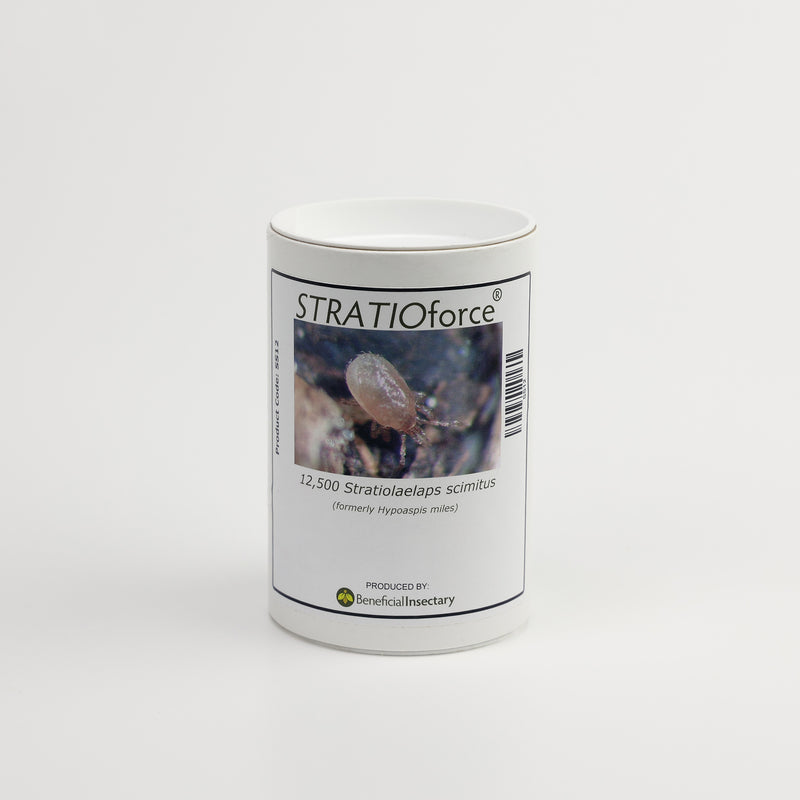
Stratiolaelaps scimitus
STRATIOforce™. Lives in the top half inch of media and hunts fungus gnat larvae, pupae, and eggs continuously.
| Application | Rate (ft²) | Rate (m²) | Timing | Notes |
|---|---|---|---|---|
| Prevention and control | 10 | 100 | Apply at planting, repeat every 6 weeks | If transplanting, reapply at half the original rate after transplant |
How to apply: distribute evenly across the surface of your growing medium and water it lightly. Keep the top layer of soil moist after application because Stratiolaelaps needs some surface moisture to move and hunt effectively.
Best for: ongoing prevention throughout the grow cycle and as a first-response treatment for early infestations. Works in soil, coco, peat-based mixes, and other organic media.
Steinernema feltiae, aka Entomopathogenic Nematodes
What it is: microscopic roundworms that seek out and parasitize fungus gnat larvae in the root zone. Steinernema feltiae enters larvae through natural body openings and releases a bacterium that kills the host within 24 to 48 hours. The nematodes then reproduce inside the larva and release a new generation to continue hunting.
Why it works for cannabis: nematodes actively move through the growing medium in search of prey, which makes them effective at reaching larvae deeper in the root zone. They're safe for plants, beneficial insects, earthworms, and mammals. They leave no residue.
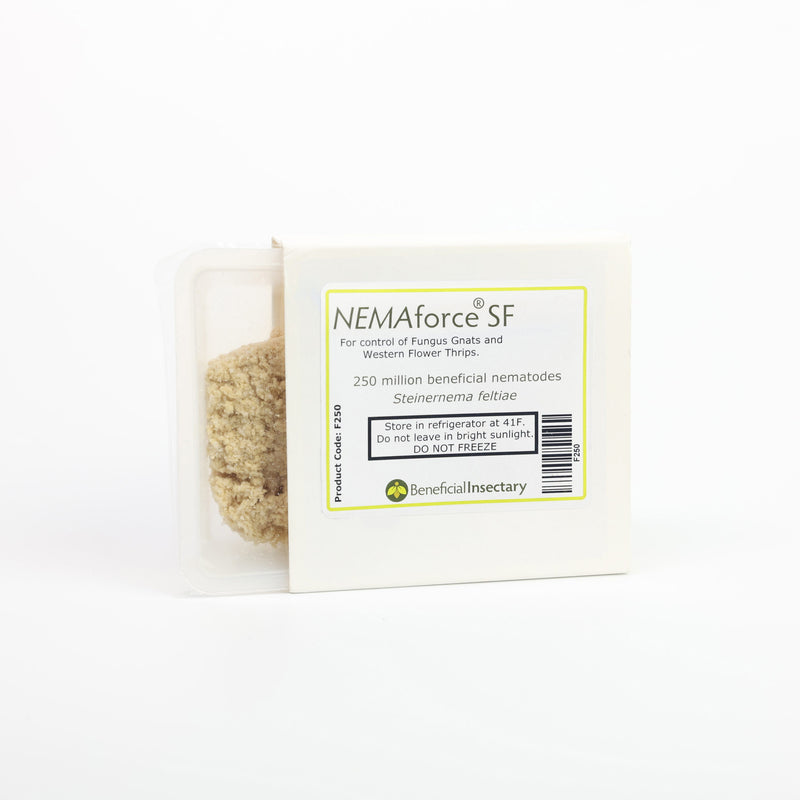
Steinernema feltiae
NEMAforce™ SF Sponge. Parasitizes larvae in the root zone and reaches deeper than sprays can.
| Application | Rate (ft²) | Rate (m²) | Timing | Notes |
|---|---|---|---|---|
| Preventive | 550 | 5,500 | Bi-weekly to every 3 weeks if historic pressure is high, especially for young plants | Rates are for nematodes produced in vivo, delivered on sponges |
| Curative | 1,100 | 11,000 | Apply twice, one week apart, once gnats are found | N/A |
Critical application notes: correct application is essential for nematode efficacy.
- Agitate the tank thoroughly before and during application to keep nematodes suspended
- Remove fine filters from spray equipment, or nematodes will clog and die
- Keep application pressure under 300 psi
- Apply in the evening or during lights-off to avoid UV exposure, which kills nematodes
- Water the medium before and after application to help nematodes move through the root zone
- Do not use nematodes with chlorinated tap water. Instead, let water sit for 24 hours or use filtered water
Best for: active infestations and as a complement to Stratiolaelaps when larval pressure is high. Particularly effective when applied as a drench that moves nematodes deep into the root zone.
Prevention vs. Active Infestation Tactics for Fungus Gnats
Prevention Mode (No Gnats Found, or Just a Few Adults)
Start at the beginning of every grow cycle, ideally at planting.
- Apply STRATIOforce™ at 10 ft² at planting, repeat every 6 weeks
- Apply NEMAforce™ SF at preventive rate (550 ft²) bi-weekly to every 3 weeks if you've had gnat pressure before, especially around seedlings and young plants
- Place yellow sticky traps horizontally above soil level to monitor adult populations. A spike in trap catches is your early warning to escalate treatment
Outbreak Control (Larvae Confirmed or Heavy Adult Pressure)
If you're finding larvae in the soil or catching large numbers of adults on sticky traps, escalate immediately.
- Apply STRATIOforce™ at 10 ft² if not already established; reapply if it's been more than 6 weeks
- Apply NEMAforce™ SF at curative rate (1,100 ft²), twice, one week apart
- Allow the top of the soil to dry out slightly between waterings. Larvae need moisture to survive and move; drying the top inch deprives them of habitat without stressing the plant
- Continue monitoring with sticky traps. A downward trend in adult catches over 2 weeks confirms the program is working
Fungus Gnats in Hydroponics and Soilless Media
Fungus gnats can establish in any organic-rich growing medium, not just potting soil. Coco coir, rockwool, peat-based mixes, and even the root zones of deep water culture systems can support larval populations if organic matter or algae is present.
For hydroponic and soilless setups:
- Control algae and organic buildup. Algae growth in reservoirs and on exposed media is a food source that supports gnat populations even without traditional soil. Keep reservoirs covered, block light from root zones, and clean organic buildup regularly.
- STRATIOforce™ works in soilless media. Predatory mites can establish in coco and peat-based mixes, not just soil. Apply as you would with any other medium.
- NEMAforce™ SF works as a drench in any medium. Nematodes move through water and are effective in coco, rockwool cubes, and other soilless media. Apply as a drench and follow the same application guidelines.
- Sand topdressing. A layer of coarse sand (1/4 to 1/2 inch) on top of your growing medium creates a dry, inhospitable surface layer that female adults avoid for egg-laying. It doesn't eliminate an existing infestation but significantly slows new egg deposition and complements your beneficial insect program.
What About Hydrogen Peroxide for Fungus Gnats?
Hydrogen peroxide (H2O2) diluted in water is a popular DIY treatment for fungus gnats. It works by releasing oxygen when it contacts organic matter, which can kill larvae on contact. It's not without tradeoffs though.
H2O2 is non-selective. As in, it kills larvae, but it also damages beneficial microbial life in the root zone, including mycorrhizal fungi and beneficial bacteria that living soil programs depend on. In a conventional inert-media setup this is less of a concern, but in a living soil or organic grow it can set back your biology significantly.
For a chemical-free, biology-friendly approach, Stratiolaelaps and Steinernema feltiae are more targeted, don't disrupt soil life, and provide ongoing control rather than a one-time knockdown.
Other Preventive Measures
- Let the top of the soil dry between waterings. Fungus gnat larvae live in the top 2 to 3 inches of growing medium and need moisture to survive. Allowing the surface to dry out between waterings dramatically reduces larval survival without harming established plants. Seedlings need more consistent moisture, which is why they're more vulnerable. Compensate with earlier beneficial insect applications.
- Quarantine new plants and growing media. Fungus gnats travel in on contaminated soil, rooted clones, and even store-bought potting mixes. Inspect all incoming plant material and consider treating new soil with beneficial insects before planting.
- Use yellow sticky traps from day one. Adults are strongly attracted to yellow. Horizontal traps placed at soil level catch egg-laying females and give you an early warning before populations build. Check counts twice a week.
- Control moisture at the soil surface. A thin topdressing of coarse sand or perlite on the surface of your medium makes it less attractive for egg-laying and harder for newly hatched larvae to establish.
- Keep the grow area clean. Decomposing plant material, spilled medium, and standing water all support fungus gnat populations. Remove fallen leaves promptly and keep floors and surfaces dry.
Frequently Asked Questions
The adults are not, but the larvae absolutely are. Larvae feed on roots and root hairs in the top few inches of growing medium, which directly reduces the plant's ability to absorb water and nutrients. They also create entry points for root pathogens like Pythium. In seedlings and young plants, a moderate infestation can cause serious stunting or plant loss.
Fungus gnats are the most common small fly in cannabis grows, but shore flies (Scatella spp.) look similar and are sometimes confused for them. Shore flies are stockier, have white spots on their wings, and feed on algae rather than roots, their larvae don't damage plants. If you see flies but can't find larvae when you dig in the soil, shore flies are worth considering. Yellow sticky traps help with monitoring either way.
Yes. While the most severe damage tends to occur in seedlings and veg, larval feeding continues throughout flowering. A large, established larval population during flower can reduce yield by limiting the plant's ability to take up nutrients during the most demanding stage of its life cycle.
Stratiolaelaps mites begin hunting immediately after application and establish within days. You should see a reduction in adult populations within 2 to 3 weeks as the larval generation they're feeding on dies off and fewer adults emerge. Nematodes work faster on contact but need to reach the larvae, so thorough application as a drench is important. Plan for 2 to 4 weeks to see significant adult population decline.
Yes. Steinernema feltiae nematodes work as a drench in any growing medium including coco, rockwool, and other soilless media. Stratiolaelaps mites can establish in organic-containing media like coco and peat. For pure hydroponic systems with no growing medium, focus on eliminating algae and organic buildup as the primary habitat control strategy.
No. Without intervention, populations grow as long as the conditions that support them (moist soil, organic matter, consistent warmth) remain. A small gnat problem becomes a large one quickly, a single female can lay 100 to 300 eggs in her lifespan. Early treatment is always easier than dealing with a well-established population.
The most reliable approach is keeping Stratiolaelaps established in your growing medium throughout each grow cycle by reapplying every 6 weeks. Combined with consistent sticky trap monitoring and letting the soil surface dry between waterings, this creates conditions where gnat populations can't get a foothold. Think of it as maintenance, not a one-time fix.
If you receive a defective or damaged unit, email us a photo at help@happyhydro.com and we'll make it right immediately: replacement or refund, your call. For change-of-mind returns, we accept returns within 30 days for items in new, resalable condition. If you're not sure whether this product is right for your setup, call us first at 716-217-0353. We'd rather answer your questions before you order.
Happy Hydro has been selling growing equipment since 2006. We've carried Beneficial Insects for years because the biology works and customers who buy them leave happy. Have questions before you order? Call 716-217-0353 or email help@happyhydro.com. We're easy to reach and happy to help!