
Outdoor Growing
How to Secure an Outdoor Growing Space Without Trapping Water and Air
Most outdoor garden security advice stops at the fence. That skips the two things that decide whether the garden works: where water goes after a heavy rain, and how fast leaves dry once it stops. A six foot privacy fence stops the neighbor's dog, and it also slows the air that would have dried those leaves by evening.
The fix is not less security. It is picking the barrier that matches the animal you actually have, then keeping water, air, and access working the way they did before you built anything.
Read the site before you buy any fence
Walk the space during a hard rain and mark where water pools. Those low spots are where you will lose plants, and they are much harder to fix once posts are set and beds are built.
Do the same with light. Track shade across the space at 9 am, noon, and 4 pm on a clear day. A fence, a shed, or a neighbor's maple can pull two or three hours off a bed that looked fine when you scouted it in March.
Container placement matters more than most people expect here. A plastic pot sitting flat on a patio or on compacted clay has one drainage path, and when that path is under water the root zone stays saturated. Fabric pots drain through the entire wall and dry from the sides, so a wet week does not turn into root rot. Set them on pot feet, pavers, or a two inch gravel pad so the base is never sitting in a puddle.
Fabric pots for outdoor beds and containers
Breathable fabric drains through the whole wall instead of a few holes in the bottom, which is the difference between a heavy rain draining off and a root zone that sits wet for three days. Grassroots and AC Infinity sizes from 1 to 200 gallon.
Shop fabric potsMatch the barrier to the animal, not to the catalog
Fence height is the wrong first question. The right one is which animal is eating your plants, because the answers are not close to each other.
Deer
Deer clear six and seven foot fences routinely. Cornell Cooperative Extension puts complete exclusion at an eight foot woven wire fence and describes shorter fences as deterrents rather than barriers.1 If eight feet is not practical, two parallel four foot fences set about four feet apart works on a different principle: deer can jump high or wide, but not both at once.
Rabbits
Two feet of one inch mesh handles cottontails and three feet handles jackrabbits, but only if the bottom edge is buried four to six inches and splayed outward, away from the beds. Rabbits dig. An unburied rabbit fence is a suggestion.
Voles, mice, chipmunks
Chicken wire does nothing here. The openings are large enough for voles and mice to walk through. Use quarter inch hardware cloth, roughly 12 inches tall with 2 to 3 inches buried, or 6 inches down where pine voles are active. Take that same fence to 18 inches and it covers rabbits and ground squirrels too. Quarter inch cloth is commonly sold in 24 and 36 inch heights.2 Wear leather gloves and cut it with tin snips, because the cut edges are genuinely sharp and the roll snaps back when you release it.
For a permanent perimeter, the material decision is about site conditions rather than looks. A provider like FencePro can walk through wood, vinyl, aluminum, and chain link against humidity, wind exposure, property layout, and how much privacy you actually need. Bring the animal list with you. It changes the mesh spec at the bottom of the fence, which is where most failures happen.
Solid fencing changes your microclimate
A solid privacy fence blocks wind, and blocked wind means leaves stay wet longer after rain or irrigation. Powdery mildew, downy mildew, and botrytis all need extended leaf wetness to establish. You are not fighting a spore problem at that point, you are fighting a drying problem.
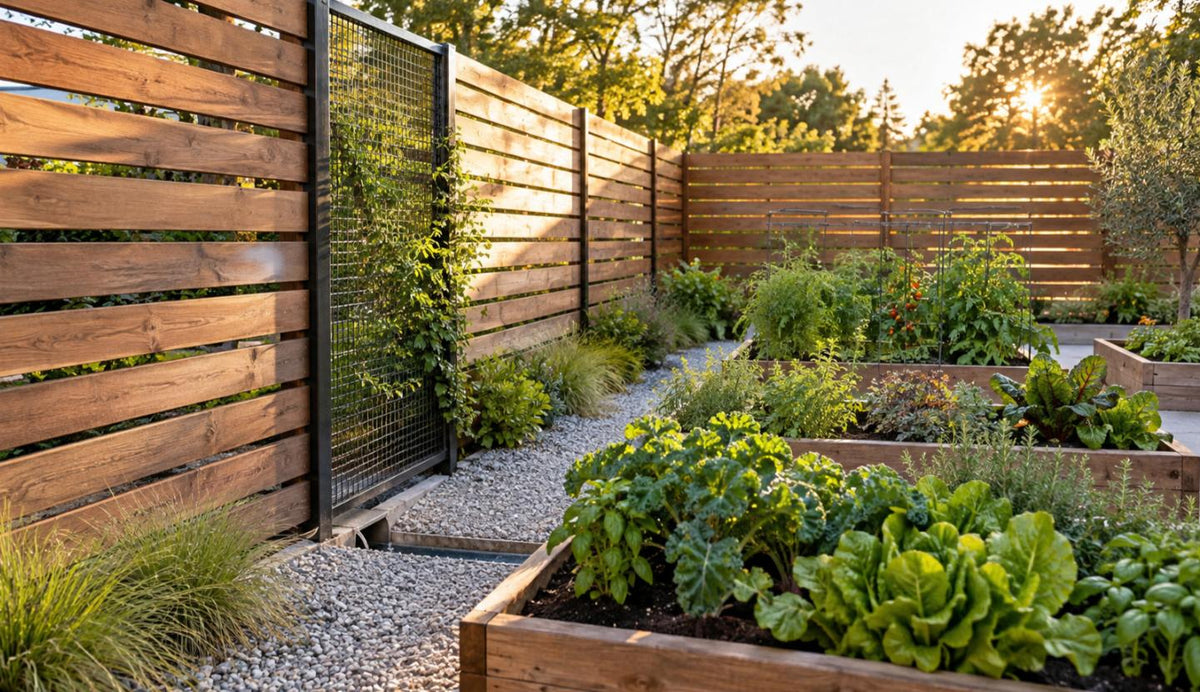
Two things keep it manageable. Leave 12 to 18 inches between the fence line and your first row of containers so air can move behind them. And where privacy is not the point, pick slat, picket, or welded wire over solid panel, since a porous barrier still slows wind without creating a dead pocket on the leeward side.
If the fence has to be solid, plan spacing harder. Crowding a fenced garden to the last square foot is how you end up spraying for mildew in August.
One gate, wide enough for what you actually carry
Multiple casual entrances mean multiple things to inspect and multiple places for a latch to drift. Build one main gate and make it the working entrance to the beds, the water source, and the storage.
Size it for a wheelbarrow with a bag of soil in it, not for a person walking through empty handed. Anything narrower and you will start propping the gate open on soil delivery day, which defeats the whole build. Keep the swing path clear instead of letting empty pots and bags collect against it.
Get irrigation out of the walking path
Hose ends, valves, and fittings that cross a path get stepped on, run over by a cart, and clipped by a string trimmer. A cracked fitting on an automated line does not announce itself. It quietly saturates one corner of the garden for a week.
Run supply lines along bed edges and the inside of the fence line, and use a system that does not need a timer guessing at what the plants want.
Tropf-Blumat systems work off ceramic sensors buried in the root zone. As soil dries, tension inside the sensor opens a valve and lets water through, and it closes as the soil rewets. The whole thing runs on gravity from an elevated reservoir, so there is no pump, no controller, and no power line to protect from weather. One sensor covers a small planting area, and additional sensors tee off the same supply line as beds get wider.
Tropf-Blumat watering systems
Gravity fed and sensor driven, with no electricity at the bed. Ceramic sensors in the root zone decide when water moves instead of a clock that cannot tell rain from drought.
Shop Blumat systemsFor containers rather than beds, AutoPot runs the same way from the other direction. The AQUAvalve fills the tray, shuts off, and holds until the plant has taken the water down, which produces a real wet and dry cycle instead of a constant trickle. Tank sits above the pots, gravity does the rest.
AutoPot gravity fed systems
No pump, no timer, no power at the garden. Useful outdoors specifically because there is no controller sitting in the weather and nothing to fail while you are away for a weekend.
Shop AutoPot systemsStore amendments where weather cannot reach them
Dry amendments and mineral fertilizers cake and clump once they take on moisture, and a caked bag is hard to measure accurately. Bagged soil left open in sun and rain loses structure and grows things you did not plant.
A sealed tote or a weather resistant deck box near the gate covers most of it. Keep the tools you touch daily within reach, and keep anything with handling instructions on the label stored the way that label says, away from kids and pets.
Walk the perimeter every week
Weekly five minute check
- Gate latch closes and seats without lifting the gate
- No fresh digging or gaps under the bottom rail
- Every irrigation fitting dry to the touch
- No soft or muddy ground under a container that should be draining
- Reservoir level tracking where you expect it, since a fast drop means a leak
- Nothing leaning on or growing through the fence
Do it again after any storm with real wind. Storms move containers, open gaps at the base of a fence, and pull tubing off barbs, and none of that is visible from the back door.
Key takeaway
- Map drainage and shade before you set a single post
- Eight feet of woven wire for deer, buried mesh for rabbits, quarter inch hardware cloth for voles
- Solid fencing traps humid air, so leave 12 to 18 inches of clearance behind containers
- One gate, sized for a loaded wheelbarrow
- Run irrigation along bed edges and use gravity fed sensor watering so there is no controller in the weather
- Five minute perimeter walk weekly, plus one after every windstorm
Security and plant health are the same project. A space that is hard for a deer to enter should still be easy for you to water, inspect, and harvest, and that only happens if drainage, airflow, and access get designed in at the same time as the fence.
Not sure which watering setup fits your beds or containers? Call us at 716-217-0353 before you order. We would rather size it correctly the first time.
Sources
- Cornell Cooperative Extension, Reducing Deer Damage
- University of Wisconsin Division of Extension, Protecting Trees and Shrubs from Critter Damage in Winter
- Extension Wildlife Damage Management, How Can I Keep Rabbits From Eating My Plants?
- University of Wisconsin Extension Horticulture, Water, Water, Everywhere, but Never on the Leaves
- Alabama Cooperative Extension System, Plant Spacing's Role in Disease Control
Questions? We're easy to reach.
Happy Hydro has been serving growers since 2006. Call or email us before you order, after you order, or any time something comes up. When you're happy, we're happy.