
Harvest and Processing
Pollen Tumbler Sizes Are Grams Per Cycle, and the Screen Micron Is a Separate Choice
The 150, 500 and 1500 printed on a dry sift tumbler are batch weights, not mesh sizes. The number that decides what lands in your tray is the screen, and you pick it when you order the machine.
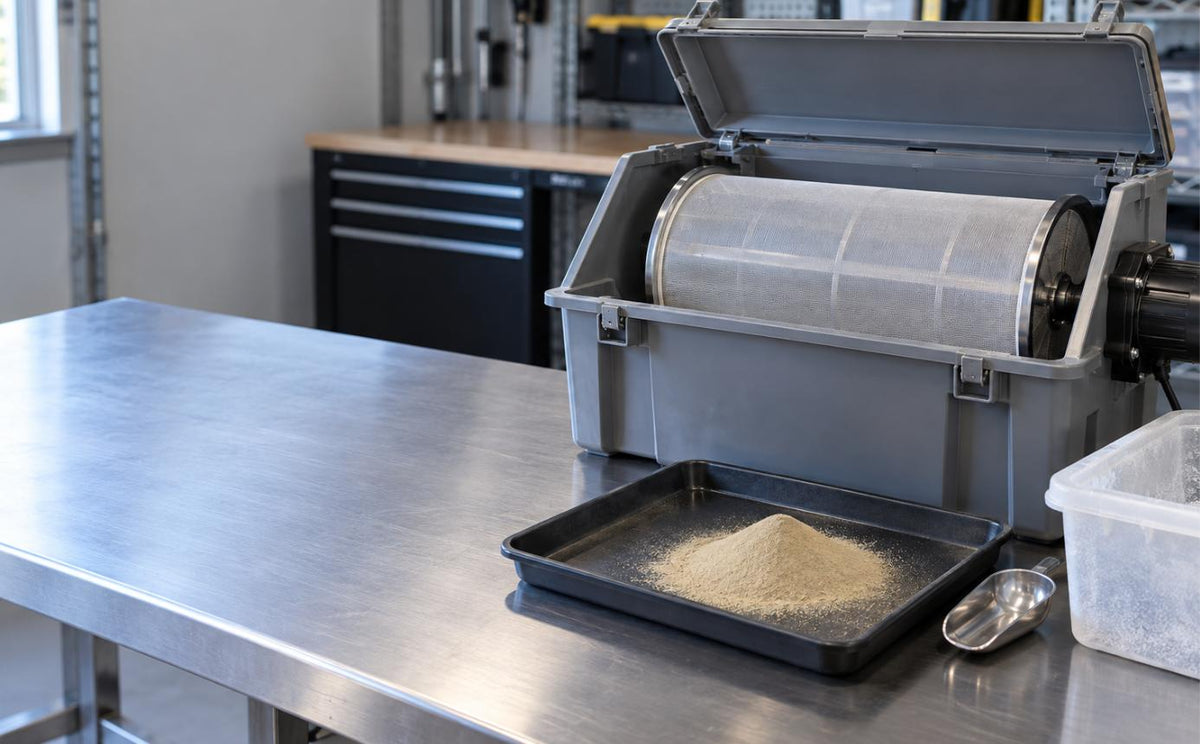
You have a bin of frozen trim and a hand screen, and the second hour of shaking is where the enthusiasm goes. A tumbler takes that job over: a mesh drum turns slowly, the frozen resin heads snap off and fall through, and the plant material stays in the barrel. It is the least complicated piece of extraction equipment you can own, because there is no water to chill, no bag stack to rinse, and nothing to dry afterward.
The buying part is where people get tangled, and it is a labeling problem rather than a hard technical question. Dry sift tumblers are sold as 150, 500 and 1500. Those look like micron numbers because every other piece of gear on the shelf next to them is sold by micron. They are not. They are grams of dry plant material per cycle, and the screen inside the drum is a separate spec that gets chosen at checkout and is expensive to change later.
The short answer
- Under about 150 grams of dry trim per session, a screened trim tray at $29.95 does the job and takes no floor space.
- One to two sessions of a home harvest: the Bubble Magic Pollen Tumbler 150 gram at $429.95, 150 grams per 15 minute cycle.
- Running a pound or more of dry trim at a time: the 500 gram at $595.00 is the value tier, at less than half the cost per gram of cycle capacity.
- Want a cleaner grade and do not mind ice, water and a drying step: the 5 Gallon Ice Water Extraction Machine at $199.00 takes 225 grams per wash.
- Screen choice: 145 micron is the default that ships in the drum. Order 125 micron for a cleaner, smaller yield or 185 micron for more of everything.
What the 150, 500 and 1500 actually mean
Bubble Magic publishes capacity as grams of dry plant material the drum will take at one time, with a stated cycle of 15 minutes. The three machines share the same electric drive and the same screen options. What changes across the line is drum volume, footprint and weight.
| Model | Price | Capacity per cycle | Cycle | Dimensions | Weight |
|---|---|---|---|---|---|
| Pollen Tumbler 150 | $429.95 | 150 g | 15 min | 20.75 x 11.75 x 13.5 in | 13.5 lb |
| Pollen Tumbler 500 | $595.00 | 500 g | 15 min | 29 x 16 x 13.75 in | 21 lb |
| Pollen Tumbler 1500 | $854.99 | 1500 g | 15 min | 38 x 24 x 21 in | 36 lb |
Read those dimensions before the prices. The 1500 is 38 inches long and 36 pounds, which is a dedicated table or a rolling cart, not a corner of the trim bench. The 150 fits on a bench next to a trim tray and weighs less than a bag of soil.
One thing the spec sheet does not give you: Bubble Magic states capacity and cycle time, and publishes no motor wattage, drum speed or yield figure for the tumbler line. Capacity is a drum fill number. It tells you how much material you can load, not how much comes out, and no published number for the second one exists, because output depends entirely on how resinous and how cold your material is.
The screen is what sets the grade
All three machines ship with a 145 micron screen and offer 125 micron and 185 micron as alternatives. That single choice does more to your finished product than the size of the machine does.
Small and Naraine, publishing in Genetic Resources and Crop Evolution in 2016, measured resin gland heads across high resin strains and fiber hemp cultivars. Mean head diameter came out at 129 microns for the high resin material and 80 microns for the fiber types, with resin head volume in the high resin plants more than four times larger.
Line that up against the screens. A 145 micron mesh sits just above the measured mean for high resin material, so the bulk of the head population drops straight through, along with any leaf fragment, stalk piece or dust that also happens to be under 145 microns. A 125 micron mesh sits below that mean. It is not simply filtering out debris. It is rejecting the largest heads too, which are the ones carrying the most resin by volume.
Screens in a tumbler work in the opposite direction from wash bags. In ice water, the bag catches the grade you want, so a finer bag collects finer material. In a tumbler, the screen is a pass through: whatever fits falls into your tray. Finer mesh means less of everything, including the good part.
So the screen choice reads like this. Take 125 micron if your material is genuinely frosty and you would rather run twice and get a cleaner tray. Take 185 micron if you are running lower grade trim where the yield matters more than the color, and accept that more leaf matter comes with it. Take the stock 145 micron if you do not know yet, because it is the middle of the range and it is what your first runs will teach you against.
Changing the micron later means buying a barrel
The screen is fitted into the tumbler barrel, and the way you change grade is by swapping the whole barrel. Replacement barrels are sold per machine size in all three mesh options.

| Replacement barrel | Price | Mesh options | Share of machine price |
|---|---|---|---|
| 150 gram barrel | $160.00 | 125, 145, 185 micron | 37 percent |
| 500 gram barrel | $209.00 to $229.99 | 125, 145, 185 micron | 35 to 39 percent |
| 1500 gram barrel | $320.99 | 125, 145, 185 micron | 38 percent |
On the 150 and the 1500, all three mesh options cost the same, so there is no price penalty for picking 125 or 185 at the start. The 500 gram barrel is the exception: 125 and 145 micron are $209.00 and the 185 micron is $229.99. Either way the penalty is in changing your mind afterward, because a second grade costs more than a third of the machine again.
Decide the mesh before you order. Buying a 145 micron machine and adding a 125 micron barrel later puts a 150 gram setup at $589.95, which is $5.05 short of the 500 gram machine that holds more than three times as much per cycle.
Tumbler or washing machine at the same money
The real comparison at this price point is against ice water extraction, because the same brand sells both and the money overlaps.

| Machine | Price | Material per cycle | Cost per gram of capacity | What the cycle needs |
|---|---|---|---|---|
| 5 Gallon Ice Water Extraction v2 | $199.00 | 225 g | $0.88 | Ice, water, bag stack, drying |
| 20 Gallon Ice Water Extraction | $324.95 | 900 g | $0.36 | Ice, water, bag stack, drying |
| Pollen Tumbler 150 | $429.95 | 150 g | $2.87 | Frozen material only |
| Pollen Tumbler 500 | $595.00 | 500 g | $1.19 | Frozen material only |
| Pollen Tumbler 1500 | $854.99 | 1500 g | $0.57 | Frozen material only |
On throughput per dollar the water machines win, and it is not close at the small end. A $199.00 machine takes 50 percent more material per cycle than a $429.95 tumbler. If your only measure is grams processed per dollar spent, buy the washer.
The tumbler is not sold on that measure. It is sold on what it removes from the job. No ice run, no 40 pounds of water to move, no drain hose, no bag rinse, and above all no drying step. Wet hash comes out of the bags as a paste that needs days on a screen or a freeze dryer to become storable. Dry sift comes out of the tumbler ready to press, jar or store the same afternoon. That is the trade, and it is a workflow trade rather than a quality one.
On quality, carefully run ice water hash grades above dry sift from the same material, because water separates by density as well as size while a screen separates by size alone. If your goal is the cleanest possible product from prize material, wash it. If your goal is turning a mountain of dry trim into something usable without setting up a wash station, tumble it. This breakdown of bubble hash micron sizes covers the bag stack if you go the water route.
Where the money lands
Bubble Magic Pollen Tumbler
- You have dry trim in quantity and no freeze dryer
- You want finished material the same day, not next week
- You run in a cold room or can work out of a freezer
- You would rather buy one machine than build a wash station
- 150 gram, 20.75 x 11.75 x 13.5 in, 13.5 lb $429.95
- 500 gram, 29 x 16 x 13.75 in, 21 lb $595.00
- 1500 gram, 38 x 24 x 21 in, 36 lb $854.99
Running it so the screen does its job
The manufacturer instruction is one line long: load frozen plant material into the drum and let the motor work. Everything that separates a good tray from a green one comes from respecting the word frozen.
Freeze the material, and keep it frozen
Resin heads snap off cleanly when they are brittle and smear when they are not. Material straight from a hang line at room temperature will leave resin flattened on the mesh instead of dropping through it, and a blinded screen passes nothing. Deep freeze the trim, work in the coldest room you have, and load straight from the freezer rather than letting a bin sit out while you set up.
Short runs beat long ones
The 15 minute figure is a full cycle, not a target. The first minutes give you the heads that were already loose. After that, every additional rotation is abrading plant material, and once a leaf fragment is ground below 145 microns the screen has no way to tell it from a resin head. Size is the only thing a mesh can judge. Check the tray, and pull the run when the fall off slows rather than when the clock says so.
Over running is the most common way to ruin a batch, and it does not look like damage while it is happening. The tray keeps filling, the color just walks from blonde toward green. Weigh a short run and a long run separately once, look at both, and you will never guess again.
Work the same material twice
A first short run with the 145 micron screen gives the cleanest fraction. The same load will keep giving lower grade material on a second and third pass, and there is nothing wrong with that as long as you keep the trays separate. Combining them wastes the first run.
Cases where the machine is the wrong purchase
A tumbler is a volume tool. Three situations come up often enough in phone calls that they are worth naming, because in all three the money is better spent elsewhere.
You harvest one or two plants a year. A single plant might give you 100 to 200 grams of dry trim, which is one or two cycles once a year. A screened trim tray at $29.95 collects while you are already sitting there trimming, which is the one moment when the labor is free because you were going to spend it anyway. The machine only starts saving time when the trim pile exists as a separate job.

Your trim is not frosty. Fan leaf and outer sugar leaf from a light fed plant will run through any mesh and give you a tray of pale green powder. A tumbler does not concentrate what is not there, and the 185 micron screen makes that worse rather than better. Look at the material under magnification first, and if you cannot see intact heads standing on the leaf surface, the problem is upstream of the equipment.
You cannot keep the material cold. The whole mechanism depends on brittle heads snapping at the stalk. If your work area sits at 75°F and you have no freezer space for the bin, the resin softens within a few minutes of loading and you get smearing instead of separation. Solve the cold problem before buying the machine, because a warm run wastes the material as well as the time.
150 gram against 500 gram
These two are the real decision for almost every home and small commercial setup, and the gap between them is wider than the $165.05 price difference suggests.
| 150 gram | 500 gram | |
|---|---|---|
| Price | $429.95 | $595.00 |
| Capacity per 15 min cycle | 150 g | 500 g |
| Cost per gram of capacity | $2.87 | $1.19 |
| Bench length needed | 20.75 in | 29 in |
| Weight | 13.5 lb | 21 lb |
| Cycles to clear one pound | Just over 3 (454 g at 150 g) | 1 |
A pound of dry trim is just over three full loads and about 45 minutes of cycle time on the 150, against one 15 minute cycle on the 500. The 500 costs 38 percent more and holds 233 percent more. If you have 29 inches of bench and you process a pound or more at a harvest, the 500 is the one that makes sense, and the 150 is for setups where space or the initial number is the binding constraint.
The 1500 is a different category of purchase. At 38 inches and 36 pounds it wants a dedicated station, and at $0.57 per gram of cycle capacity it only starts paying back when you are running multiple pounds in a session on a regular schedule.
Gear for this job
What the numbers do not tell you
Three limits in the published data are worth stating before you spend the money, because they are about what the manufacturer measured rather than about the machines themselves.
First, capacity figures are drum fill limits measured with dry plant material, and the manufacturer qualifies them with "up to." Fluffy sugar leaf takes up far more volume per gram than dense broken down trim, so a 500 gram rating is a ceiling you hit with compact material and not a promise for every load. Work to about three quarters of the rating until you know your own material.
Second, running cost is not a factor worth weighing on either side. Bubble Magic publishes 135 watts for the 5 gallon washer, which works out to 0.034 kWh for a 15 minute wash, about half a cent at $0.17 per kWh. No motor draw is published for the tumbler line, but a slow turning drum of that size is in the same territory. Buy on capacity and screen, not on the meter.
Third, the 129 micron mean head diameter from the 2016 measurements is a mean across strains, not a figure for your plant. Strain, maturity at harvest and how hard the material was handled all move the distribution. The reason the screen choice still holds is that the direction never changes: finer mesh rejects the largest heads first, coarser mesh admits the most contaminant. Where your particular material sits inside that is something one side by side run will tell you better than any table.
The verdict, three ways
Buy the 500 gram at $595.00 if you process a pound or more per harvest. Cost per gram of cycle capacity drops from $2.87 to $1.19, and a pound becomes one cycle instead of three and a bit.
Pick the mesh when you order, not later. A replacement barrel runs $160.00 to $320.99, and adding a second grade to the 150 gram machine costs about as much as stepping up to the 500 in the first place.
If grade matters more than convenience, the $199.00 5 Gallon washer beats any tumbler. It takes 225 grams per wash against 150, and separates by density as well as size. You pay for it in ice, water and drying time.
Not sure which side of that line you are on? Call us at 716-217-0353, 10am to 4pm EST Monday to Friday, and tell us what you are running.
Sources
Bubble Magic published product specifications for the Pollen Tumbler 150, 500 and 1500 gram machines, including capacity, cycle time, screen micron options, dimensions and weight: bubblebag.com.
Bubble Magic published specifications for the 5 gallon and 20 gallon extraction washing machines, including material load per wash, timer increments and motor voltage: bubblebag.com.
Small, E. and Naraine, S.G.U., resin gland head diameter measurements in high resin and fiber type plants, Genetic Resources and Crop Evolution 63, 2016: link.springer.com.
Related reads
- Bubble Hash Micron Sizes: What Each Bag Catches and Which Ones Matter
- Kief Collection for Cultivators: The Best Small to Large Scale Solutions
- How to Collect Kief with the Happy Hydro Kief Collector
- Pick a Harvest Right Freeze Dryer by Batch Weight and Circuit Size, Not by Price
- Different Types of Grove Bags Explained
Questions? We're easy to reach.
Happy Hydro has been serving growers since 2006. Call or email us before you order, after you order, or any time something comes up. When you're happy, we're happy.
716-217-0353 help@happyhydro.com