
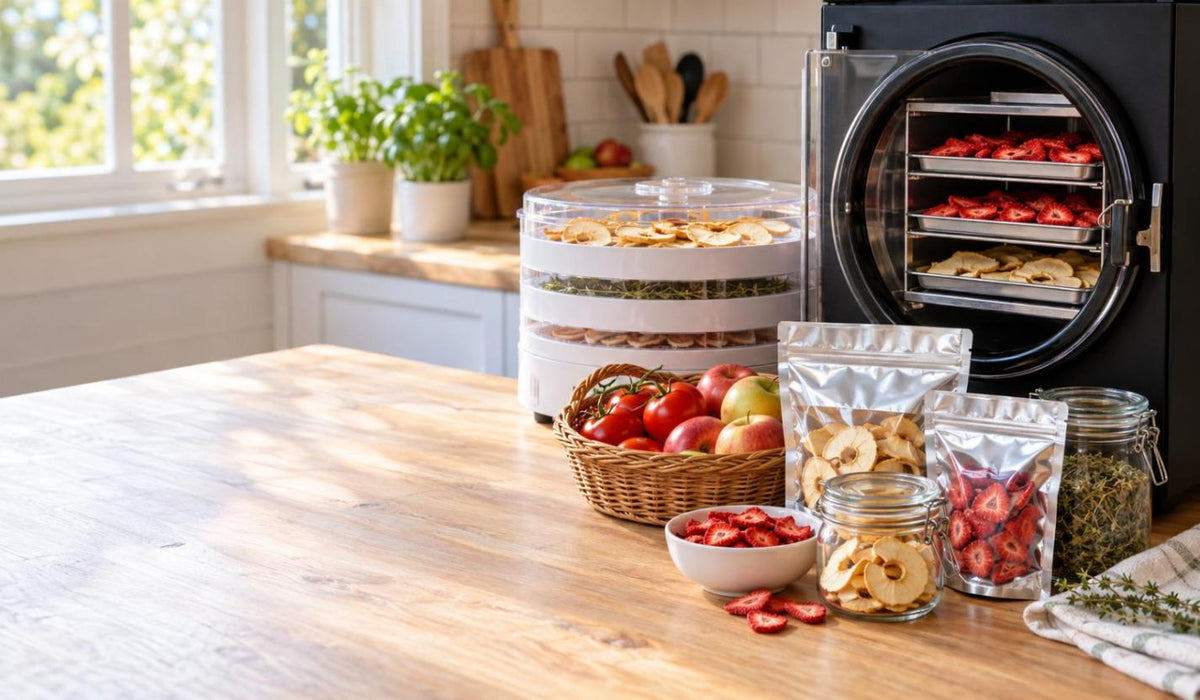
Food Preservation
Moisture Is Why Dehydrated Food Keeps for a Year and Freeze Dried Food Keeps for 25
A dehydrator is built to stop at 10 to 20 percent moisture. A freeze dryer is built to keep going. Everything else about this decision follows from that one number.
Most people run into this decision in the same week every year. The garden comes in all at once, or a half cow arrives from the butcher, or the freezer dies and you decide you are done trusting one appliance with a year of food. You look at a countertop dehydrator for a couple hundred dollars, then at a home freeze dryer for a couple thousand, and the price gap is so wide that it feels like the machines must do roughly the same job with different amounts of polish.
They do not do the same job. The two machines target different end moisture levels, and that single difference decides how long the food keeps, what you are allowed to put in it, how long a batch takes, and what your electrician has to do before you plug it in. Get the moisture question straight first and the rest of the decision stops being about money.
The short answer
- Buy a dehydrator if the list is fruit, herbs, jerky, mushrooms and vegetable chips, you plan to eat it inside a year, and you want a batch done overnight.
- Buy a freeze dryer if the list includes cooked meals, eggs, dairy, raw meat or anything you want on a shelf in ten years. A dehydrator cannot get you there at any setting.
- Start at the Harvest Right Medium Pro at $2,495 for a household, or the Large Pro at $3,095 once you are processing a real garden.
- Check your circuit before you check your counter space. Every home freeze dryer in the Harvest Right line wants a dedicated circuit, and the X-Large wants a NEMA 5-20 outlet.
The moisture target is the whole argument
A dehydrator moves warm air across food until enough water has evaporated to slow spoilage down. It is not trying to remove all of it. The National Center for Home Food Preservation, which sets the home preservation guidance most extension programs teach from, puts the target for home dried fruit at about 20 percent moisture, and about 10 percent for vegetables. That is the finish line. Push past it and you get hard, brittle, badly textured food that nobody eats.
Those percentages are why the storage guidance reads the way it does. The same source recommends storage times for dried foods in the range of 4 months to 1 year, and gets specific about why the range is so wide: most dried fruit keeps about 1 year at 60 degrees Fahrenheit and about 6 months at 80 degrees, and vegetables have roughly half the shelf life of fruit. Warmer pantry, shorter window.
Read that next to the number Harvest Right puts on the front of its freeze dryers, which is that properly freeze dried, packaged and stored food can last up to 25 years, and the comparison stops being a matter of opinion. Nothing you do downstream closes that gap. Better bags do not close it. Oxygen absorbers do not close it. A 20 percent moisture apple slice is a 20 percent moisture apple slice inside mylar, and the water still in it is what runs the clock.
Conditioning is a dehydrator step, not a freeze dryer step
Home dried fruit is supposed to be packed loosely in jars and left for 7 to 10 days, shaken daily, and watched for condensation on the glass. Any condensation means moisture is still moving around inside the batch and it goes back in the dehydrator. That step exists because dehydrating leaves an uneven amount of water behind.
What each machine is actually allowed to preserve
The moisture target also sets the menu, and this is where most buyers are surprised. A dehydrator is good at foods that are already mostly structure: beef jerky, fruit slices, herbs, mushrooms, vegetable chips and fruit leather. Those are the foods that survive having warm air pushed through them for hours and still taste like something.
Harvest Right lists a much wider range for freeze drying, and the interesting part of the list is the items a dehydrator has no answer for: complete cooked meals, raw and cooked meats, eggs, dairy, soups, leftovers and ice cream. Those are all high moisture, high fat or structurally fragile foods. Warm air ruins them. Sublimation under vacuum does not, because the water leaves as vapor straight from the frozen state and the food never softens, slumps or cooks on the way out.
This is the real dividing line for most households. If your preservation list is a garden list, a dehydrator covers a surprising amount of it. If your list includes the contents of a chest freezer, or the idea of shelf stable dinners, one machine can do that and the other cannot.
A dehydrator is not a safety shortcut for meat
Drying meat at home has its own handling rules that have nothing to do with which appliance you own. If jerky is the reason you are buying, follow your extension service guidance on pre-heating the meat rather than assuming any machine setting handles it for you.
Batch size, batch time, and why the cheaper machine is often faster
A home freeze dryer holds less food per batch than people expect, and it holds it for a long time. Harvest Right publishes 6 to 9 pounds of fresh food for the four tray Small, 10 to 15 pounds for the five tray Medium, 18 to 23 pounds for the six tray Large, and 35 to 45 pounds for the seven tray X-Large. The company puts most batches at 13 to 35 hours, with candy finishing in about two hours because there is so little water in it to move.
| Model | Trays | Tray size | Fresh food per batch | Per year | Unit size (W x D x H) | Weight | Average draw |
|---|---|---|---|---|---|---|---|
| Small Pro | 4 | 7.75 x 14 x 0.75 in | 6 to 9 lb | 2,250 lb | 17.4 x 21.5 x 26.8 in | 98 lb | 9 to 11 A (990 to 1,210 W) |
| Medium Pro | 5 | 7.5 x 18 x 0.75 in | 10 to 15 lb | 3,750 lb | 19 x 25 x 29 in | 127 lb | 9 to 11 A (990 to 1,210 W) |
| Large Pro | 6 | 9 x 20.5 x 0.75 in | 18 to 23 lb | 5,750 lb | 21.3 x 27.5 x 31.3 in | 150 lb | About 13 A (1,500 W) |
| X-Large Pro | 7 | 10.9 x 29.5 x 0.75 in | 35 to 45 lb | 11,000 lb | 24.3 x 37.4 x 35.6 in | 258 lb | About 15 A (1,700 W) |
Run the arithmetic on a Large. At 18 to 23 pounds a batch and a cycle that can stretch to 35 hours, you are looking at roughly one batch every day and a half in the worst case. A dehydrator with 12 square feet of tray space handles about half a bushel of produce and typically runs at 140 degrees Fahrenheit, which is an overnight job, not a day and a half job.
So during the two weeks when the tomatoes and the apples all land at once, the cheaper machine moves more food per day. That is not a knock on the freeze dryer. It is the trade you are making: the freeze dryer wins on what it can preserve and how long the result keeps, and it loses on throughput during a glut. Households that own both tend to use them for different foods rather than treating one as the upgrade.
Annual capacity figures assume the machine never stops
The per year numbers above come from running batches back to back all year. They are a useful way to compare models against each other. They are not a forecast of what one household will actually put through a machine.
The circuit is the real installation constraint
Counter space is not what stops most freeze dryer installs. The circuit is. A freeze dryer runs a compressor and a vacuum pump together, continuously, for most of a day and a half, which is a completely different electrical profile from a dehydrator cycling a heating element.
Harvest Right's published requirements: the Small and Medium run on a 110 volt outlet, peak at 13 to 15 amps and average about 9 to 11 amps, or 990 to 1,210 watts, with a dedicated 15 amp circuit required. The Large runs on a 110 volt NEMA 5-15 outlet and averages about 13 amps, or 1,500 watts, also on a dedicated 15 amp circuit. The X-Large needs a 110 volt NEMA 5-20 outlet, peaks around 18 amps, averages about 15 amps or 1,700 watts, and requires a dedicated 20 amp circuit.
Harvest Right's specification page and its FAQ do not describe the smaller machines the same way. The specification page recommends 20 amps for the Small and Medium, while the FAQ calls a dedicated 15 amp circuit the requirement. If you are having a circuit run anyway, the cost difference between pulling 15 amp and 20 amp capacity is small, and sizing up removes the question.
Dedicated means dedicated
A machine drawing 13 amps for 30 straight hours does not share a kitchen circuit with a microwave and a kettle. Plan for a circuit that has nothing else on it, and keep the room between 50 and 75 degrees Fahrenheit, which is the range Harvest Right gives as ideal. The company also says not to run the unit when room temperature is above 105 degrees, which rules out an uninsulated garage in July in a lot of the country.
What a batch costs to run, with the math shown
Harvest Right publishes cost per batch figures: $1.25 to $2.80 for the Small and Medium, $2 to $3 for the Large, and about $4 for the X-Large. Those numbers are worth checking against the company's own draw figures, because the two sets do not sit comfortably together.
The formula is watts times hours, divided by 1,000, times your rate per kilowatt hour. Take a Large at its published average of 1,500 watts for a 30 hour batch:
- 1,500 W x 30 h = 45,000 watt hours, or 45 kWh
- 45 kWh at 17 cents = $7.65 a batch
- 45 kWh at 12 cents = $5.40 a batch
Substitute the rate off your own bill. Either way, the result lands well above the published $2 to $3. Working backwards, hitting $3.00 at 17 cents a kilowatt hour takes about 17.6 kWh, which is roughly 12 hours at 1,500 watts rather than 30. The published cost figures are consistent with short batches or with an average draw well below the average the company quotes, and they carry no stated electricity rate, so there is no way to reconcile them from the outside.
The practical move is to budget from the draw figure, not the cost figure. If you plan for something in the region of $5 to $8 a batch on a Large at typical residential rates, you will not be unpleasantly surprised, and a machine that comes in cheaper is a good problem. Work the same arithmetic for a Medium: 1,100 watts times 30 hours is 33 kWh, which is $5.61 at 17 cents.
Consumables are the other running cost
Oil pump machines need periodic oil changes and filter cartridges. Mylar bags, oxygen absorbers and sealer time are per batch costs on top of electricity. An oil free pump removes the oil routine and adds to the purchase price, which is the trade on every model that offers both.
Head to head: the Medium Pro at $2,495 against the Large Pro at $3,095
These two sit $600 apart and account for most of the decisions people actually agonize over, so they are worth taking seriously side by side.

Food per batch: 10 to 15 pounds against 18 to 23 pounds. The Large is not one tray better, it is roughly 60 percent more food per cycle, because the trays themselves are bigger: 7.5 by 18 inches on the Medium against 9 by 20.5 inches on the Large.
Power: 990 to 1,210 watts average against about 1,500 watts. Both are specified with a dedicated 15 amp circuit, so neither one forces a heavier install than the other.
Footprint and weight: 19 by 25 by 29 inches and 127 pounds, against 21.3 by 27.5 by 31.3 inches and 150 pounds. The Large is not dramatically bigger on the floor. It is dramatically heavier to move alone.
Where the $600 goes: entirely into throughput. If your batches are going to be half empty, the Medium finishes sooner and costs less to run. If you will fill six trays, the Large gets the same annual volume done in fewer cycles, which matters more than the purchase price over a few seasons.
Do not buy capacity you will not load
A half loaded batch takes most of the same time and most of the same power as a full one. Buying up a size and then running it at 50 percent is the most expensive way to own one of these machines.
Which machine, for which household
Three clear cases cover most buyers.
Smallest sensible freeze dryer
Small Pro, 4 trays, 6 to 9 pounds a batch
- One or two people, or a first machine you want to learn on
- 98 pounds, the only model one person can reasonably reposition
- Lowest draw in the line at 990 to 1,210 watts average
The household default
Medium Pro, 5 trays, 10 to 15 pounds a batch
- A family garden plus meals, eggs and dairy, without a new circuit conversation beyond a dedicated 15 amp line
- 3,750 pounds a year of capacity running flat out, which no household will reach
- Available in powder coated black or white, or stainless steel
Serious annual volume
Large Pro and X-Large Pro, 18 to 45 pounds a batch
- Large Pro: 18 to 23 pounds a batch on a dedicated 15 amp circuit
- X-Large Pro: 35 to 45 pounds a batch, but it needs a NEMA 5-20 outlet and a dedicated 20 amp circuit
- 258 pounds on the X-Large, so plan the placement once and leave it there
If you already own a dehydrator, keep it
The most common mistake after buying a freeze dryer is selling the dehydrator. They are not competitors in a kitchen that processes a real harvest. Herbs, fruit leather and jerky are dehydrator jobs that would occupy a freeze dryer for a day and a half and come out worse for the trouble. Freeze dry the things a dehydrator cannot touch, and let the cheap machine keep doing the overnight work it is good at.
The one thing to change is how you store the dehydrated output. Pack it in amounts you will finish in one go rather than one large container you open repeatedly, since every reopening exposes the batch to air and moisture. Label with the date, keep it cool, and treat the 4 month to 1 year window as real rather than as a suggestion.
Gear for this job
The takeaway
- Shelf life is decided by the moisture target, not by your packaging. Dehydrating finishes at roughly 10 to 20 percent moisture and stores for 4 months to 1 year. Freeze drying is the only one of the two with a 25 year claim behind it.
- The dehydrator is faster per day, the freeze dryer is broader per food. Overnight trays of fruit and jerky against 13 to 35 hour batches that can include meals, eggs, dairy and raw meat.
- Sort out the circuit before the counter. Every model wants a dedicated circuit, the X-Large wants a dedicated 20 amp line and a NEMA 5-20 outlet, and budgeting $5 to $8 a batch in electricity on a Large is more realistic than the published figure.
Not sure which size fits your kitchen and your panel? Call us at 716-217-0353, 10am to 4pm EST Monday to Friday, and we will work through it with you before you order.
Sources
- Harvest Right published specifications, FAQ and food production capacity tables, for tray counts, tray dimensions, batch and annual capacity, unit dimensions and weights, electrical requirements, batch durations, operating temperature range and cost per batch.
- National Center for Home Food Preservation, University of Georgia, for home drying moisture targets, dried food storage times and temperatures, conditioning procedure, dehydrator operating temperature and drying area guidance.
Related reads
Questions? We're easy to reach.
Happy Hydro has been serving growers since 2006. Call or email us before you order, after you order, or any time something comes up. When you're happy, we're happy.