
Soil and Substrates
bio365 Sells Seven Bags With Three Fertilizer Charges Between Them
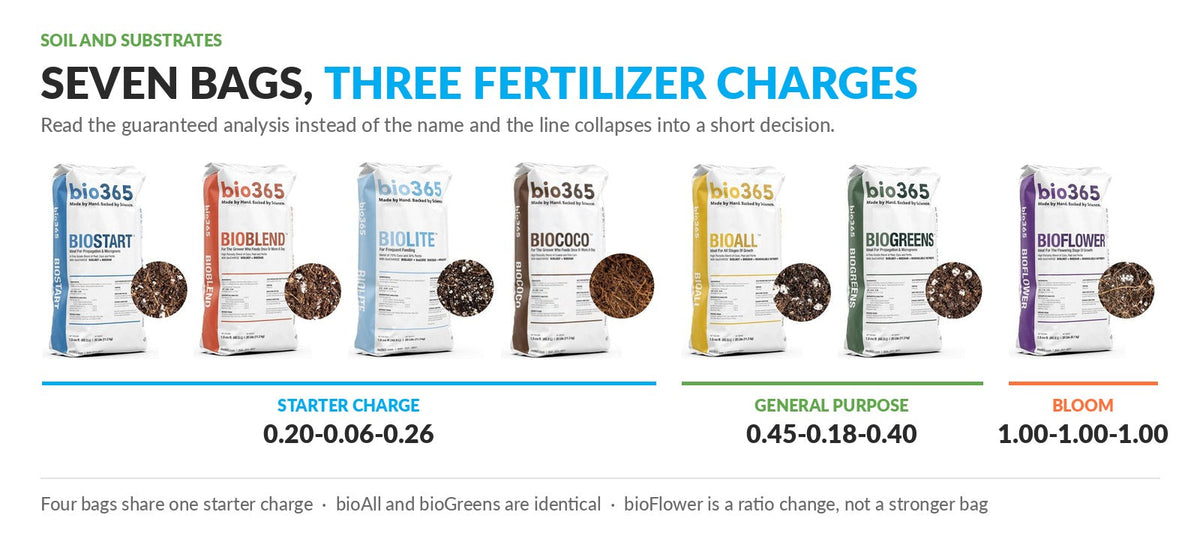
Read the guaranteed analysis instead of the name and the line collapses into a short decision: how much food you want in the bag, and how fast you want it to dry back.
Seven bags sit on the shelf between $34.95 and $44.95. Every one of them says OMRI Listed. Every one of them is peat, coco, perlite and biochar in some proportion. The names give you almost nothing: bioAll, bioBlend, bioLite, bioCoco, bioStart, bioGreens, bioFlower. A grower who has run one bag of soil for five years has no way to tell from the front label whether the next bag over is a better fit or the same thing at a different price.
The guaranteed analysis on the back settles it in about thirty seconds. Line the seven up by their nitrogen, phosphate and potash numbers and they stop being seven products. They become three fertilizer charges, offered in a few different textures, and once you see that, picking one is a two-part question: how long do you want the bag to feed the plant, and how often do you want to water it.
The short version
- Seeds, clones and plugs: bioStart, a light 0.20-0.06-0.26 charge in fine particles that will not burn a new root.
- One bag, start to finish, most crops: bioAll at 0.45-0.18-0.40, which bio365 rates for up to five weeks of feed.
- A flowering crop you want to leave alone longest: bioFlower at 1.00-1.00-1.00, rated for up to eight weeks.
- Leafy greens and microgreens: bioGreens, the same charge as bioAll in a finer grind.
- You feed on a timer, every day or most days: bioLite or bioCoco, built to dry back fast and take your numbers instead of theirs.
- You mix your own amendments in: bioBlend, a peat-forward base with a starter charge and nothing else in the way.
Seven bags, three fertilizer charges
Here is the whole line by the numbers bio365 publishes on each product page. Guaranteed analysis is nitrogen, available phosphate and soluble potash, in that order, as a percentage of the bag. Biochar is the percentage bio365 lists under active ingredients. Every mix in the line is OMRI Listed for organic use and every one carries Bacillus megaterium at 25,000 cfu per gram.
| Mix | Guaranteed analysis | Softwood biochar | Base materials | Price, 1.5 cu ft |
|---|---|---|---|---|
| bioStart | 0.20-0.06-0.26 | 2% | Fine peat, coco, perlite | $39.95 |
| bioBlend | 0.20-0.06-0.26 | 2% | Peat, coco, perlite | $34.95 |
| bioLite | 0.20-0.06-0.28 | 1% | Coco, perlite | $34.95 |
| bioCoco | 0.20-0.05-0.30 | 2% | Coarse and fine coco | $34.95 |
| bioAll | 0.45-0.18-0.40 | 7% | Peat, coco, perlite | $39.95 |
| bioGreens | 0.45-0.18-0.40 | 7% | Fine peat, coco, perlite | $44.95 |
| bioFlower | 1.00-1.00-1.00 | 8% | Peat, coco, perlite | $39.95 |
Four of the seven sit within a rounding error of each other. bioStart, bioBlend, bioLite and bioCoco all carry 0.20 percent nitrogen, five or six hundredths of a percent phosphate, and somewhere between 0.26 and 0.30 potash. That is a starter charge, the small amount of food a mix needs so a young plant is not sitting in inert fluff for its first week. Nobody is buying those four for their fertilizer. They are being bought for what they are made of and how fast water leaves them.
Two more, bioAll and bioGreens, carry an identical 0.45-0.18-0.40. And bioFlower stands on its own at 1.00-1.00-1.00.
bioAll and bioGreens are the same fertilizer charge
Set the two labels side by side and the guaranteed analysis matches to the decimal: 0.45 percent nitrogen, 0.18 percent available phosphate, 0.40 percent soluble potash. Both list 7 percent softwood biochar. Both are peat, coco and perlite. The difference bio365 describes is grind and target crop: bioGreens uses fine peat and is aimed at leafy greens, microgreens and food crops, where seed contact and an even surface matter, while bioAll is a general purpose bag for anything in a container.
That is worth knowing because bioGreens lists at $44.95 against $39.95 for bioAll. You are paying $5.00 for particle size, not for food. If you are potting up tomatoes or peppers or anything with a root ball already on it, the finer grind buys you nothing and bioAll does the same job. If you are broadcasting lettuce or basil seed across a tray, the fine grind is the point and it is worth the five dollars.


Worth knowingbioStart and bioBlend also share a guaranteed analysis, 0.20-0.06-0.26 with 2 percent biochar. Same trade: bioStart is the fine grind for propagation, bioBlend is the standard grind for potting. If one is out and the other is on the shelf, the plant will not know the difference once it has roots.
bioFlower is a different ratio, not a bigger bioAll
The easy assumption is that bioFlower is bioAll with more fertilizer in it. It is not. Run the three numbers against each other and the increases do not move together.
| Nutrient | bioAll | bioFlower | Increase |
|---|---|---|---|
| Total nitrogen | 0.45% | 1.00% | 2.2x |
| Available phosphate | 0.18% | 1.00% | 5.6x |
| Soluble potash | 0.40% | 1.00% | 2.5x |
Nitrogen and potash roughly double. Phosphate goes up more than five times. bioAll is a nitrogen-leaning mix with phosphate as its smallest number, which is what a plant in leaf wants. bioFlower flattens all three to 1.00 and in doing so front-loads the phosphate a crop reaches for when it sets flower or fruit.
The practical consequence is that you cannot turn bioAll into bioFlower by using more bioAll. Doubling the volume of bioAll doubles the nitrogen at the same time it doubles the phosphate, so the ratio never changes. If you have bioAll in the pot and a plant that has started flowering, what you are short of is phosphate specifically, and that gets fixed with a phosphate-forward top dress, not with a bigger pot of the same soil.
The ingredient lists back the ratio up. bioFlower's fertilizer is derived from feather meal, bone meal, poultry litter, alfalfa meal, volcanic ash, dolomite, kelp meal, magnesium sulfate and sulfate of potash. bioAll's list is shorter. Bone meal and volcanic ash are where a lot of that extra phosphate comes from, and both release slowly, which is consistent with a bag meant to feed for two months rather than one.

The biochar percentage tracks the fertilizer, not the airflow
Biochar gets sold as an aeration story. Porous carbon, more air in the root zone, better drainage. Look down the biochar column in the table above and that story does not survive contact with the numbers.
| Mix | Guaranteed analysis | Biochar |
|---|---|---|
| bioLite | 0.20-0.06-0.28 | 1% |
| bioStart, bioBlend, bioCoco | 0.20-0.06-0.26 range | 2% |
| bioAll, bioGreens | 0.45-0.18-0.40 | 7% |
| bioFlower | 1.00-1.00-1.00 | 8% |
Biochar percentage rises in lockstep with the fertilizer charge, from 1 percent in the lightest-fed mix to 8 percent in the heaviest. Meanwhile bioLite, the mix bio365 describes as having dramatically higher air-filled porosity than a typical 70/30 blend, has the least biochar in the line. If biochar were doing the aeration work, that relationship would run the other way.
What biochar is doing here is holding the charge. bio365 calls its biochar bioCORE, an ultra-pure carbon matrix produced from softwoods under high temperature and low oxygen, and describes it as a host for beneficial microorganisms and a storage site for nutrients. A high-surface-area carbon with exchange capacity holds onto cations and hands them back slowly. The more fertilizer you put in a bag, the more you need something to keep it from washing straight out the bottom on the first heavy water. So the 8 percent in bioFlower is not there to make the bag fluffy. It is there because there is eight weeks of food in it that has to stay put.
The aeration in these mixes comes from perlite and from coarse coco particles. If what you want is a fast-draining bag, the biochar number on the label is the wrong number to read.
What "high porosity" means against the published standard
bio365 states that all of its growing media contain more than 20 percent air porosity. That is a real claim and it is useful to put next to the range horticultural extension programmes recommend for container media.
UC Agriculture and Natural Resources puts the target at an air-filled porosity of at least 10 percent and generally no more than 25 percent of total soil volume, with at least 40 percent of the volume holding water at container capacity after full drainage, for a total porosity at or above 50 percent. Read bio365's figure against that and their media sit in the upper part of the recommended band rather than outside it.
That matters because more air is not automatically better. Above roughly a quarter of the volume, you have bought yourself a pot that drains beautifully and dries out on a Saturday you are not home. A mix at the top of the range needs watering discipline or automation. A mix in the middle forgives you.
Costs you moneybioLite is built for frequent fertigation, with low water holding and fast dry-backs by design. In a hand-watered pot on a twice-a-week schedule under strong light, that is a mix that will be bone dry by day three and a plant that spends half its life stressed. If you water by hand and not on a timer, bioAll or bioFlower are the safer bags.
How long the charge actually lasts
bio365 publishes a feed window for the two nutrient-dense mixes: up to five weeks for bioAll, up to eight weeks for bioFlower. The phrase to pay attention to is "up to." That is a ceiling under favourable conditions, not a schedule.
Three things move it. Pot size is the biggest: a 1.5 cubic foot bag is about 11.2 gallons of media, which bio365 says fills one 10-gallon pot. Put that same bag into three 3-gallon pots and each plant has a third of the food, so the window closes in roughly a third of the time. Light intensity is the second: a plant running hard under a high-output fixture eats the charge faster than the same plant on a windowsill. Watering volume is the third, since anything you run to significant drainage takes dissolved nutrients out the bottom with it.
The practical read is that a single plant in a 10-gallon pot of bioFlower is genuinely a water-only bag for the first stretch of its life, and four plants in 3-gallon pots out of the same bag are not. Plan to start top dressing at around week four in a small pot regardless of which bag you bought.
If you never want to feedA pre-amended water-only living soil such as the KIS Organics Original Water Only Soil Mix takes a different approach: a much larger reserve of slow-release amendments intended to carry a full cycle in a big container. It costs more per bag and it wants a large pot to work in, but it removes the top-dress step that every bio365 bag eventually asks for.
Match the bag to how you water
Once the fertilizer question is settled, the remaining choice is drainage speed, and that is set by what the bag is made of rather than what is dissolved in it.
| If you water like this | Pick | Why |
|---|---|---|
| By hand, twice a week | bioAll or bioFlower | Peat-forward, holds water longest, carries its own food for weeks |
| By hand, every day or two | bioBlend | Peat base with a starter charge, so your feed program sets the numbers |
| Automated fertigation, several times a day | bioLite | Coco and perlite, lowest water holding, fastest dry-back |
| Crop steering with controlled dry-backs | bioCoco | Coarse and fine coco blended for a steerable moisture curve |
| Trays, plugs and propagation | bioStart | Fine particles for seed and root contact, lightest charge |
| Seeded food crops and microgreens | bioGreens | Fine grind, bioAll's charge, tested for food safety |


bioAll against bioFlower, both at $39.95
These two land on the same price for the same 1.5 cubic feet, which makes the comparison unusually clean. Nothing about cost is pushing the decision, so the decision is entirely about what you are growing.
| bioAll | bioFlower | |
|---|---|---|
| Guaranteed analysis | 0.45-0.18-0.40 | 1.00-1.00-1.00 |
| Biochar | 7% | 8% |
| Feed window, bio365 figure | Up to 5 weeks | Up to 8 weeks |
| Nutrient shape | Nitrogen-leaning, low phosphate | Balanced, phosphate front-loaded |
| Price, 1.5 cu ft | $39.95 | $39.95 |
| Also sold as | 12 quart bag, $12.95 | 4-bag pack, 85-bag pallet, 4-yard sack |
Pick bioAll for anything you are growing for leaves, stems or general vigour, for vegetables you will feed yourself, and for the case where you want a smaller 12 quart bag to fill a few pots without committing to 1.5 cubic feet. Pick bioFlower when the crop is going to flower or fruit and you want the longest hands-off window the line offers.
The uncomfortable version: if you are buying bioFlower for a plant that will spend the next two months in vegetative growth, you have bought the wrong bag and you are putting five and a half times the phosphate a leafy plant needs into the pot on day one. Excess phosphate in a container does not politely wait its turn. It competes with zinc and iron uptake, and the symptom shows up as interveinal yellowing on new growth that people usually treat as a nitrogen problem.
Where most growers land
bioAll, 1.5 cubic feet
- One bag fills one 10-gallon pot or several small ones
- 0.45-0.18-0.40 with 7 percent biochar, up to five weeks of feed
- Peat, coco and perlite, so it holds water on a hand-watering schedule
- OMRI Listed, and works with organic or salt-based feeding after the charge runs down
- Available in a 12 quart bag if you want to try it before buying the big one
Gear for this job
What the guaranteed analysis does not tell you
Three limits are worth naming, because they are limits in how the numbers are published rather than in the product.
Guaranteed analysis is a percentage of the bag's weight. bio365 does not publish a bag weight alongside it, so 1.00 percent nitrogen tells you the concentration and not how many grams of nitrogen you are carrying to the car. That is fine for comparing two bio365 bags against each other, which is what this article does, and it is not enough to compare a bio365 bag against a dry amendment sold by the pound.
The five-week and eight-week figures are bio365's own, and they are stated as a ceiling. There is no published test condition behind them, no pot size, no light level, no irrigation volume. Treat them as a ranking of the two mixes against each other, which they reliably are, rather than as a date on a calendar.
And the air porosity figure, more than 20 percent, is published for the line as a whole rather than per mix. It tells you every bag clears the bar. It does not tell you which bag clears it by the most, which is the number you would actually want when choosing between bioLite and bioBlend. The qualitative descriptions are the best guide available there: coco and perlite drain faster than peat, and coarse particles drain faster than fine ones.
The takeaway
- Four of the seven bags carry the same starter charge. bioStart, bioBlend, bioLite and bioCoco sit at 0.20 nitrogen with five or six hundredths phosphate. Choose between them on drainage speed and particle size, never on fertilizer.
- bioAll and bioGreens are the same soil at different grinds. Identical 0.45-0.18-0.40 and identical 7 percent biochar, $5.00 apart. Pay the extra only if you are seeding a tray.
- bioFlower is a ratio change, not a strength change. Phosphate goes up 5.6x while nitrogen goes up 2.2x, so it belongs under a flowering or fruiting crop and nowhere else.
Not sure which one fits your pot size and watering schedule? Call us at 716-217-0353, 10am to 4pm EST, Monday to Friday.
Sources
- bio365 product pages and guaranteed analysis panels for BIOSTART, BIOBLEND, BIOLITE, BIOCOCO, BIOALL, BIOGREENS and BIOFLOWER, bio365.com
- bio365, "What Makes Our Soil Unique," on bioCHARGE, bioCORE and UltimateAIR, bio365.com
- Steven A. Tjosvold, "Soil Mixes Part 3: How much air and water?", University of California Agriculture and Natural Resources, on recommended air-filled porosity and container capacity, ucanr.edu
- Organic Materials Review Institute, OMRI Listed criteria for organic inputs
Related reads
Questions? We're easy to reach.
Happy Hydro has been serving growers since 2006. Call or email us before you order, after you order, or any time something comes up. When you're happy, we're happy.